
If you’ve ever written “anual” and paused, wondering if something looks off—you’re absolutely right to question it.
This is one of those small spelling mistakes that can quietly slip into emails, reports, or articles and affect how polished your writing feels.
Understanding the difference between annual vs anual is simple once you see it clearly. In this guide, we’ll break it down in a friendly, practical way so you can use the correct spelling with total confidence every time.
Quick Answer
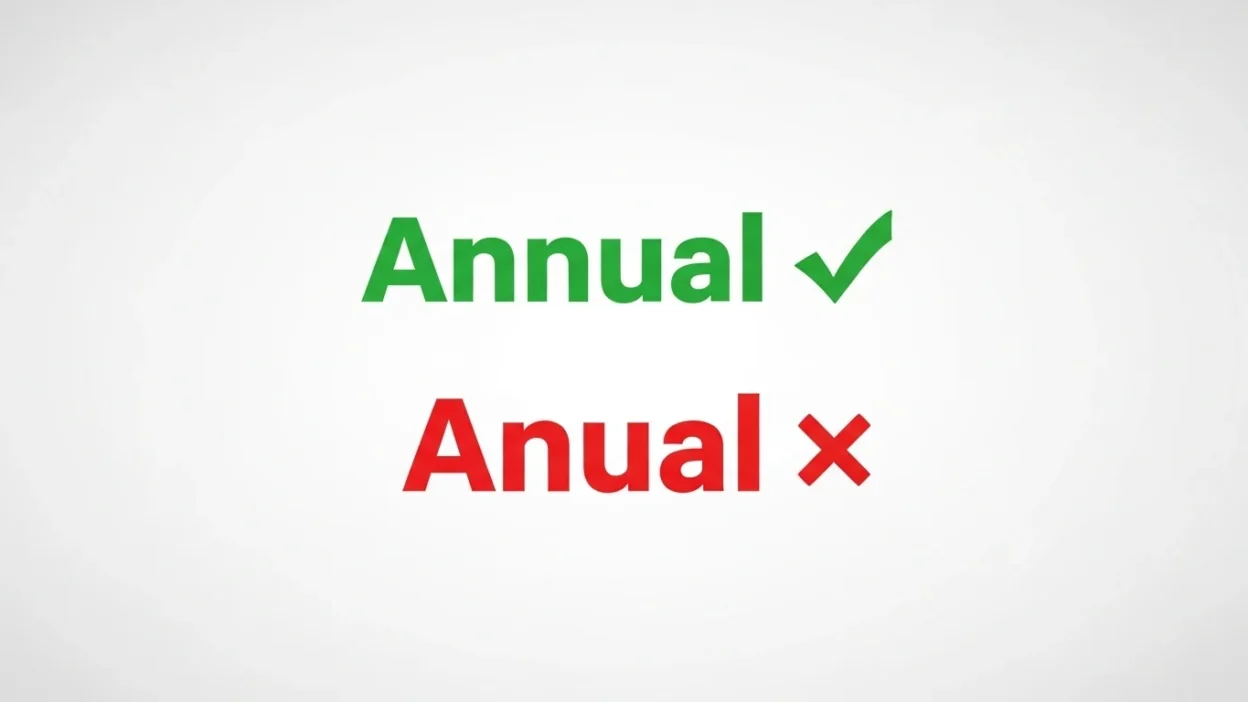
- ✅ Annual is the correct spelling
- ❌ Anual is incorrect and not a real English word
- Always use annual when referring to something that happens once a year
What Does “Annual” Mean?
The word annual is a commonly used adjective that refers to something that occurs once every year.
Core meaning:
- Happening yearly
- Occurring once a year
- Related to a full year period
Examples:
- The company holds an annual meeting every December.
- We go on an annual family trip.
- The school publishes an annual report.
As a noun:
In some contexts, annual can also refer to:
- A plant that completes its life cycle in one year
- Example: Sunflowers are annuals.
LSI keywords and related phrases:
- yearly
- per year
- once a year
- yearly event
- annual report
- annual income
These variations help improve both clarity and SEO relevance.
What Is “Anual”? Is It Ever Correct?
Let’s make this clear: “anual” is not a correct English word.
It’s a common spelling mistake where one “n” is accidentally omitted.
Why people write “anual”:
- Typing too quickly
- Forgetting that the word has double “n”
- Pronunciation doesn’t strongly emphasize both “n” sounds
Important:
- ❌ Anual → Incorrect
- ✅ Annual → Correct
Even in casual writing, “anual” should be corrected to maintain clarity and professionalism.
Annual vs Anual: Side-by-Side Comparison
| Feature | Anual ❌ | Annual ✅ |
|---|---|---|
| Valid word | No | Yes |
| Meaning | None | Occurring once every year |
| Usage | Incorrect | Correct |
| Accepted globally | No | Yes (US & UK English) |
| Example | ✖ Anual report | ✔ Annual report |
How to Use “Annual” Correctly
Using annual is straightforward once you remember the spelling.
1. Events and activities
- The annual festival attracts thousands of visitors.
- They host an annual charity event.
2. Business and finance
- The company released its annual report.
- Employees receive an annual bonus.
3. Personal routines
- We schedule an annual health check-up.
- It’s our annual tradition to celebrate together.
Tip:
Use annual whenever something happens once every year consistently.
Common Mistakes to Avoid
Even though the difference is simple, these mistakes are very common:
1. Dropping one “n”
- ❌ Anual meeting
- ✅ Annual meeting
2. Confusing pronunciation with spelling
The word sounds like “an-yoo-al,” which can hide the double “n.”
3. Mixing with similar words
- Manual → one “n”
- Annual → two “n”s
4. Ignoring spellcheck suggestions
Most tools catch “anual”—don’t overlook it.
Why “Annual” Has Double “N”
The spelling comes from the Latin root “annus,” meaning year.
Breakdown:
- “ann” = year
- “-ual” = relating to
Memory trick:
👉 Think: “Year = ann → annual needs two N’s”
This simple association helps lock in the correct spelling.
American vs British English Differences
Here’s the easy part:
- Annual is spelled the same in American English and British English
- There are no variations
- Anual is incorrect everywhere
So once you learn the correct spelling, you’re covered globally.
Synonyms and Related Words
To keep your writing engaging and varied, here are alternatives for annual:
Synonyms:
- yearly
- once-a-year
- per annum
- recurring yearly
Related phrases:
- annual event
- annual income
- annual report
- annual growth
Example:
- Annual meeting → Yearly meeting
- Annual report → Yearly report
Using these alternatives can improve readability and SEO performance.
Real-Life Usage Examples
Let’s look at how annual appears in everyday contexts:
Business:
- The CEO presented the annual performance report.
Education:
- Students participated in the annual sports day.
Healthcare:
- Doctors recommend an annual check-up.
Personal life:
- Our annual reunion is coming up soon.
These examples reinforce how commonly and naturally the word is used.
FAQs About Annual vs Anual
Is “anual” ever correct?
No, it is always a misspelling of “annual.”
What does “annual” mean in simple terms?
It means something that happens once every year.
Why is “annual” spelled with two “n”s?
Because it comes from the Latin word “annus,” meaning year.
Is there a British spelling of “annual”?
No, both British and American English use the same spelling.
Can “annual” be used as a noun?
Yes, it can refer to a plant that lives for one year.
What is the difference between “annual” and “yearly”?
They mean the same thing, but “annual” is slightly more formal.
How can I remember the correct spelling?
Think of “ann” (year) → always use double “n.”
Summary:
The difference between annual vs anual is clear and easy to remember. Annual is the correct spelling used worldwide to describe something that happens once every year.
On the other hand, anual is simply a common spelling mistake caused by dropping one “n.”
By understanding the meaning, origin, and correct usage of annual, you can avoid this error and make your writing more accurate and professional. Whether you’re writing emails, reports, or blog content, using the right spelling builds trust and clarity.
Actionable Takeaway
Here’s your simple rule:
👉 Always use annual with two “n”s when referring to yearly events—never write anual
Before you publish or send anything, take a quick moment to check spelling. Small details like this can significantly improve your credibility and writing quality.