
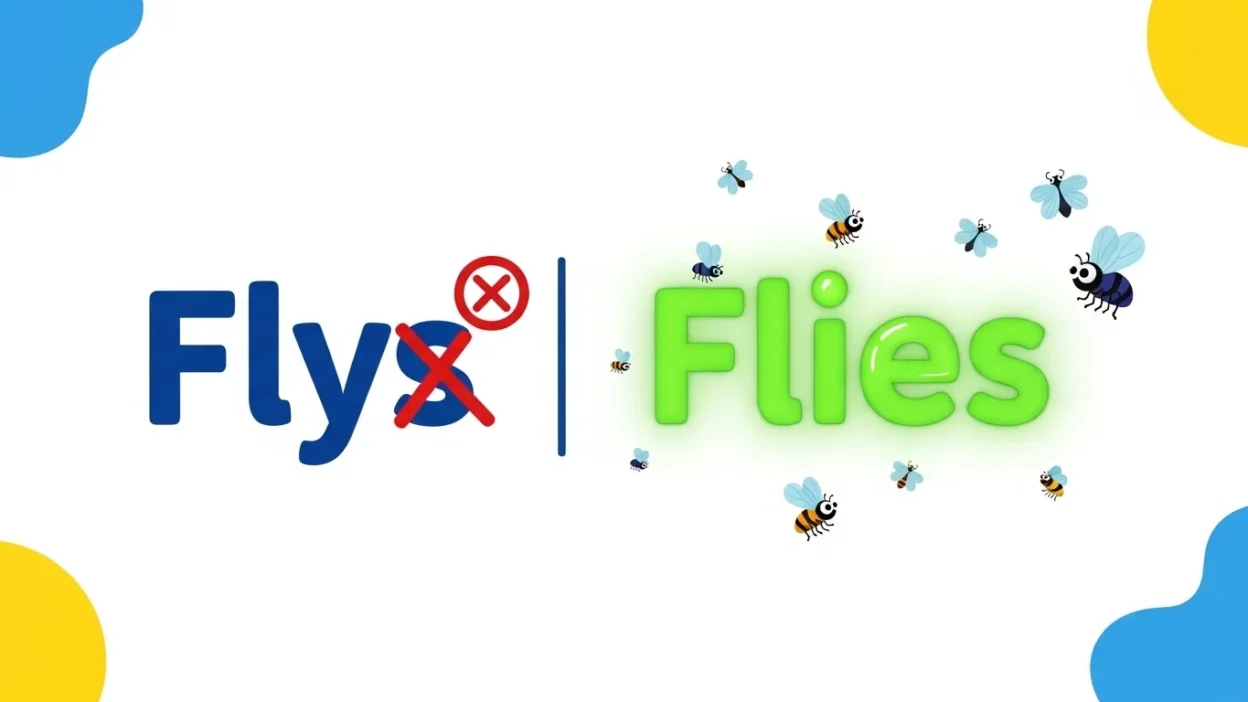
Many writers hesitate when choosing between flys vs flies. The words look similar, but only one is usually correct in standard English. Because “fly” changes its spelling when pluralized or used in the third-person verb form, confusion happens frequently.
In this guide, you will learn the correct spelling, meanings, examples, common mistakes, and a simple trick to remember the difference. By the end, you will confidently know when to use flies and when flys might appear.
Quick Answer: Flys vs Flies
Flies is the correct spelling in most situations.
- Flies = plural of fly (the insect) or third-person singular of the verb fly.
- Flys = very rare spelling, sometimes used as a proper noun or in specific names.
For everyday writing, you should almost always use “flies.”
What Does Flies Mean?
The word flies has two main meanings in English.
Plural of Fly (The Insect)
Flies are small flying insects often found around food, garbage, or outdoors.
Examples
- The kitchen window had several flies on it.
- Summer brings many flies into the house.
- These flies can spread bacteria.
Here, flies simply means more than one fly.
Third-Person Form of the Verb “Fly”
Flies can also be a verb.
Examples
- The bird flies across the lake every morning.
- She flies to New York for work.
- The superhero flies through the sky.
In these sentences, flies describes the action performed by “he,” “she,” or “it.”
What Does Flys Mean?
The spelling flys is rarely used in standard English.
However, it may appear in a few limited situations.
Proper Names or Brand Names
Some businesses, usernames, or titles may intentionally use flys.
Example:
- A brand name like “Joe’s Flys Shop.”
These cases are stylistic choices rather than grammar rules.
Historical or Informal Usage
In very old texts or dialects, you might occasionally see “flys,” but modern English has standardized flies as the correct form.
Because of this, most grammar guides consider flys incorrect in normal writing.
Flys vs Flies: Comparison Table
| Feature | Flies | Flys |
|---|---|---|
| Correct Modern Spelling | ✔ Yes | ✘ Usually No |
| Meaning | Plural insect or verb form | Rare or stylistic |
| Common Usage | Very common | Extremely rare |
| Recommended for Writing | Always | Avoid |
If you are unsure, choose flies.
Grammar Rule Behind Flies
The spelling change happens because of a common English rule.
When a word ends in consonant + y, the y changes to “ies” in plural or third-person forms.
Examples:
- Fly → Flies
- Cry → Cries
- Try → Tries
- Spy → Spies
This rule explains why “flys” is not normally correct.
Examples of Flies in Sentences
Seeing real sentences helps make the rule clear.
As a Plural Noun
- The fruit attracted several flies.
- Flies gathered near the trash can.
- The farmer used traps to control the flies.
As a Verb
- The airplane flies above the clouds.
- The eagle flies over the mountains.
- Time flies when you are having fun.
These examples show how versatile the word flies can be.
Common Mistakes with Flys and Flies
Many writers accidentally type the wrong spelling. Let’s fix the most common errors.
Mistake 1: Adding “S” Instead of “IES”
❌ The bird flys across the sky.
✅ The bird flies across the sky.
Mistake 2: Writing the Plural Incorrectly
❌ There were many flys in the room.
✅ There were many flies in the room.
Mistake 3: Ignoring the Y Rule
Whenever a word ends in consonant + y, remember to change it to ies.
That rule prevents this mistake instantly.
Memory Trick to Remember the Correct Spelling
Here is an easy trick.
Think of the sentence:
“A fly becomes flies when there are many.”
Just remember:
Fly → Flies
Your brain will automatically avoid writing “flys.”
Similar Words with the Same Rule
Many English words follow the same pattern.
Examples:
- Baby → Babies
- Lady → Ladies
- Story → Stories
- City → Cities
Because these words change y to ies, the same rule applies to fly → flies.
Learning this pattern improves your spelling across many words.
American vs British English
There is no difference between American and British English for this word.
Both use:
- Flies (correct spelling)
- Flys (considered incorrect)
So whether you are writing for American or British readers, the rule remains the same.
Frequently Asked Questions
Is flys ever correct?
It is rarely correct and mainly appears in names or branding.
What is the plural of fly?
The correct plural is flies.
Why does fly change to flies?
Because English changes consonant + y endings to ies in plural and verb forms.
Is flies a noun or verb?
It can be both. It can refer to insects or describe the action of flying.
Is there a difference in UK and US spelling?
No, both use flies.
What does “time flies” mean?
It means time passes very quickly.
Final Summary: Flys vs Flies
Understanding flys vs flies becomes easy once you know the spelling rule. In modern English, flies is the correct form for both the plural noun and the third-person verb form of “fly.” Meanwhile, flys is rarely used and usually appears only in names or informal contexts.
Because English changes consonant + y words to ies, the correct spelling naturally becomes flies. Following this rule ensures your writing remains clear, professional, and grammatically accurate.
Actionable Takeaway
Whenever you write about more than one fly or describe someone flying, remember this simple rule: fly becomes flies. Avoid using “flys” unless it appears in a specific brand or name.

Fenwick Quentin is a creative blogging author known for his analytical yet engaging writing style.
He explores topics such as innovation, digital culture, and personal development with depth and clarity.
Through his articles, Fenwick encourages readers to think critically and embrace continuous growth.