
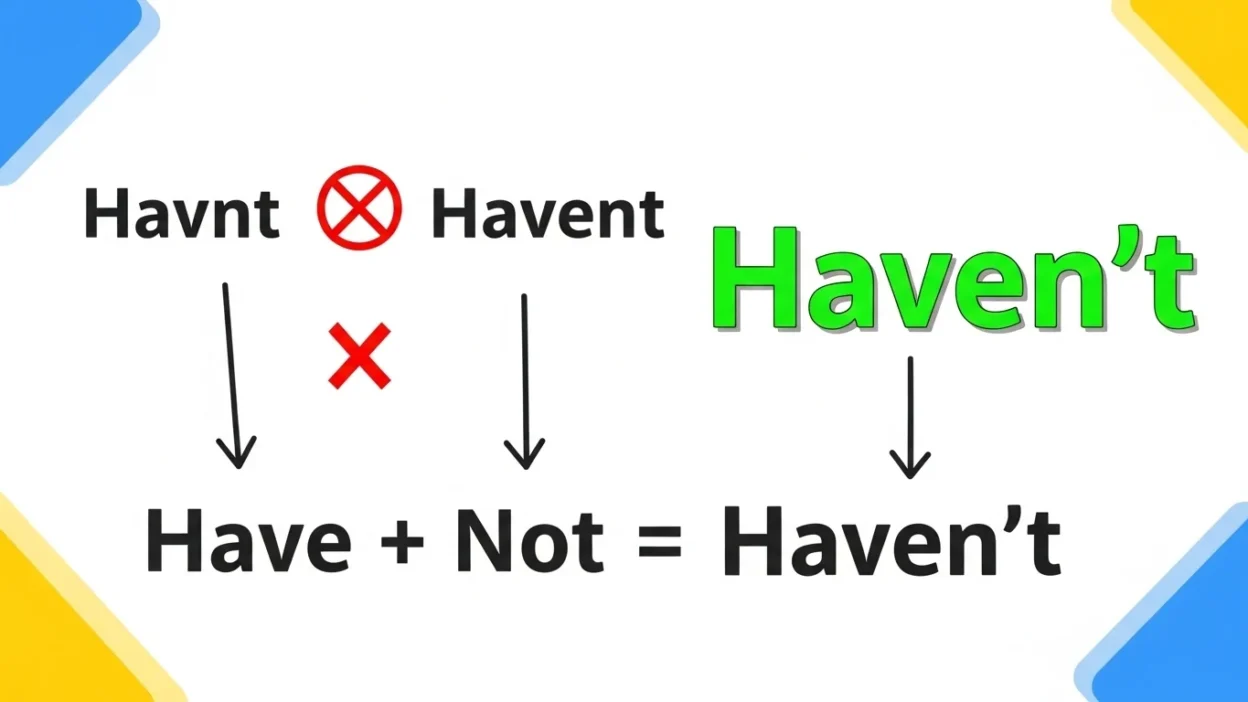
Many writers get confused between havnt vs havent when typing quickly in messages or emails. These spellings look very similar, but neither of them is completely correct in standard English. The confusion happens because people forget to add an important punctuation mark.
In this guide, you will learn the correct spelling, meaning, examples, common mistakes, and a simple trick to remember the difference. By the end, you will clearly understand why haven’t is the correct form and why havnt and havent should be avoided.
Quick Answer: Havnt vs Havent
Both havnt and havent are incorrect spellings.
The correct form is haven’t, which is a contraction of have not.
Examples:
- I haven’t finished my homework yet.
- We haven’t seen that movie before.
Incorrect examples:
- I havnt finished my homework. ❌
- I havent finished my homework. ❌
In proper English writing, always use haven’t with an apostrophe.
What Does Haven’t Mean?
Haven’t is a contraction of have not. Contractions combine two words by removing letters and replacing them with an apostrophe.
So:
Have not → Haven’t
It is commonly used in everyday conversations and writing.
Examples:
- I haven’t eaten lunch yet.
- They haven’t arrived at the airport.
- We haven’t decided on the plan.
In these sentences, “haven’t” simply means “have not.”
Why Havnt and Havent Are Incorrect
Both spellings are missing an important punctuation mark.
Missing the Apostrophe
The contraction haven’t removes the letter o from “not.” The apostrophe replaces the missing letter.
Correct form:
Have not → Have n’t
So the correct spelling is:
✔ Haven’t
Without the apostrophe, the word becomes incorrect.
Common Typing Mistakes
People often write havent or havnt because they type quickly or ignore punctuation. However, in formal writing, this mistake should always be corrected.
Havnt vs Havent vs Haven’t: Comparison Table
| Word | Correct? | Meaning |
|---|---|---|
| Haven’t | ✔ Yes | Contraction of “have not” |
| Havent | ✘ No | Missing apostrophe |
| Havnt | ✘ No | Misspelled contraction |
Whenever you want to shorten have not, the correct form is haven’t.
Examples of Haven’t in Sentences
Let’s look at how the word is used in everyday communication.
Everyday Conversations
- I haven’t seen him today.
- We haven’t finished the project yet.
- They haven’t answered my message.
Questions
- Why haven’t you called me?
- Haven’t they arrived yet?
Informal Writing
- I haven’t checked my email today.
- She haven’t—wait, that should be hasn’t—finished the work.
These examples show how frequently the word appears in everyday English.
Common Mistakes with Haven’t
Many writers make small errors when typing contractions.
Mistake 1: Writing Havent
❌ I havent completed the task.
✔ I haven’t completed the task.
Mistake 2: Writing Havnt
❌ I havnt seen that show.
✔ I haven’t seen that show.
Mistake 3: Forgetting the Apostrophe
The apostrophe is essential because it shows letters have been removed.
Without it, the contraction becomes incorrect.
Memory Trick to Remember the Correct Spelling
Here is a simple trick.
Think of the full phrase:
Have not
When you shorten it, remove the o in “not” and replace it with an apostrophe.
Have not → Have n’t
So the final word becomes:
Haven’t
Remembering this transformation makes the spelling easy.
Similar Contractions in English
Many English contractions follow the same pattern.
Examples:
| Full Form | Contraction |
|---|---|
| Do not | Don’t |
| Is not | Isn’t |
| Are not | Aren’t |
| Has not | Hasn’t |
Like these examples, haven’t also needs an apostrophe.
American vs British English
There is no spelling difference between American and British English.
Both use the same contraction:
✔ Haven’t
The incorrect forms havent and havnt are not accepted in either variety.
Frequently Asked Questions
Is “havnt” a real word?
No, it is considered a spelling mistake.
Is “havent” correct?
No, it is missing the apostrophe required in the contraction.
What does haven’t mean?
Haven’t means have not.
Is haven’t formal or informal?
It is commonly used in both spoken and informal written English.
Can haven’t start a sentence?
Yes, especially in questions, such as “Haven’t you finished yet?”
Is the spelling different in British and American English?
No, both use the same spelling: haven’t.
Final Summary: Havnt vs Havent
The difference between havnt vs havent is simple. Both are incorrect spellings that appear when writers forget the apostrophe in the contraction haven’t. The correct form, haven’t, combines the words have and not and replaces the missing letter with an apostrophe.
Using the correct contraction helps your writing look clear, professional, and grammatically accurate. Once you remember that haven’t = have not, you will easily avoid this common mistake.
Actionable Takeaway
Whenever you type havent or havnt, pause and add the missing apostrophe. Writing haven’t ensures your sentence is grammatically correct.