
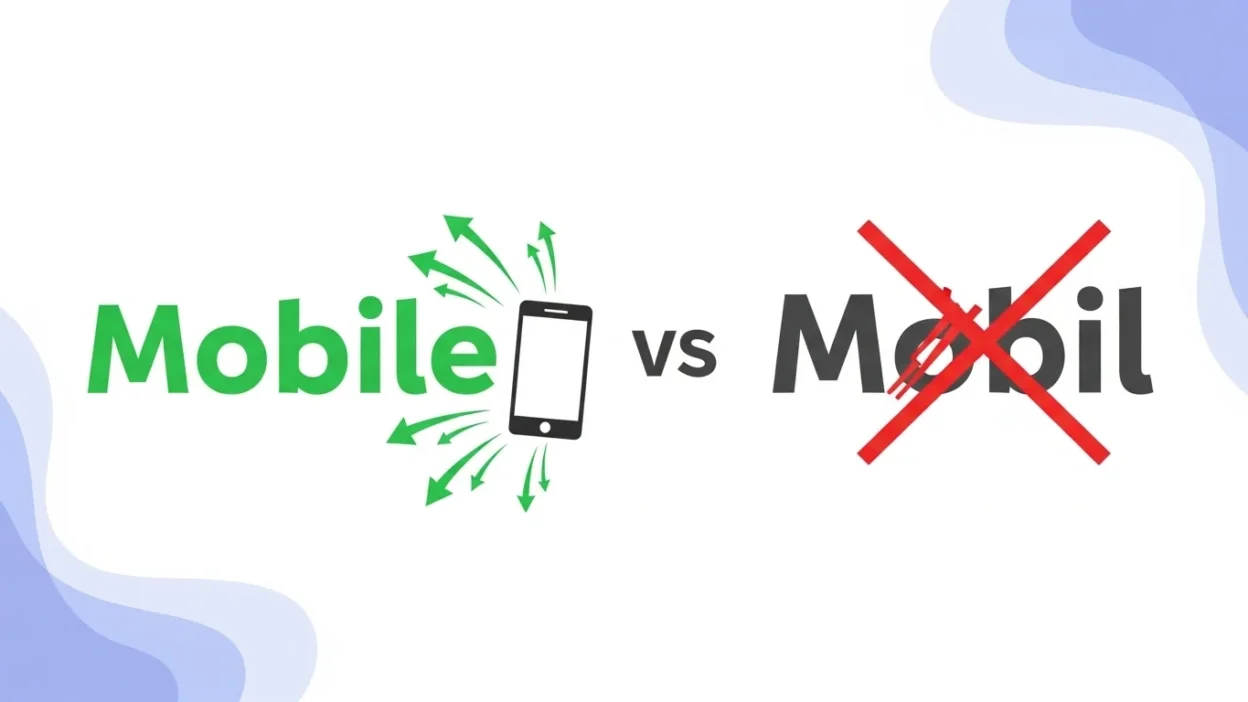
Many writers get confused between mobil vs mobile, especially because both forms appear in different contexts. However, only one is the correct general English spelling, while the other is either a mistake or a proper name.
In this guide, you will learn the correct spelling, meanings, examples, common mistakes, and a simple trick to remember the difference. By the end, you will clearly understand why mobile is correct and when mobil might still appear.
Quick Answer: Mobil vs Mobile
Mobile is the correct spelling in standard English.
Mobil is usually a spelling mistake (except as a proper name).
Correct examples:
- I forgot my mobile phone at home.
- The app works well on mobile devices.
Incorrect example:
- I forgot my mobil phone. ❌
Always use mobile in everyday writing.
What Does Mobile Mean?
Mobile is an adjective and noun that generally means able to move or related to portable devices like phones.
Mobile as Movable
Examples:
- The sculpture is light and mobile.
- Modern furniture is often mobile and easy to move.
Mobile as Technology
In modern usage, mobile commonly refers to phones or portable devices.
Examples:
- She uses a mobile for work.
- This website is optimized for mobile users.
Why “Mobil” Is Incorrect
The spelling mobil is usually incorrect because it is missing the final “e.”
The correct word is:
Mobile
Not:
Mobil ❌
Important Note: “Mobil” as a Name
Mobil can be correct as part of a brand name, such as the oil company Mobil.
In such cases, it is a proper noun, not the general English word.
Mobil vs Mobile: Comparison Table
| Word | Correct? | Meaning |
|---|---|---|
| Mobile | ✔ Yes | Able to move or related to phones |
| Mobil | ✘ No (general use) | Misspelling or brand name |
Whenever you talk about movement or phones, use mobile.
Examples of Mobile in Sentences
Here are examples showing correct usage.
Everyday Use
- I left my mobile in the car.
- He bought a new mobile yesterday.
Technology Context
- The app is designed for mobile devices.
- Mobile usage is increasing worldwide.
General Meaning
- The system is fully mobile and flexible.
- The equipment is lightweight and mobile.
These examples show how widely the word is used.
Common Mistakes with Mobile
Let’s review typical errors.
Mistake 1: Writing Mobil
❌ I use my mobil every day.
✔ I use my mobile every day.
Mistake 2: Dropping the Final “E”
Writers often forget the last letter.
Mistake 3: Confusing with Brand Names
Seeing Mobil as a brand can lead to incorrect usage.
Memory Trick to Remember the Correct Spelling
Here is a simple trick.
Think of the word:
Mobile = Move + able
If something is able to move, it is mobile.
Also remember:
Mobile ends with “e.”
Related Words to Mobile
Here are some related forms:
- Mobility
- Mobilize / Mobilise
- Mobilization / Mobilisation
These words share the same root, helping you remember the correct spelling.
American vs British English
There is no difference in the base spelling.
Both use:
✔ Mobile
However, related forms may differ:
- American English: Mobilize
- British English: Mobilise
Still, mobil is not correct in general usage.
Frequently Asked Questions
Is “mobil” a real word?
Only as a proper name, such as a brand, not as a standard English word.
What does mobile mean?
It means able to move or related to portable devices like phones.
Why do people write mobil?
Because they forget the final e or confuse it with brand names.
Is mobile used in everyday English?
Yes, it is very common, especially for phones and technology.
Is the spelling different in US and UK English?
No, both use mobile.
What is mobile technology?
Technology designed for portable devices like smartphones and tablets.
Final Summary: Mobil vs Mobile
The difference between mobil vs mobile is simple. Mobile is the correct spelling and is used to describe something that can move or relates to portable devices. Meanwhile, mobil is usually a spelling mistake or a proper name.
By remembering that mobile ends with “e” and relates to “move,” you can avoid this common error easily.
Actionable Takeaway
Whenever you write about phones or movement, use mobile. If you see mobil, check the context and correct it unless it is a proper name.