
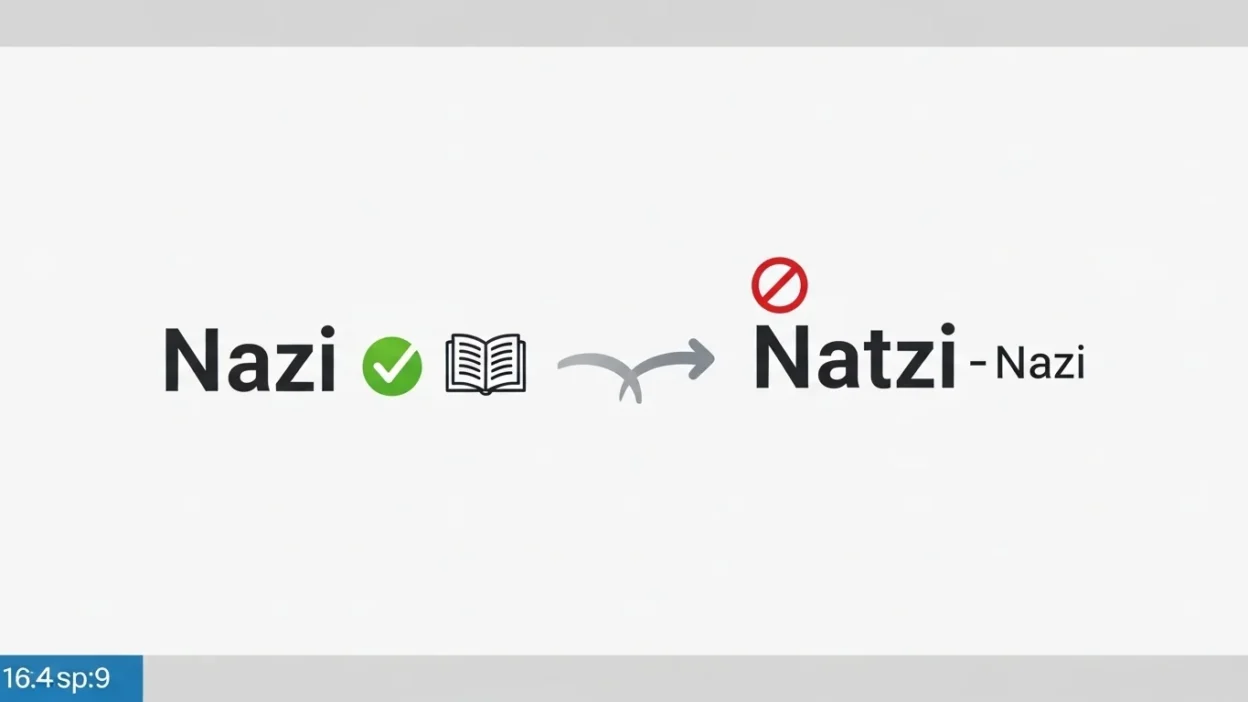
Many writers become unsure when choosing between natzi vs nazi. The two spellings look similar, but only one is historically and grammatically correct in English. Because the word refers to an important historical concept, spelling it correctly is especially important.
In this guide, you will learn the correct spelling, meaning, historical background, examples, and common mistakes. By the end, you will clearly understand why Nazi is correct and why natzi should not be used.
Quick Answer: Natzi vs Nazi
Nazi is the correct spelling.
Natzi is a spelling mistake.
Correct examples:
- The Nazi regime ruled Germany during the 1930s and 1940s.
- World War II involved the defeat of Nazi Germany.
Incorrect example:
- The natzi regime ruled Germany. ❌
In proper English writing, always use Nazi.
What Does Nazi Mean?
Nazi refers to a member or supporter of the National Socialist German Workers’ Party, the political party that ruled Germany under Adolf Hitler from 1933 to 1945.
The term is strongly connected to the government of Nazi Germany and the historical period surrounding World War II.
Historical Context
The word “Nazi” is a shortened form of the German word Nationalsozialist (National Socialist).
Members of this political movement supported the ideology of the Nazi Party.
During that period, the regime carried out major events including the tragic Holocaust.
Because of this history, the term carries serious historical meaning.
Why “Natzi” Is Incorrect
The spelling natzi is simply a misspelling of “Nazi.”
The correct spelling follows the original German abbreviation “Nazi.”
There is no “t” in the word.
Pronunciation Confusion
People sometimes write natzi because the pronunciation of Nazi can sound like “naht-see.” This can make some writers mistakenly insert the letter t.
However, dictionaries and historical texts consistently use Nazi.
Natzi vs Nazi: Comparison Table
| Word | Correct? | Meaning |
|---|---|---|
| Nazi | ✔ Yes | Member or supporter of the Nazi Party |
| Natzi | ✘ No | Misspelling |
Whenever referring to the historical movement or ideology, always write Nazi.
Examples of Nazi in Sentences
Here are examples showing how the word appears in historical discussions.
Historical Writing
- The Nazi government controlled Germany during the 1930s.
- Many countries fought against Nazi forces in World War II.
Educational Context
- Students learn about Nazi history in modern world history classes.
- Museums document the impact of the Nazi regime.
Political Discussion
- The Nazi ideology had a lasting impact on global history.
- Scholars study how Nazi propaganda influenced society.
These examples show the word used in academic and historical contexts.
Common Mistakes with Nazi
Let’s look at the most frequent spelling errors.
Mistake 1: Writing Natzi
❌ The natzi regime controlled Germany.
✔ The Nazi regime controlled Germany.
Mistake 2: Writing It in Lowercase
Because the word refers to a political party and ideology, it is usually capitalized.
✔ Nazi
❌ nazi (sometimes used informally but less standard in formal writing)
Mistake 3: Mispronunciation Leading to Misspelling
The pronunciation may lead some writers to add a t, but that letter does not belong in the word.
Memory Trick to Remember the Correct Spelling
Here is a simple trick.
Think of the word Nazi as a shortened form of National Socialist.
Na + zi → Nazi
There is no letter “t” in either part, so it cannot appear in the spelling.
American vs British English
There is no spelling difference between American and British English.
Both varieties use:
✔ Nazi
The spelling natzi is incorrect everywhere.
Frequently Asked Questions
Is “natzi” a real word?
No, it is considered a spelling mistake.
What does Nazi mean?
A Nazi is a member or supporter of the Nazi Party in Germany during the 1930s and 1940s.
Why is the word capitalized?
Because it refers to a specific political party and historical movement.
Is the spelling different in American and British English?
No, both use the spelling Nazi.
Where does the word Nazi come from?
It comes from the German abbreviation of Nationalsozialist.
Can Nazi be used as an adjective?
Yes. For example: Nazi ideology or Nazi regime.
Final Summary: Natzi vs Nazi
The difference between natzi vs nazi is straightforward. Nazi is the correct spelling and refers to members or supporters of the Nazi Party that ruled Germany during the era of Adolf Hitler. The spelling natzi is simply a mistake caused by pronunciation confusion.
Because the word represents an important historical term, it should always be spelled correctly and used carefully. Remembering that the word comes from National Socialist helps reinforce the correct spelling.
Actionable Takeaway
Whenever writing about history, politics, or World War II, double-check the spelling. Replace natzi with Nazi to keep your writing accurate and historically correct.