
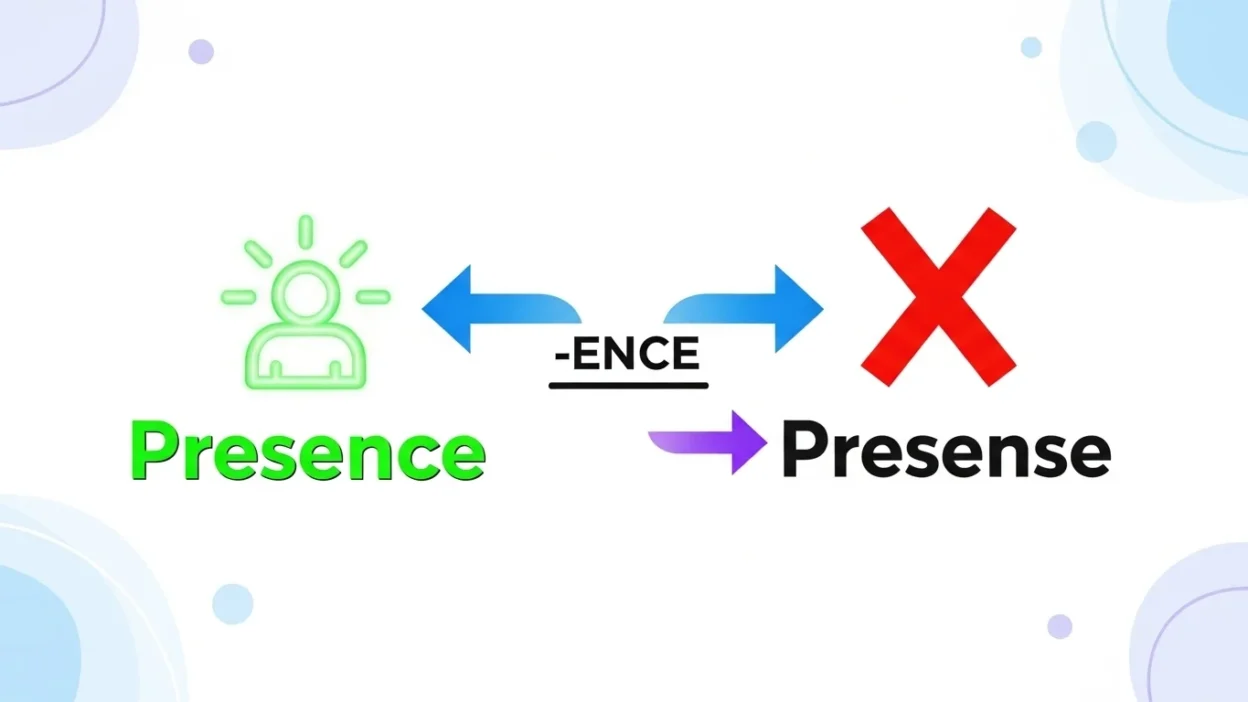
Many writers get confused between presense vs presence because the words sound very similar. However, only one spelling is correct in standard English, while the other is a common mistake.
In this guide, you will learn the correct spelling, meaning, examples, common mistakes, and an easy trick to remember the difference. By the end, you will clearly understand why presence is correct and why presense should not be used.
Quick Answer: Presense vs Presence
Presence is the correct spelling.
Presense is a spelling mistake.
Correct examples:
- Her presence made everyone feel comfortable.
- The teacher’s presence kept the class quiet.
Incorrect example:
- Her presense made everyone feel comfortable. ❌
Always use presence in proper writing.
What Does Presence Mean?
Presence is a noun that means the state of being present or existing in a place, or a person’s impact or aura in a situation.
Presence as Being There
Examples:
- His presence at the meeting was important.
- The guard’s presence increased security.
Presence as Influence or Aura
Sometimes presence refers to someone’s strong or noticeable impact.
Examples:
- She has a powerful stage presence.
- His calm presence helped everyone relax.
Why “Presense” Is Incorrect
The spelling presense is a common error caused by confusion between “s” and “c” sounds.
The correct word is formed from:
Present + ence → Presence
Not:
Present + ense → Presense ❌
Because of this structure, the correct spelling always uses -ence, not -ense.
Presense vs Presence: Comparison Table
| Word | Correct? | Meaning |
|---|---|---|
| Presence | ✔ Yes | The state of being present |
| Presense | ✘ No | Misspelling |
Whenever you refer to being present or someone’s influence, use presence.
Examples of Presence in Sentences
Here are some examples showing correct usage.
Everyday Situations
- Her presence made the event special.
- The manager’s presence improved discipline.
Professional Context
- His presence in the company is valuable.
- Leaders often have a strong presence.
Emotional Context
- Her kind presence comforted the child.
- A calm presence can reduce stress.
These examples show how widely the word is used.
Common Mistakes with Presence
Let’s review typical errors.
Mistake 1: Writing Presense
❌ His presense was noticed by everyone.
✔ His presence was noticed by everyone.
Mistake 2: Confusing -ence and -ense
Some English words end with -ence, while others use -ense, which causes confusion.
Mistake 3: Spelling Based on Sound
Because both endings sound similar, writers sometimes choose the wrong one.
Memory Trick to Remember the Correct Spelling
Here is a simple trick.
Think of the word:
Present → Presence
Since present contains a c sound, the ending becomes -ence.
Another trick:
Many related words use -ence:
- Absence
- Difference
- Confidence
This helps reinforce the correct spelling.
Related Words to Presence
Here are some related forms:
- Present
- Presence
- Presence-based
- Presently
These words share the same root, helping you remember the correct form.
American vs British English
There is no difference between American and British English.
Both use:
✔ Presence
The spelling presense is incorrect everywhere.
Frequently Asked Questions
Is “presense” a real word?
No, it is a spelling mistake.
What does presence mean?
It means the state of being present or someone’s noticeable impact.
Why is it spelled presence?
Because it comes from present + ence.
Is presence used in everyday English?
Yes, it is very common in both speech and writing.
Is the spelling different in US and UK English?
No, both use presence.
What is a strong presence?
It refers to someone having a noticeable and influential personality.
Final Summary: Presense vs Presence
The difference between presense vs presence is simple. Presence is the correct spelling and refers to being present or having influence. Meanwhile, presense is a common spelling mistake caused by confusion between -ence and -ense endings.
By remembering the connection between present and presence, you can easily avoid this error.
Actionable Takeaway
Whenever you write about being present or someone’s influence, use presence. If you see presense, correct it immediately to keep your writing accurate and professional.

Fenwick Quentin is a creative blogging author known for his analytical yet engaging writing style.
He explores topics such as innovation, digital culture, and personal development with depth and clarity.
Through his articles, Fenwick encourages readers to think critically and embrace continuous growth.