If you’ve ever typed scarry and paused for a second, you’re definitely not alone. Because English spelling sometimes feels unpredictable, many writers second-guess themselves. However, in this case, the rule is simple and clear.
So if you’re confused about scary vs scarry, don’t worry. In this guide, you’ll learn the correct spelling, understand why one version is wrong, explore helpful examples, avoid common mistakes, and confidently use the right word every time.
Quick Answer
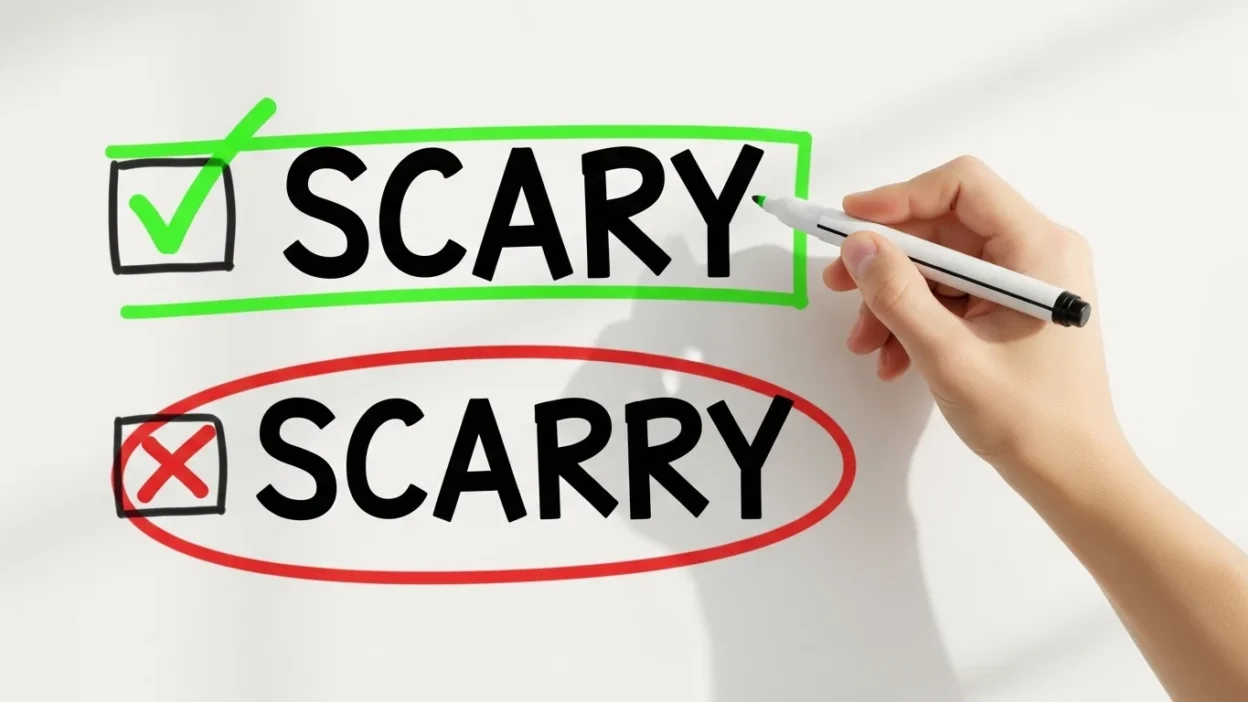
First of all, scary is the correct spelling.
In contrast, scarry is incorrect.
Therefore, whenever you describe something frightening or spooky, you should always write scary with one “r.”
What Does Scary Mean
Basic Meaning
Simply put, scary describes something that causes fear or fright.
For example:
- That horror movie was scary.
- The dark forest looks scary at night.
- I heard a scary noise outside.
In each sentence, scary describes something that creates fear or nervousness.
Emotional Context
Additionally, people often use scary to describe situations that feel overwhelming or stressful.
For example:
- Starting a new job feels scary.
- Public speaking can seem scary at first.
In these cases, scary expresses emotional fear rather than physical danger.
Why Scarry Is Incorrect
No Double R Rule Here
Unlike words such as running or stopping, the word scary does not follow the double consonant rule in this form.
Here’s why:
The base word is scare.
When you add the suffix -y, you remove the final “e.”
Scare + y → Scary
Because the base word already contains one “r,” you do not double it.
Therefore, writing scarry adds an unnecessary extra letter.
Understanding the Spelling Pattern
To make things clearer, look at similar examples:
- Rare → Rarity
- Care → Careful
- Dare → Daring
- Scare → Scary
In each case, the root word keeps its original consonants. As a result, you never double the “r” in scary.
Common Mistakes to Avoid
Adding Extra Letters
Many people assume scary follows the same pattern as words like running. However, that rule applies to short verbs ending in vowel + consonant, not adjectives formed from words like scare.
Typing Too Quickly
Sometimes, scarry appears because of fast typing. Therefore, always proofread important writing.
Ignoring Spell Check
Most grammar tools flag scarry immediately. So, when you see a red underline, correct it right away.
American vs British English
Unlike words such as color vs colour, the spelling of scary does not change between regions.
Both American English and British English use scary.
Therefore, you never need to adjust spelling based on location.
Scary vs Scarry Comparison Table
| Feature | Scary | Scarry |
|---|---|---|
| Correct spelling | Yes | No |
| Found in dictionary | Yes | No |
| Used in formal writing | Yes | No |
| Accepted in US & UK | Yes | No |
Clearly, scary wins every time.
Related Spelling Tips
If you want to avoid similar spelling mistakes, remember this pattern:
When adding -y to a word ending in silent “e,” remove the “e” but do not double consonants unless the base word changes.
Examples:
- Shine → Shiny
- Noise → Noisy
- Taste → Tasty
- Ice → Icy
Because of this rule, scare becomes scary — not scarry.
FAQs
Is scarry a real word
No, it is a spelling mistake.
Why one r in scary
Because it comes from scare + y.
Is scary correct everywhere
Yes, both US and UK use scary.
Does scary come from scare
Yes, it comes directly from scare.
Can scarry ever be correct
No, you should always write scary.
Final Thoughts
Ultimately, the confusion between scary vs scarry comes from misunderstanding spelling patterns. However, once you remember that scary comes from scare + y, the answer becomes simple. You remove the silent “e” and keep one “r.”
Although the mistake seems small, correct spelling improves clarity, credibility, and confidence.
Therefore, whenever you describe something frightening, spooky, or intimidating, confidently choose scary with one “r.” Small details create strong writing, and strong writing builds trust.