Many people get confused between whos vs whose because the words sound the same. However, their meanings and grammar are completely different. Using the wrong one can make a sentence look incorrect or unclear.
In this guide, you will learn the meanings, examples, grammar rules, and common mistakes related to these words. By the end, you will clearly understand when to use whose and why whos is usually incorrect.
Quick Answer: Whos vs Whose
Whose is the correct word used to show possession.
Whos is generally a spelling mistake.
Examples:
- Whose book is on the table?
- Do you know whose phone this is?
Incorrect example:
- Whos book is on the table. ❌
In proper English writing, always use whose.
What Does Whose Mean?
Whose is a possessive pronoun. It asks or shows ownership or belonging.
In simple terms, whose means “belonging to whom.”
Examples:
- Whose jacket is this?
- Do you know whose car is parked outside?
- She met the writer whose book became famous.
In these examples, “whose” connects something to the person who owns it.
Whose in Questions
It is often used when asking about ownership.
Examples:
- Whose bag is this?
- Whose idea was it?
- Whose turn is next?
Here, the speaker wants to know who something belongs to.
Whose in Sentences
Whose can also connect ideas in a sentence.
Examples:
- I met a teacher whose students admire her.
- He adopted a dog whose owner moved away.
In these cases, whose links possession within the sentence.
What Does Whos Mean?
The word whos without an apostrophe is not considered correct in standard English.
It usually appears because people forget the apostrophe in the contraction who’s.
For example:
Incorrect:
❌ Whos coming to the party?
Correct:
✔ Who’s coming to the party?
Here, who’s means who is.
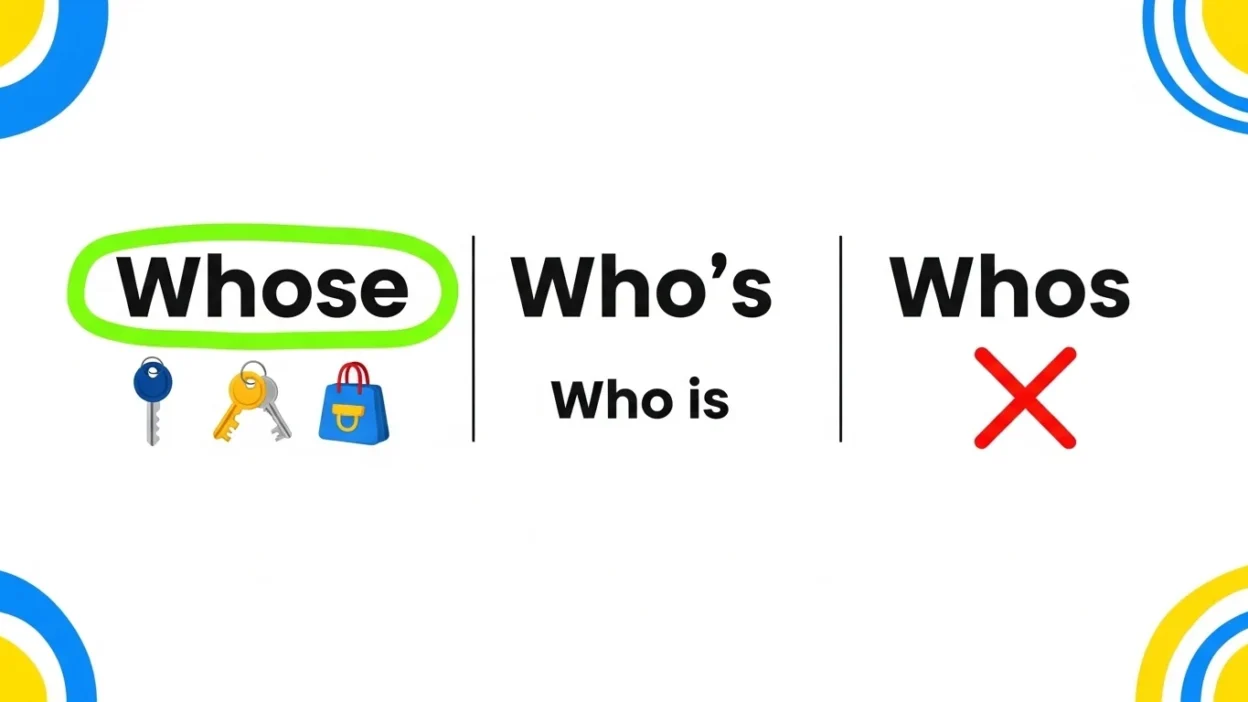
Whose vs Who’s vs Whos
Understanding these three forms helps avoid confusion.
| Word | Meaning | Example |
|---|---|---|
| Whose | Possession | Whose laptop is this? |
| Who’s | Contraction of “who is” or “who has” | Who’s ready to start? |
| Whos | Incorrect spelling | Avoid using |
So remember:
- Whose = possession
- Who’s = who is / who has
- Whos = mistake
Simple Grammar Rule to Remember
A helpful rule is:
If you can replace the word with “who is”, use who’s.
If the sentence talks about ownership, use whose.
Examples:
- Who’s coming to dinner? (Who is coming)
- Whose keys are these? (Keys belong to someone)
This quick test makes the choice easy.
Examples of Whose in Sentences
Let’s see how the word works in everyday writing.
Questions About Ownership
- Whose shoes are at the door?
- Whose laptop is missing?
Describing People or Things
- The artist whose painting won the award was surprised.
- I met a chef whose restaurant is very popular.
Informal Conversations
- Whose turn is it to cook?
- Whose phone keeps ringing?
These examples show how frequently the word appears in daily communication.
Common Mistakes with Whose
Here are the most common errors writers make.
Mistake 1: Writing “Whos”
❌ Whos idea was this?
✔ Whose idea was this?
Mistake 2: Confusing Whose and Who’s
❌ Who’s bag is on the chair?
✔ Whose bag is on the chair?
Because the sentence shows ownership, “whose” is correct.
Mistake 3: Forgetting the Apostrophe
When you mean who is, you must write who’s.
Example:
✔ Who’s coming with us?
Memory Trick to Remember the Difference
Here is a simple trick.
Think of whose like his or hers.
All of them show possession:
- His car
- Her phone
- Whose bag
Since they show ownership, they do not need an apostrophe.
This makes it easier to remember the correct form.
American vs British English
There is no difference between American and British English for this word.
Both varieties use:
- Whose (correct)
- Who’s (correct contraction)
- Whos (incorrect spelling)
The grammar rules remain exactly the same.
Frequently Asked Questions
Is “whos” a real word?
No, it is considered a spelling mistake in standard English.
What does whose mean?
Whose shows possession and means “belonging to whom.”
What is the difference between whose and who’s?
Whose shows ownership, while who’s means “who is” or “who has.”
Can whose refer to objects?
Yes, whose can refer to people, animals, or things.
Is whose formal or informal?
It works in both formal and informal writing.
Is the spelling different in UK and US English?
No, both use the same spelling: whose.
Final Summary: Whos vs Whose
The difference between whos vs whose is simple but important. Whose is the correct possessive word used to ask or describe ownership. Meanwhile, whos is usually a spelling mistake caused by forgetting the apostrophe in who’s.
Understanding the difference between whose and who’s helps keep your writing clear and grammatically correct. Once you remember that whose shows possession, choosing the correct word becomes easy.
Actionable Takeaway
Before publishing your writing, quickly check sentences with whose. If you see whos, replace it with whose or who’s, depending on the meaning.

Fenwick Quentin is a creative blogging author known for his analytical yet engaging writing style.
He explores topics such as innovation, digital culture, and personal development with depth and clarity.
Through his articles, Fenwick encourages readers to think critically and embrace continuous growth.