It’s easy to mix up equipt vs equipped, especially because both seem logical at first glance. However, only one follows correct English spelling rules, while the other is a common mistake.
In this guide, you will learn the correct spelling, meaning, examples, common mistakes, and a simple trick to remember the difference. By the end, you will clearly understand why equipped is correct and why equipt should not be used.
Quick Answer: Equipt vs Equipped
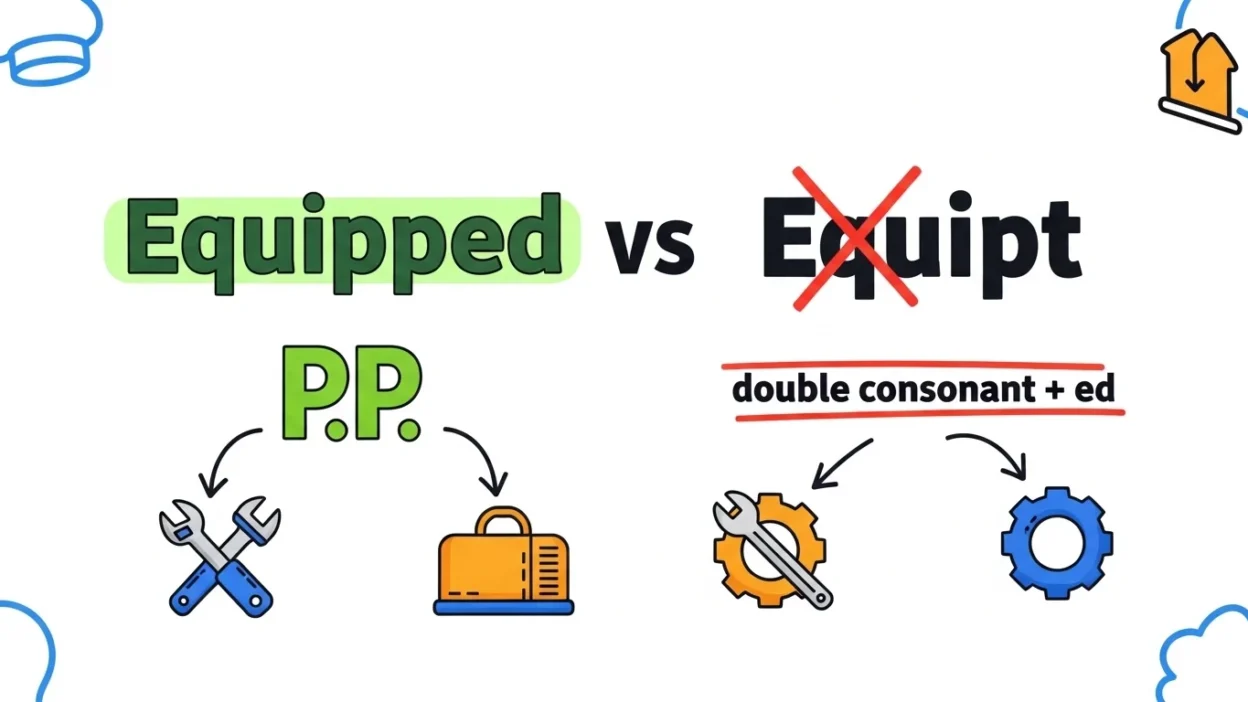
Equipped is the correct spelling.
Equipt is a spelling mistake.
Correct examples:
- The team is fully equipped for the mission.
- She equipped herself with the necessary tools.
Incorrect example:
- The team is fully equipt for the mission. ❌
Always use equipped in proper writing.
What Does Equipped Mean?
Equipped is the past tense and past participle of the verb equip, which means to provide with the necessary tools, skills, or resources.
Equipped as Prepared with Tools
Examples:
- The soldiers were well equipped for battle.
- The lab is fully equipped with modern machines.
Equipped as Prepared with Skills
Examples:
- He is well equipped to handle challenges.
- Students are equipped with knowledge for the future.
Why “Equipt” Is Incorrect
The spelling equipt is incorrect because it ignores a key spelling rule for verbs ending in -p.
The Rule: Double the Final Consonant
When a verb ends in a single vowel + consonant, and you add -ed, you usually double the final consonant.
Example pattern:
| Base Verb | Past Form |
|---|---|
| Stop | Stopped |
| Drop | Dropped |
| Equip | Equipped |
So:
Equip → Equipped
Not:
Equip → Equipt ❌
Equipt vs Equipped: Comparison Table
| Word | Correct? | Meaning |
|---|---|---|
| Equipped | ✔ Yes | Provided with tools or skills |
| Equipt | ✘ No | Misspelling |
Whenever you refer to something prepared or supplied, use equipped.
Examples of Equipped in Sentences
Here are examples showing correct usage.
Equipment and Tools
- The vehicle is equipped with safety features.
- The kitchen is fully equipped.
Skills and Abilities
- She is equipped to lead the project.
- He feels equipped to face new challenges.
Everyday Use
- The team came equipped for success.
- The classroom is well equipped for learning.
These examples show how widely the word is used.
Common Mistakes with Equipped
Let’s review typical errors.
Mistake 1: Writing Equipt
❌ The room is well equipt.
✔ The room is well equipped.
Mistake 2: Forgetting to Double the “P”
Writers often forget to double the final consonant.
Mistake 3: Confusing Verb Forms
Some people mix up the base form equip with its past form.
Memory Trick to Remember the Correct Spelling
Here is a simple trick.
Think of:
Equip → Equipped (add extra “p”)
Or remember:
“Fully equipped = fully prepared”
Both words feel complete, just like the double p.
Related Words to Equip
Here are some related forms:
- Equip
- Equipping
- Equipment
Notice that equipping also doubles the p, reinforcing the rule.
American vs British English
There is no difference between American and British English.
Both use:
✔ Equipped
The spelling equipt is incorrect everywhere.
Frequently Asked Questions
Is “equipt” a real word?
No, it is a spelling mistake.
What does equipped mean?
It means being provided with tools, resources, or skills.
Why does equipped have double “p”?
Because of the rule to double the final consonant before adding -ed.
Is equipped used in formal writing?
Yes, it is very common in both formal and informal English.
Is the spelling different in US and UK English?
No, both use equipped.
What is the base form of equipped?
The base verb is equip.
Final Summary: Equipt vs Equipped
The difference between equipt vs equipped is simple. Equipped is the correct spelling and follows the rule of doubling the final consonant before adding -ed. Meanwhile, equipt is a common spelling mistake.
By remembering that equip becomes equipped with double “p”, you can avoid this error easily.
Actionable Takeaway
Whenever you write about something being prepared or supplied, use equipped. If you see equipt, correct it immediately to maintain accurate and professional writing.