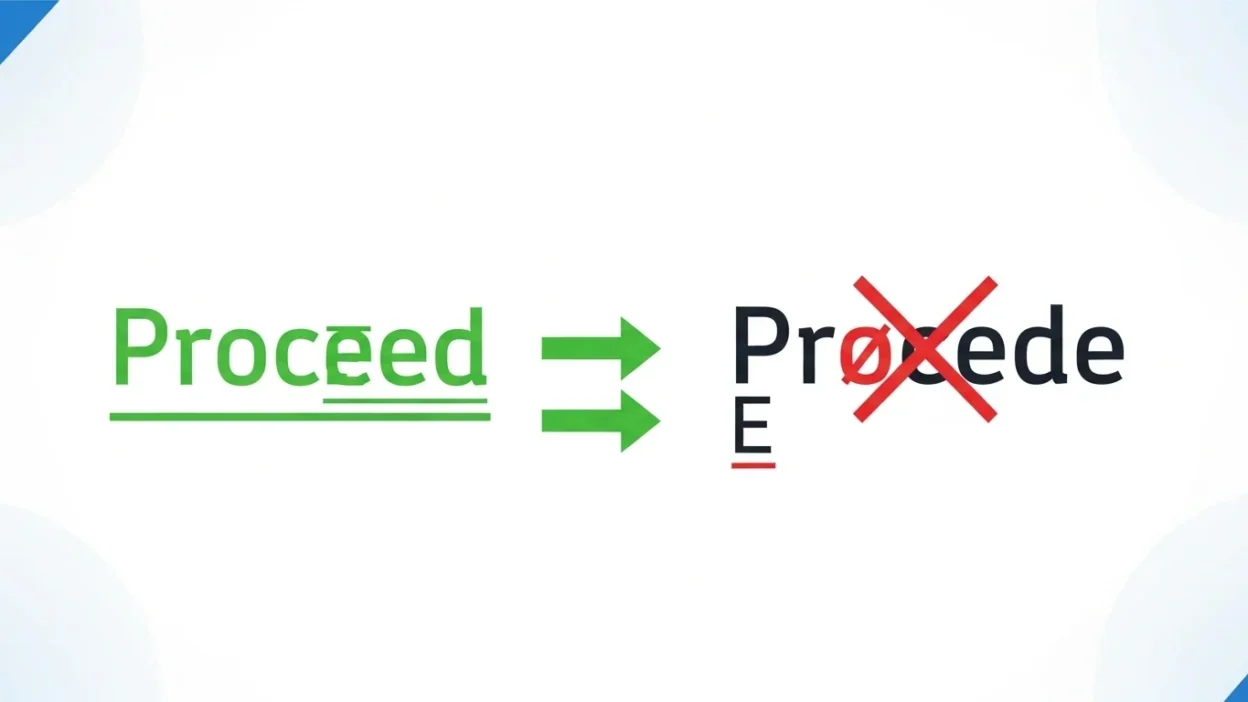
Many writers get confused between proceed vs procede because the words sound similar. However, only one of these spellings is correct in standard English, while the other is a common mistake.
In this guide, you will learn the correct spelling, meaning, examples, common mistakes, and an easy trick to remember the difference. By the end, you will clearly understand why proceed is correct and why procede should not be used.
Quick Answer: Proceed vs Procede
Proceed is the correct spelling.
Procede is a spelling mistake.
Correct examples:
- Please proceed with the next step.
- The meeting will proceed as planned.
Incorrect example:
- Please procede with the next step. ❌
Always use proceed in proper writing.
What Does Proceed Mean?
Proceed is a verb that means to continue, move forward, or carry on with something.
Proceed as Continue
Examples:
- After the break, we will proceed with the discussion.
- The teacher asked the student to proceed.
Proceed as Move Forward
Examples:
- The car began to proceed down the road.
- The team decided to proceed with the plan.
Why “Procede” Is Incorrect
The spelling procede is incorrect because it is missing one “e.”
The correct spelling is:
Proceed
Not:
Procede ❌
The word comes from Latin roots related to “ceed”, which is why it includes double “e.”
Proceed vs Procede: Comparison Table
| Word | Correct? | Meaning |
|---|---|---|
| Proceed | ✔ Yes | To continue or move forward |
| Procede | ✘ No | Misspelling |
Whenever you mean to continue or move forward, use proceed.
Examples of Proceed in Sentences
Here are examples showing correct usage.
Instructions
- You may proceed to the next page.
- Please proceed carefully.
Formal Context
- The court will proceed with the case.
- The project will proceed despite challenges.
Everyday Use
- We decided to proceed with caution.
- The event will proceed as scheduled.
These examples show how commonly the word is used.
Common Mistakes with Proceed
Let’s review typical errors.
Mistake 1: Writing Procede
❌ The meeting will procede.
✔ The meeting will proceed.
Mistake 2: Forgetting Double “E”
Many writers drop one e, which makes the word incorrect.
Mistake 3: Spelling Based on Sound
Since the pronunciation does not clearly show both e’s, people often miss one.
Memory Trick to Remember the Correct Spelling
Here is a simple trick.
Think of the phrase:
“Proceed to succeed.”
Both words contain “ceed.”
So remember:
Proceed has double “e” in “ceed.”
Related Words to Proceed
Here are some related forms:
- Proceeding
- Proceeds
- Proceeded
All of these keep the base spelling proceed.
American vs British English
There is no difference between American and British English.
Both use:
✔ Proceed
The spelling procede is incorrect everywhere.
Frequently Asked Questions
Is “procede” a real word?
No, it is a spelling mistake.
What does proceed mean?
It means to continue or move forward.
Why does proceed have double “e”?
Because of its root spelling, which includes “ceed.”
Is proceed used in formal writing?
Yes, it is commonly used in formal and professional contexts.
Is the spelling different in US and UK English?
No, both use proceed.
What is the noun form of proceed?
The noun form is proceeds, often referring to money earned.
Final Summary: Proceed vs Procede
The difference between proceed vs procede is simple. Proceed is the correct spelling and means to continue or move forward. Meanwhile, procede is a common spelling mistake caused by missing one e.
Remembering that proceed contains “ceed” with double “e” makes it easier to spell correctly.
Actionable Takeaway
Whenever you write about continuing or moving forward, use proceed. If you see procede, correct it immediately to ensure accurate writing.

Fenwick Quentin is a creative blogging author known for his analytical yet engaging writing style.
He explores topics such as innovation, digital culture, and personal development with depth and clarity.
Through his articles, Fenwick encourages readers to think critically and embrace continuous growth.