
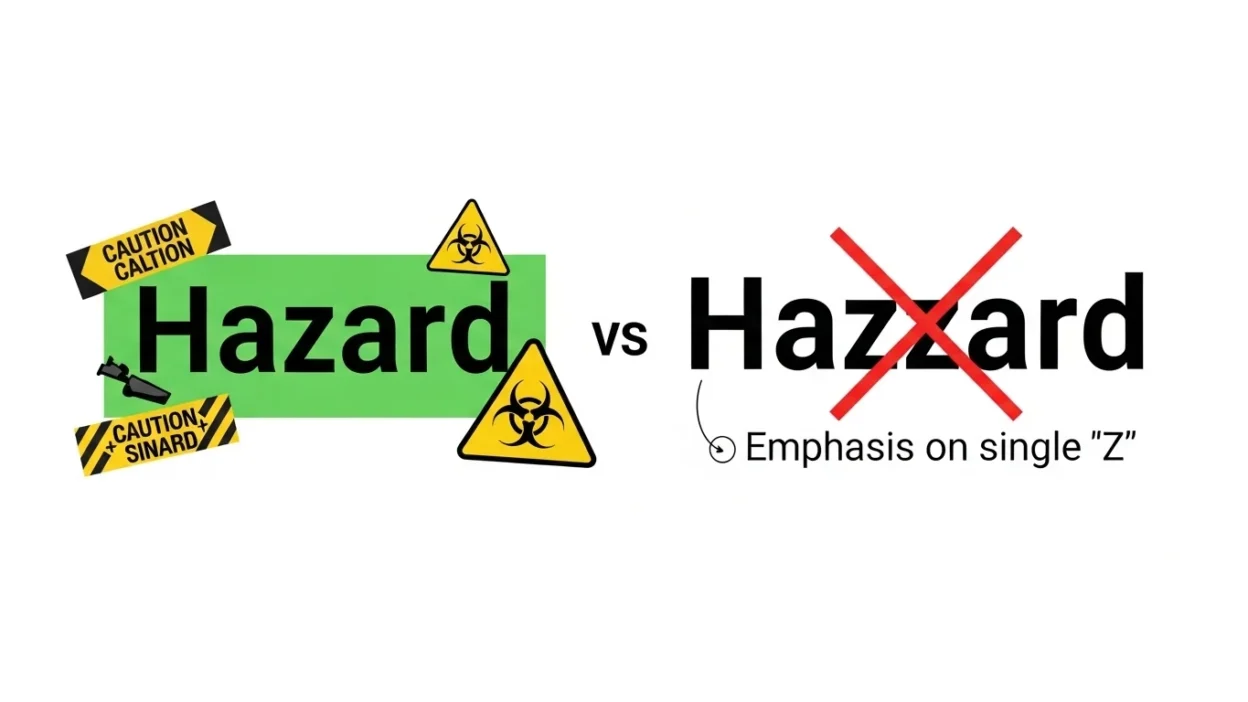
It’s easy to get confused between hazard vs hazzard because both look similar and sound almost the same. However, only one of these spellings is correct in standard English, while the other is a common mistake.
In this guide, you will learn the correct spelling, meaning, examples, common mistakes, and a simple trick to remember the difference. By the end, you will clearly understand why hazard is correct and why hazzard should not be used.
Quick Answer: Hazard vs Hazzard
Hazard is the correct spelling.
Hazzard is a spelling mistake (except as a proper name).
Correct examples:
- Wet floors can be a safety hazard.
- Smoking is a health hazard.
Incorrect example:
- Wet floors can be a safety hazzard. ❌
Always use hazard in standard writing.
What Does Hazard Mean?
Hazard is a noun (and sometimes a verb) that means a danger, risk, or potential source of harm.
Hazard as a Danger
Examples:
- Fire is a serious hazard.
- Chemicals can pose a health hazard.
Hazard as Risk
It can also refer to the chance of something harmful happening.
Examples:
- Driving in fog increases the hazard.
- Construction sites often have many hazards.
Why “Hazzard” Is Incorrect
The spelling hazzard is incorrect because it adds an extra “z” that does not exist in the standard word.
The correct spelling is:
Hazard
Not:
Hazzard ❌
Important Note: “Hazzard” as a Name
Hazzard may appear as a proper noun, such as a surname or fictional place.
For example:
- The Dukes of Hazzard (a TV show title)
In such cases, Hazzard is a name, not the general English word.
Hazard vs Hazzard: Comparison Table
| Word | Correct? | Meaning |
|---|---|---|
| Hazard | ✔ Yes | A danger or risk |
| Hazzard | ✘ No (general use) | Misspelling or proper name |
Whenever you refer to danger or risk, use hazard.
Examples of Hazard in Sentences
Here are examples showing correct usage.
Safety Context
- Slippery roads are a major hazard.
- Workers must be aware of workplace hazards.
Health Context
- Pollution is an environmental hazard.
- Loud noise can be a hearing hazard.
Everyday Use
- Leaving wires exposed is a hazard.
- Poor lighting can become a safety hazard.
These examples show how commonly the word is used.
Common Mistakes with Hazard
Let’s review typical errors.
Mistake 1: Writing Hazzard
❌ This area is a fire hazzard.
✔ This area is a fire hazard.
Mistake 2: Adding Extra Letters
Writers sometimes add extra letters based on pronunciation.
Mistake 3: Confusing with Names
Some people see Hazzard as a name and assume it is always correct.
Memory Trick to Remember the Correct Spelling
Here is a simple trick.
Think of the word:
Hazard → Has a danger
Both start with “haz” and have only one “z.”
So remember:
Hazard has one Z, not two.
Related Words to Hazard
Here are some related forms:
- Hazardous
- Hazards
- Hazardously
All of these keep the same base spelling hazard.
American vs British English
There is no difference between American and British English.
Both use:
✔ Hazard
The spelling hazzard is incorrect in general usage everywhere.
Frequently Asked Questions
Is “hazzard” a real word?
Only as a proper name, not as a standard English word.
What does hazard mean?
It means a danger or risk.
Why do people write hazzard?
Because of pronunciation or confusion with names.
Is hazard used in safety rules?
Yes, it is commonly used in safety and warning contexts.
Is the spelling different in US and UK English?
No, both use hazard.
What is a hazardous situation?
A situation that involves danger or risk.
Final Summary: Hazard vs Hazzard
The difference between hazard vs hazzard is simple. Hazard is the correct spelling and refers to danger or risk. Meanwhile, hazzard is either a spelling mistake or a proper name, not the standard word.
By remembering that hazard has only one “z”, you can easily avoid this common error.
Actionable Takeaway
Whenever you write about danger or risk, use hazard. If you see hazzard, correct it unless it is being used as a proper name.