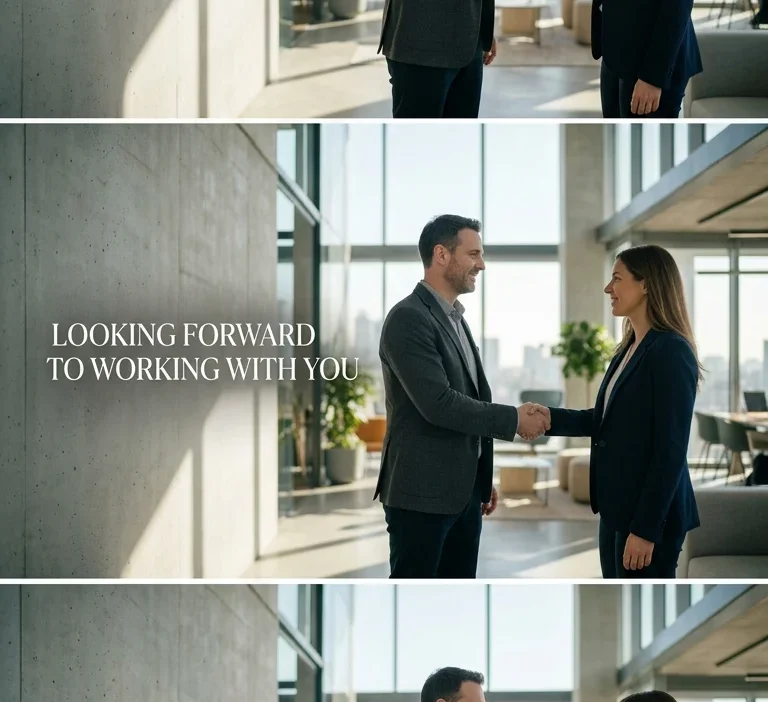
“Looking forward to working with you” is a polite and professional expression used when you are excited or pleased about working with someone in the future. It is especially common in emails, business communication, job-related messages, and professional introductions.
The phrase is grammatically correct because “looking forward to” is followed by a noun or a gerund (-ing form), so “working” is correct, not “work.” For example, you can say, “I’m looking forward to working with you on this project.”
The expression communicates a positive attitude and shows that you expect a future collaboration. However, it can be slightly formal depending on the situation, so alternatives such as “I’m excited to work with you” may sound more natural in casual communication.
Quick Answer
“Looking forward to working with you” means “I am excited or pleased about the opportunity to work with you.” It is grammatically correct and commonly used in professional emails, workplaces, business communication, and introductions. The phrase “looking forward to” must be followed by “working,” not “work.”
Why Do People Confuse “Looking Forward to Working With You”?
People often make mistakes with this expression because “to” usually introduces the base form of a verb, such as:
- to work
- to learn
- to speak
- to meet
However, in “look forward to,” the word “to” is a preposition, not part of an infinitive.
Therefore, it is followed by a noun or gerund:
- looking forward to working with you
- looking forward to meeting you
- looking forward to hearing from you
- looking forward to learning more
So:
❌ I’m looking forward to work with you.
✅ I’m looking forward to working with you.
What Does “Looking Forward to” Mean?
“Looking forward to” means feeling happy, excited, or positive about something that is expected to happen in the future.
For example:
I’m looking forward to the meeting.
This means:
I am pleased or excited that the meeting will happen.
When you say:
I’m looking forward to working with you.
you are expressing a positive feeling about a future professional relationship.
What Does “Working With You” Mean?
“Working with you” means cooperating or doing a job, project, task, or activity together.
For example:
- I enjoy working with you.
- We will be working with you next month.
- I’m looking forward to working with you.
The phrase can refer to a colleague, manager, client, customer, business partner, teacher, student, or new team member.
Looking Forward to Working With You: Correct Form
The standard structure is:
Subject + look/looking forward to + noun or -ing form
Examples:
- I’m looking forward to working with you.
- We’re looking forward to meeting you.
- She looks forward to joining the team.
- They are looking forward to hearing from you.
The important point is that “working” functions as a gerund after the preposition “to.”
Comparison Table
| Expression | Correct? | Meaning | Common Use |
| Looking forward to working with you | ✅ | Excited about future cooperation | Professional |
| Looking forward to work with you | ❌ | Incorrect grammar | Avoid |
| I look forward to working with you | ✅ | Formal/professional anticipation | Emails and business |
| I’m looking forward to working with you | ✅ | Friendly and professional | General workplace use |
| Excited to work with you | ✅ | Happy about future cooperation | Professional and casual |
| I can’t wait to work with you | ✅ | Very excited | More casual |
| Looking forward to work with you | ❌ | Incorrect structure | Avoid |
When Should You Use “Looking Forward to Working With You”?
You can use this expression when you expect to work with someone in the future.
1. After joining a new team
I’m looking forward to working with you all.
2. After accepting a new job
I’m looking forward to working with you and the rest of the team.
3. When starting a new project
We’re looking forward to working with you on this project.
4. In a business email
Thank you for your time. I’m looking forward to working with you.
5. When beginning a partnership
We’re looking forward to working with you on this exciting opportunity.
10+ Examples of “Looking Forward to Working With You”
- I’m looking forward to working with you.
- We’re looking forward to working with you on this project.
- I look forward to working with you and your team.
- I’m really looking forward to working with you.
- Our team is looking forward to working with you.
- Thank you for the opportunity. I’m looking forward to working with you.
- I’m looking forward to working with you on the new campaign.
- We look forward to working with you in the coming months.
- I’m excited about the opportunity and look forward to working with you.
- Everyone here is looking forward to working with you.
- I look forward to working with you and contributing to the team.
- We’re very much looking forward to working with you.
Common Mistakes
Mistake 1: Using “work” instead of “working”
❌ I’m looking forward to work with you.
✅ I’m looking forward to working with you.
Because “to” is a preposition in “look forward to,” it is followed by the -ing form.
Mistake 2: Writing “looking forward working”
❌ I’m looking forward working with you.
✅ I’m looking forward to working with you.
The preposition “to” cannot be omitted.
Mistake 3: Using “looking forward for”
❌ I’m looking forward for working with you.
✅ I’m looking forward to working with you.
The established expression is “look forward to,” not “look forward for.”
Mistake 4: Forgetting the subject in formal writing
❌ Looking forward to working with you.
This is common and acceptable as a shortened email closing, but a complete sentence is:
✅ I’m looking forward to working with you.
Memory Trick
Remember:
Look forward to + -ing
Think of these examples:
- look forward to meeting
- look forward to working
- look forward to learning
- look forward to hearing
- look forward to speaking
If you see “look forward to,” think “-ing.”
American vs. British English
“Looking forward to working with you” is correct in both American English and British English.
There is no major difference in grammar or meaning between the two varieties.
Both use:
I’m looking forward to working with you.
The phrase is widely understood in professional communication in both American and British English.
Similar Words and Expressions
Several expressions have a similar meaning:
I’m excited to work with you
This sounds enthusiastic and is slightly more direct.
I’m excited to work with you on this project.
I look forward to working with you
This is polished and professional.
I look forward to working with you.
I’m pleased to work with you
This sounds polite and somewhat formal.
I’m pleased to work with you on this important project.
I can’t wait to work with you
This expresses stronger excitement and is more conversational.
I can’t wait to work with you!
It will be great working with you
This sounds friendly and positive.
It will be great working with you.
Final Verdict
“Looking forward to working with you” is correct, natural, and professional. It is an excellent choice for emails, workplace communication, business relationships, new projects, and professional introductions.
The key grammar rule is simple:
look forward to + noun or -ing verb
Therefore:
✅ I’m looking forward to working with you.
Not:
❌ I’m looking forward to work with you.
FAQs:
Is “looking forward to working with you” correct?
Yes. “Looking forward to working with you” is grammatically correct and commonly used in professional communication.
Is it “looking forward to work” or “looking forward to working”?
The correct form is “looking forward to working.” In this expression, “to” is a preposition, so it is followed by the -ing form.
Is “I look forward to working with you” formal?
Yes. “I look forward to working with you” is polite and professional and works especially well in business emails and workplace communication.
Can I say “I’m looking forward to work with you”?
No. In standard English, use “I’m looking forward to working with you.”
What does “looking forward to working with you” mean?
It means you feel positive or excited about the opportunity to work with someone in the future.
Can I use this phrase in an email?
Yes. It is very common in professional emails, especially when starting a new project, joining a team, or beginning a business relationship.
Is “excited to work with you” better than “looking forward to working with you”?
Neither is universally better. “Excited to work with you” sounds more enthusiastic, while “looking forward to working with you” sounds polished and professional.
Remember This
Look forward to + noun or -ing form
- ✅ looking forward to working
- ✅ looking forward to meeting
- ✅ looking forward to hearing
- ✅ looking forward to learning
- ❌ looking forward to work
The correct sentence is:
“I’m looking forward to working with you.”
Conclusion:
“Looking forward to working with you” is a correct and useful English expression for showing that you are positive about future cooperation. It is especially appropriate in professional emails, workplace conversations, business partnerships, and new team situations.
The most important grammar point is the structure “look forward to + -ing.” Since “to” acts as a preposition here, “working” is required rather than “work.” Once you remember this pattern, you can easily use similar expressions such as “looking forward to meeting you” and “looking forward to hearing from you.”