Have you ever hesitated between “superseded” and “superceded” while writing? You’re definitely not alone.
This is one of those tricky English spelling situations where even confident writers sometimes get it wrong.
The confusion between superseded vs superceded happens because English spelling doesn’t always follow predictable patterns.
In this guide, you’ll learn the correct spelling, what the word means, how to use it properly, and simple tricks to remember it for good.
Quick Answer
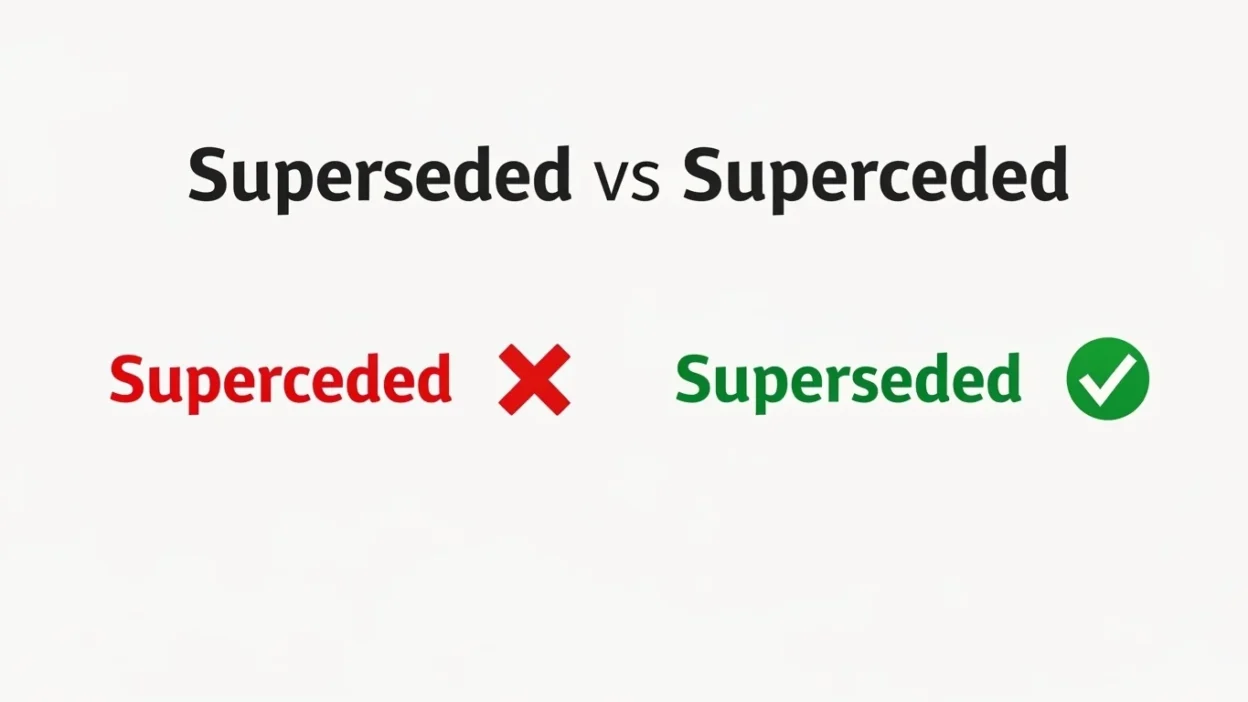
- ❌ Superceded is incorrect
- ✅ Superseded is the correct spelling
- Always use superseded when something replaces or takes the place of something else
What Does “Superseded” Mean?
The word superseded is the past tense of “supersede.” It means to replace something older, outdated, or no longer useful.
Core meanings:
- To take the place of something
- To replace or override
- To make something obsolete
Examples:
- The new policy superseded the old one.
- This version has been superseded by a better update.
- Modern technology has superseded traditional methods.
LSI keywords and related phrases:
- replaced
- outdated
- overridden
- substituted
- upgraded
- obsolete
These help improve SEO and readability.
What Is “Superceded”? Is It Ever Correct?
Let’s clear this up right away: “superceded” is not a correct spelling.
Even though many people assume it follows the “-cede” pattern (like “precede” or “concede”), this word is an exception.
Why people write “superceded”:
- Confusion with words like “precede” and “intercede”
- Misleading pronunciation
- Habit or lack of proofreading
Important:
- ❌ Superceded → Incorrect
- ✅ Superseded → Correct
No matter the context, always avoid “superceded.”
Superseded vs Superceded: Side-by-Side Comparison
| Feature | Superceded ❌ | Superseded ✅ |
|---|---|---|
| Valid word | No | Yes |
| Meaning | None | Replaced or made obsolete |
| Grammar | Incorrect spelling | Correct |
| Usage | Incorrect | Correct |
| Example | ✖ Superceded rule | ✔ Superseded rule |
Why “Superseded” Is the Correct Form
The word superseded comes from Latin roots and does not follow the usual “-cede” spelling pattern.
Key insight:
Even though it sounds like “super-ceed,” the correct spelling is -sede, not -cede.
Memory trick:
👉 Think: “Super SEDE replaces”
Or:
👉 Remember: Supersede is a spelling exception
Helpful note:
English has many irregular spellings—this is one you simply need to memorize.
How to Use “Superseded” Correctly
The word superseded is commonly used in formal, technical, and everyday contexts.
1. Business and policies
- The new guidelines superseded previous rules.
- This contract has been superseded.
2. Technology
- The software was superseded by a newer version.
- Old systems are often superseded quickly.
3. Law and regulations
- The law was superseded by updated legislation.
4. General use
- His ideas were superseded by better solutions.
Tip:
Use superseded when something is replaced or no longer valid.
Common Mistakes to Avoid
Here are the most common errors with superseded vs superceded:
1. Following the “-cede” pattern
- ❌ Superceded
- ✅ Superseded
2. Relying on pronunciation
Spelling doesn’t always match sound in English.
3. Assuming consistency
Not all similar-sounding words follow the same rule.
4. Skipping proofreading
Always double-check uncommon words.
Supersede vs Precede vs Concede
This is where confusion often starts.
Supersede:
- Means to replace
Precede:
- Means to come before
Concede:
- Means to admit or yield
Example:
- The new rule superseded the old one.
- Dinner preceded the meeting.
- He conceded defeat.
👉 Only supersede uses “-sede.”
American vs British English Differences
Good news—there’s no difference here:
- Superseded is spelled the same in both American English and British English
- No regional variation exists
- Superceded is incorrect everywhere
Key takeaway:
- ✅ Superseded → correct globally
- ❌ Superceded → incorrect globally
Synonyms and Alternatives for “Superseded”
To add variety and improve readability, consider these alternatives:
General context:
- replaced
- substituted
- displaced
- outdated
Formal context:
- overridden
- nullified
- invalidated
Examples:
- Superseded law → Replaced law
- Superseded version → Updated version
These synonyms enhance SEO and engagement.
Real-Life Usage Examples
Let’s explore how superseded is used in real situations:
Technology:
- The device was superseded by a newer model.
Business:
- The old strategy was superseded.
Legal:
- The agreement was superseded by a new contract.
Everyday life:
- Old habits are often superseded by better ones.
These examples show how useful the word is.
FAQs About Superseded vs Superceded
Is “superceded” ever correct?
No, it is always incorrect.
What does “superseded” mean?
It means replaced or made obsolete.
Why is “superseded” spelled differently?
It’s an exception to the usual “-cede” spelling pattern.
Is “superseded” used in formal writing?
Yes, it is common in legal, business, and technical contexts.
Is there a British spelling difference?
No, it is the same in both British and American English.
What is the base word of “superseded”?
The base word is supersede.
How can I remember the correct spelling?
Remember that it ends with -sede, not -cede.
Summary: Superseded vs Superceded Made Simple
The difference between superseded vs superceded is straightforward once you know the rule.
Superseded is the correct spelling used when something replaces or makes another thing obsolete, while superceded is a common but incorrect variation.
Because “supersede” doesn’t follow the usual spelling pattern, it’s easy to get wrong. However, once you memorize this exception, you’ll avoid a mistake that many writers still make.
Actionable Takeaway
Here’s your simple rule:
👉 Always use superseded—never write superceded
Before finalizing your writing, double-check tricky words like this. Small corrections can greatly improve your clarity, professionalism, and credibility.