Have you ever typed “visable” and felt unsure if it looked right? You’re not alone. This small spelling confusion—visable vs visible—is surprisingly common, especially because both words sound almost identical when spoken.
But here’s the truth: one is correct, and the other can quietly weaken your writing. Whether you’re writing emails, blog posts, assignments, or professional content, knowing the difference helps you communicate clearly and confidently. Let’s break it down in a simple, memorable way.
Quick Answer
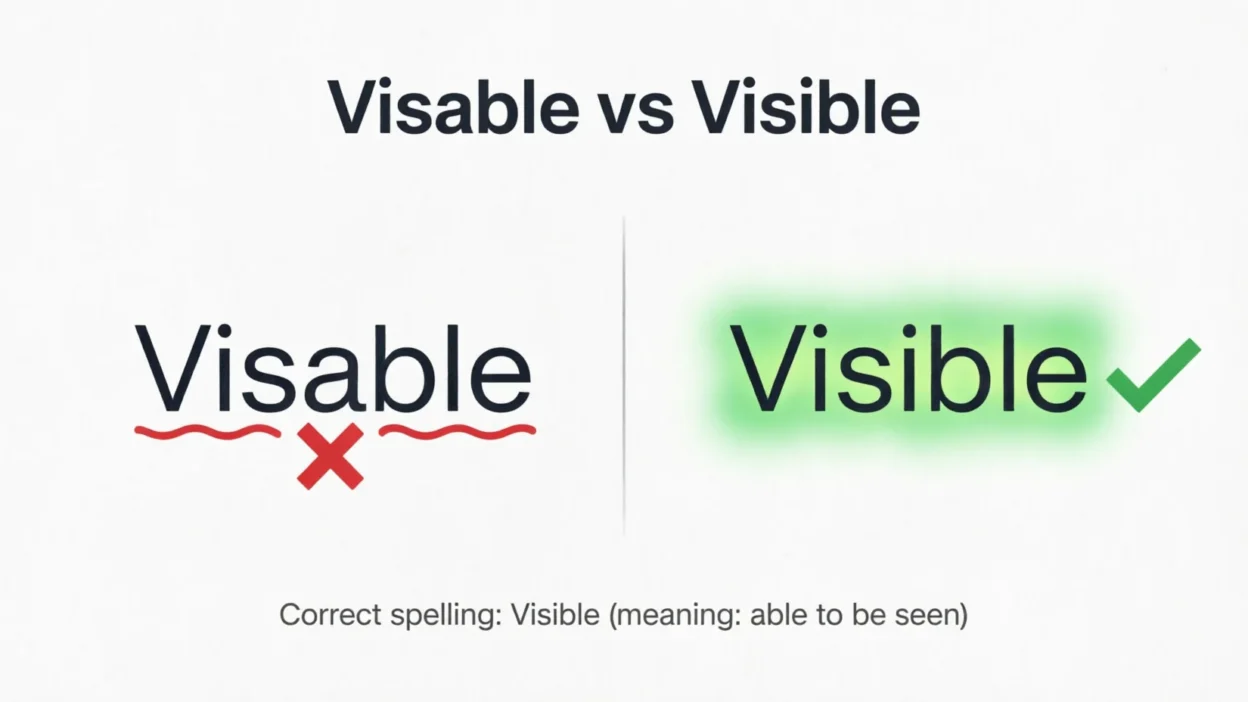
- ❌ Visable is incorrect
- ✅ Visible is the correct spelling
- 👉 Always use visible in all contexts
What Does “Visible” Mean?
The word visible is an adjective that describes something that can be seen or easily noticed.
Core meanings of “visible”:
- Able to be seen with the eyes
- Noticeable or apparent
- Clear and obvious
Examples:
- The stars are clearly visible tonight.
- There was a visible improvement in her performance.
- The damage is visible from a distance.
LSI keywords and related phrases:
- noticeable
- apparent
- observable
- clear
- evident
- detectable
- in sight
Using these related terms enhances both readability and SEO relevance.
What Is “Visable”? Is It Ever Correct?
Let’s clear this up right away:
👉 “Visable” is not a correct English word.
It’s simply a misspelling of “visible.”
Why people write “visable”:
- Confusion between “-able” and “-ible” endings
- Pronunciation sounds similar
- Habit or repeated typo
- Lack of proofreading
Important:
- ❌ Visable → Incorrect
- ✅ Visible → Correct
There are no exceptions.
Visable vs Visible: Side-by-Side Comparison
| Feature | Visable ❌ | Visible ✅ |
|---|---|---|
| Correct spelling | No | Yes |
| Meaning | None | Able to be seen |
| Usage | Never correct | Standard English usage |
| Grammar | Incorrect | Correct adjective |
| Example | ✖ Clearly visable | ✔ Clearly visible |
Why “Visible” Ends with “-ible”
One of the main reasons for confusion is the difference between “-able” and “-ible” endings.
Key rule:
- Words ending in “-ible” often come from Latin roots
- These words don’t always follow a simple pattern and must be memorized
Examples of similar words:
- visible
- possible
- responsible
- flexible
Memory trick:
👉 Think: “If it’s ‘visible,’ it’s ‘-ible,’ not ‘-able.’”
Or:
👉 “You can SEE it → vis-IBLE”
How to Use “Visible” Correctly
The word visible fits naturally into many contexts.
1. Physical visibility
- The moon is visible tonight.
- The mountain is visible from here.
2. Emotional or behavioral clarity
- His frustration was clearly visible.
- There was a visible reaction from the audience.
3. Progress or change
- There’s a visible improvement in your work.
- The results are already visible.
4. Technology and design
- Make sure the text is visible on all devices.
- The button should be clearly visible to users.
Example sentences:
- The sign is not visible from the road.
- Her confidence became more visible over time.
- Ensure your website content is easily visible.
Common Mistakes to Avoid
Even simple words can trip us up. Here are the most common errors:
1. Using “-able” instead of “-ible”
- ❌ Visable
- ✅ Visible
2. Writing based on pronunciation
The word sounds like it could end in “-able,” but it doesn’t.
3. Skipping proofreading
Small spelling errors often go unnoticed.
4. Repeating the typo
Using “visable” multiple times reduces credibility.
👉 Tip: Always double-check commonly confused words.
Visible in Different Contexts
Understanding how visible works across different areas helps you remember it better.
Everyday language:
- Clearly visible signs
- Visible changes
Business:
- Visible growth
- Visible results
Technology:
- Visible interface elements
- Visible UI components
Science:
- Visible light spectrum
- Visible reactions
👉 No matter the context, the spelling remains visible.
American vs British English Differences
Good news—there’s no variation here.
- ✅ Visible is correct in American English
- ✅ Visible is correct in British English
Key takeaway:
The spelling is consistent worldwide.
Synonyms and Alternatives for “Visible”
To make your writing more engaging and varied, consider these synonyms:
For “able to be seen”:
- observable
- detectable
- in sight
- perceptible
For “clear or obvious”:
- evident
- noticeable
- apparent
- obvious
Examples:
- A visible change → A noticeable change
- Clearly visible → Easily observable
Using synonyms improves both clarity and SEO performance.
Real-Life Usage Examples
Here are practical ways to use visible in daily life:
Casual:
- The stars are visible tonight.
Professional:
- The improvements are clearly visible in the report.
Digital:
- Ensure your CTA button is visible.
Academic:
- The effects are visible in the data.
Social:
- Her excitement was visible to everyone.
FAQs About Visable vs Visible
Is “visable” ever correct?
No, it is always a spelling mistake.
What is the correct spelling?
The correct spelling is visible.
Why is it “visible” and not “visable”?
Because it follows the “-ible” ending from Latin roots.
Is “visible” an adjective?
Yes, it describes something that can be seen.
How can I remember the spelling?
Think: “see → vis-ible.”
Does British English spell it differently?
No, both use “visible.”
Can “visible” be used figuratively?
Yes, for emotions, changes, and results.
Does spelling matter in SEO?
Yes, correct spelling improves credibility and ranking.
Summary: Visable vs Visible Made Simple
The confusion between visable vs visible is common, but the solution is simple. Visible is the correct spelling used in all contexts, while visable is just a frequent typo caused by confusion between “-able” and “-ible.”
Because “visible” is widely used in everyday communication, business writing, and digital content, getting it right helps you appear more polished and professional. Even a small spelling mistake can affect how your message is received.
Actionable Takeaway
Here’s your simple rule to remember:
👉 Always write visible, never visable
Before publishing or sending your work, take a quick moment to proofread. Fixing small errors like this can instantly improve your writing quality and confidence.