Have you ever typed “undecisive” and wondered if it sounded a bit off? You’re not alone. The confusion between undecisive vs indecisive is very common because both seem logical at first glance—but only one is actually correct.
In everyday writing, especially emails, academic work, or professional communication, using the right word matters. A small mistake like this can affect how clear and polished your message feels. Let’s break it down simply so you’ll never second-guess it again.
Quick Answer
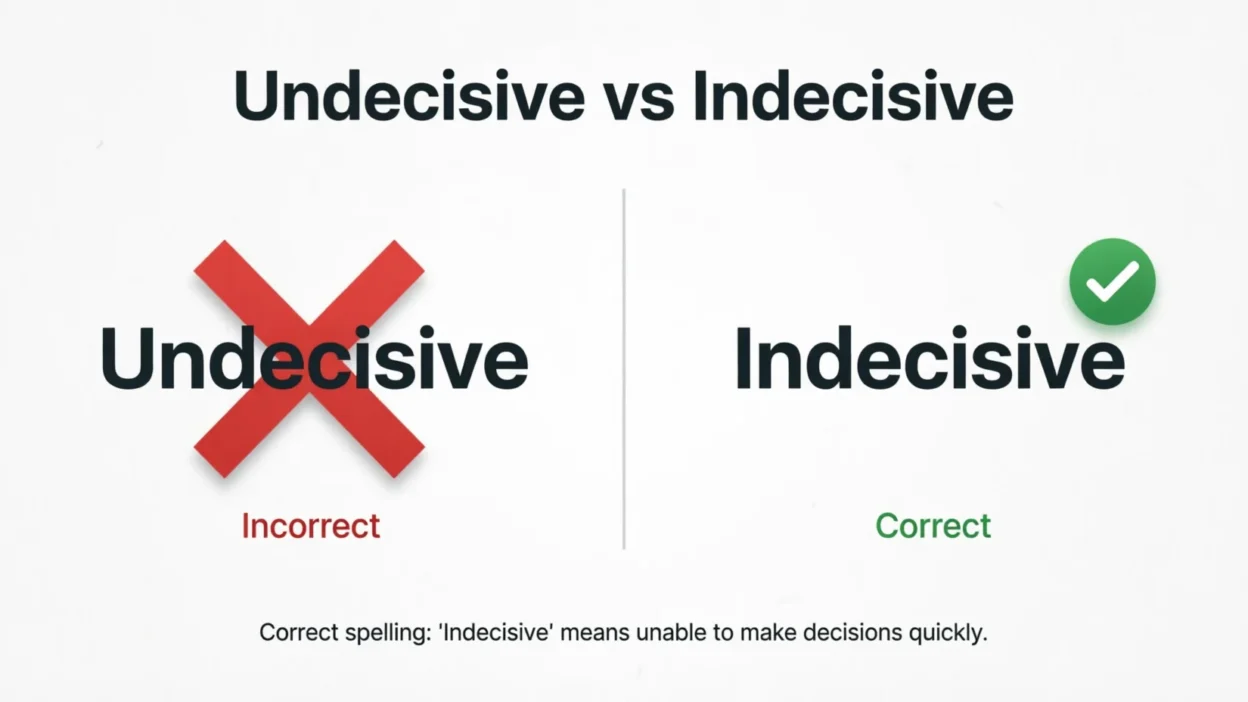
- ❌ Undecisive is incorrect
- ✅ Indecisive is the correct word
- 👉 Always use indecisive in writing and speech
What Does “Indecisive” Mean?
The word indecisive is an adjective used to describe someone who has difficulty making decisions or is uncertain between choices.
Core meanings of “indecisive”:
- Unable to make a decision easily
- Hesitant or uncertain
- Lacking clear direction or commitment
Examples:
- He is very indecisive when choosing what to eat.
- Her indecisive nature slowed the project.
- The results were indecisive, so no clear winner was declared.
LSI keywords and related phrases:
- hesitant
- unsure
- uncertain
- wavering
- doubtful
- irresolute
- ambivalent
These related terms improve clarity and help your content rank better in search engines.
What Is “Undecisive”? Is It Ever Correct?
Let’s be clear:
👉 “Undecisive” is not considered correct in standard English.
While you might occasionally hear it in casual speech, it is not accepted in formal or professional writing.
Why people use “undecisive”:
- Confusion between prefixes “un-” and “in-”
- Assuming “un-” works like in “uncertain” or “unhappy”
- Habit or informal speech
- Lack of proofreading
Important:
- ❌ Undecisive → Incorrect or nonstandard
- ✅ Indecisive → Correct
Undecisive vs Indecisive: Side-by-Side Comparison
| Feature | Undecisive ❌ | Indecisive ✅ |
|---|---|---|
| Correct spelling | No (nonstandard) | Yes |
| Meaning | Not accepted formally | Unable to make decisions |
| Usage | Avoid in writing | Standard English |
| Grammar | Incorrect | Correct adjective |
| Example | ✖ He is undecisive | ✔ He is indecisive |
Why “Indecisive” Is the Correct Form
The confusion comes from English prefixes.
Key rule:
- The prefix “in-” often means “not”
- It is commonly used before words starting with certain letters
Examples:
- indecisive (not decisive)
- incorrect (not correct)
- incomplete (not complete)
Why not “un-”?
While “un-” also means “not,” it doesn’t fit naturally with every word. English has established patterns, and “indecisive” is the accepted form.
Memory trick:
👉 Think: “In doubt = indecisive”
Or:
👉 “If you can’t decide, you’re IN-deciding → indecisive.”
How to Use “Indecisive” Correctly
The word indecisive is widely used in different contexts.
1. Describing people
- She is too indecisive to choose quickly.
- He felt indecisive about the offer.
2. Describing actions or behavior
- His indecisive attitude caused delays.
- The team’s indecisive approach affected results.
3. Describing outcomes
- The match ended in an indecisive result.
- The experiment produced indecisive data.
Example sentences:
- Being indecisive can lead to missed opportunities.
- Try not to be indecisive under pressure.
- Her indecisive nature made planning difficult.
Common Mistakes to Avoid
Here are the most frequent errors writers make:
1. Using “undecisive”
- ❌ Undecisive
- ✅ Indecisive
2. Mixing prefixes incorrectly
Not all “un-” words work the same way.
3. Writing based on sound
Both words sound similar, but only one is correct.
4. Skipping proofreading
Small mistakes can easily slip through.
👉 Tip: When in doubt, stick with indecisive.
Indecisive in Different Contexts
Understanding where the word fits can help you remember it better.
Personal life:
- Indecisive about career choices
- Indecisive in relationships
Business:
- Indecisive leadership
- Indecisive decision-making
Psychology:
- Indecisive personality traits
- Chronic indecision
Sports or results:
- Indecisive outcomes
- No clear winner
👉 In every case, the correct word is indecisive.
American vs British English Differences
There is no difference between American and British English here.
- ✅ Indecisive is correct in both
- ❌ Undecisive is incorrect in both
Key takeaway:
The rule is universal.
Synonyms and Alternatives for “Indecisive”
To make your writing more engaging, try these alternatives:
For hesitation:
- hesitant
- unsure
- uncertain
- doubtful
For lack of decision:
- irresolute
- wavering
- ambivalent
- vacillating
Examples:
- An indecisive person → A hesitant person
- Indecisive behavior → Uncertain behavior
Using synonyms adds variety and improves readability.
Real-Life Usage Examples
Here’s how indecisive appears in everyday situations:
Casual:
- I’m too indecisive to pick a movie.
Professional:
- The manager seemed indecisive during the meeting.
Academic:
- The findings were indecisive and required further study.
Social:
- Her indecisive nature made planning difficult.
Personal growth:
- Overcoming indecisiveness can boost confidence.
FAQs About Undecisive vs Indecisive
Is “undecisive” ever correct?
No, it is considered nonstandard and incorrect in formal English.
What is the correct word?
The correct word is indecisive.
Why do people say “undecisive”?
Because they confuse the prefixes “un-” and “in-.”
Is “indecisive” an adjective?
Yes, it describes someone who struggles to make decisions.
Can “indecisive” describe results?
Yes, it can describe unclear or inconclusive outcomes.
Is there a British vs American difference?
No, both use “indecisive.”
How can I remember the correct word?
Think: “in doubt = indecisive.”
Does using “undecisive” affect credibility?
Yes, it can make your writing seem less polished.
Summary:
The difference between undecisive vs indecisive is clear once you understand the rule. Indecisive is the correct and widely accepted word, while undecisive is nonstandard and should be avoided in proper writing.
Because this word is often used to describe behavior, decisions, and outcomes, using the correct form helps your message sound more professional and trustworthy.
Actionable Takeaway
Here’s the simple rule to remember:
👉 Always use indecisive, never undecisive
Before submitting or publishing your work, take a moment to check for common spelling errors. Fixing small mistakes like this can significantly improve your writing clarity and confidence.