If you’ve ever wondered whether to use “anyone” or “anybody,” you’re not alone. These two words often appear interchangeable, and in many situations, they actually are. However, there are subtle differences in tone, style, and usage that can make one choice sound more natural than the other.
The good news is that both words have nearly the same meaning. Understanding the small distinctions between anyone vs anybody will help you communicate more clearly and confidently in both spoken and written English.
Quick Answer
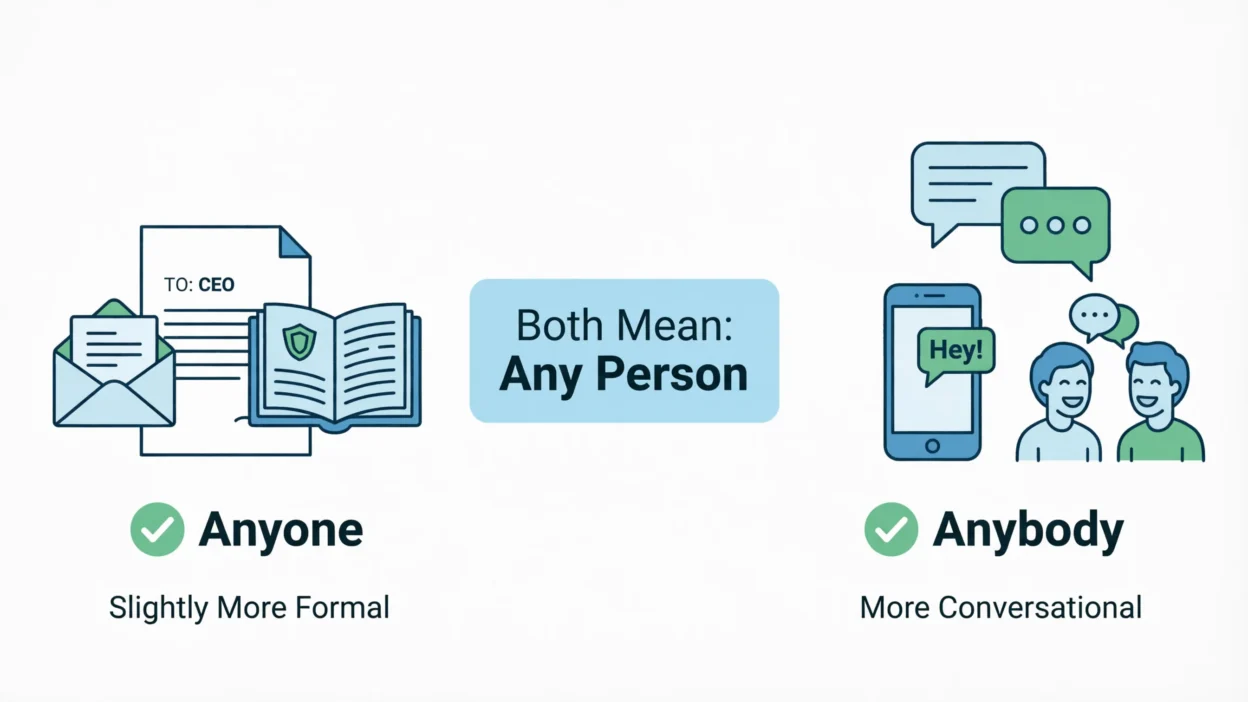
- Anyone ✅ means any person and is slightly more common in formal writing.
- Anybody ✅ also means any person and is often considered a bit more conversational.
👉 In most situations, anyone and anybody can be used interchangeably.
What Does “Anyone” Mean?
The word anyone is an indefinite pronoun that refers to any person, regardless of who that person is.
Simple definition:
Anyone = any person
Examples:
- Can anyone help me with this problem?
- I don’t know anyone in the city.
- If anyone calls, tell them I’m busy.
In each example, the speaker is referring to no specific person.
What Does “Anybody” Mean?
The word anybody is also an indefinite pronoun that means any person.
Simple definition:
Anybody = any person
Examples:
- Does anybody have a pen?
- I didn’t see anybody at the meeting.
- Anybody can learn a new skill with practice.
The meaning is essentially identical to anyone.
Anyone vs Anybody: Key Differences
| Feature | Anyone ✅ | Anybody ✅ |
|---|---|---|
| Meaning | Any person | Any person |
| Formality | Slightly more formal | Slightly more casual |
| Usage | Common in writing | Common in conversation |
| Grammar | Indefinite pronoun | Indefinite pronoun |
| Interchangeable? | Usually yes | Usually yes |
Are Anyone and Anybody Interchangeable?
In most cases, yes.
Examples:
✅ Anyone:
- Is anyone home?
✅ Anybody:
- Is anybody home?
Both sentences are correct and mean exactly the same thing.
Similarly:
- I don’t know anyone here.
- I don’t know anybody here.
The meaning remains unchanged.
Subtle Difference in Tone
Although the definitions are the same, some native speakers perceive a slight difference in style.
Anyone
Often sounds:
- Slightly more formal
- More common in professional writing
- A bit more polished
Anybody
Often sounds:
- More casual
- More conversational
- Slightly friendlier in everyday speech
Example:
Formal:
- If anyone has questions, please contact the manager.
Casual:
- Does anybody want pizza?
Both are correct, but the tone differs slightly.
Common Mistakes to Avoid
Mistake 1: Thinking one is grammatically wrong
❌ Incorrect assumption:
- Only “anyone” is correct.
✅ Correct:
- Both anyone and anybody are correct.
Mistake 2: Using them inconsistently
While not a grammar error, sticking to one form throughout a document often improves consistency.
Mistake 3: Confusing “anyone” with “any one”
These are different expressions.
Example:
Anyone:
- Can anyone answer this question?
Any one:
- Any one of these books will work.
How to Use “Anyone” Correctly
1. Formal communication:
- If anyone requires assistance, please ask.
2. Professional writing:
- Has anyone submitted the report?
3. General statements:
- Anyone can improve with practice.
How to Use “Anybody” Correctly
1. Everyday conversation:
- Does anybody know the answer?
2. Informal writing:
- I didn’t tell anybody about the surprise.
3. Friendly invitations:
- Can anybody join the game?
Synonyms and Related Words (LSI Keywords)
Using related terms can enrich your writing naturally.
Synonyms:
- Any person
- Whoever
- Someone
- Somebody
- Everyone (depending on context)
Related phrases:
- Anybody else
- Anyone else
- Anyone can
- Anybody can
- Any person
Example:
- Anyone can succeed with effort.
- Any person can succeed with effort.
Anyone vs Somebody
People also compare these words frequently.
| Word | Meaning |
|---|---|
| Anyone | Any person at all |
| Somebody | A particular but unspecified person |
Example:
- Anyone can enter the contest.
- Somebody left their keys here.
American vs British English Differences
There is no significant difference between American and British English.
American English:
- Anyone ✅
- Anybody ✅
British English:
- Anyone ✅
- Anybody ✅
Both forms are common and accepted in both varieties of English.
When Should You Use “Anyone”?
Use anyone when:
- Writing professionally
- Creating academic content
- You prefer a slightly more formal tone
Examples:
- Has anyone completed the survey?
- If anyone objects, speak now.
When Should You Use “Anybody”?
Use anybody when:
- Speaking casually
- Writing conversational content
- Creating a friendly tone
Examples:
- Does anybody need help?
- Can anybody recommend a movie?
Memory Trick to Remember the Difference
Here’s a simple trick:
👉 Anyone = slightly more formal.
👉 Anybody = slightly more conversational.
But remember:
Both mean “any person.”
FAQs About Anyone vs Anybody
1. What is the difference between anyone and anybody?
The meaning is the same. The main difference is tone: anyone sounds slightly more formal, while anybody sounds slightly more casual.
2. Are anyone and anybody interchangeable?
Yes. In most situations, they can be used interchangeably.
3. Which is more common in writing?
Anyone is often preferred in formal and professional writing.
4. Which is more common in speech?
Anybody is slightly more common in casual conversation.
5. Is anybody informal?
Not exactly informal, but it generally sounds more conversational.
6. Can I use either word in emails?
Yes. Both are grammatically correct.
7. Is “anyone” one word?
Yes. When referring to a person, anyone is one word.
8. What is the difference between “anyone” and “any one”?
Anyone means any person. Any one refers to a specific item from a group.
Final Summary
The difference between anyone vs anybody is very small. Both words mean “any person” and can usually be used interchangeably without changing the meaning of a sentence. The primary distinction is tone: anyone often sounds slightly more formal, while anybody tends to feel more conversational and relaxed.
Because both forms are accepted in American and British English, the choice often comes down to personal preference and writing style. Understanding this subtle difference allows you to match the tone of your message more effectively.
Actionable Takeaway
Next time you’re writing:
- ✅ Use anyone for a slightly more formal or professional tone.
- ✅ Use anybody for casual conversations and friendly writing.
- ✅ Remember that both mean “any person.”
- ❌ Don’t worry about major grammatical differences—they’re largely interchangeable.
Think: Anyone and anybody mean the same thing; only the tone changes slightly