If you’ve ever wondered whether to use “relieve” or “relief,” you’re not alone. These two words are closely related, share the same root, and are often used in similar situations involving stress, pain, comfort, or assistance. Because of this, many people accidentally use one when they mean the other.
The good news is that the difference is straightforward. Once you understand how each word functions in a sentence, you’ll be able to use relieve and relief correctly every time. This guide covers meanings, examples, common mistakes, a comparison table, and practical tips to help you remember the difference.
Quick Answer
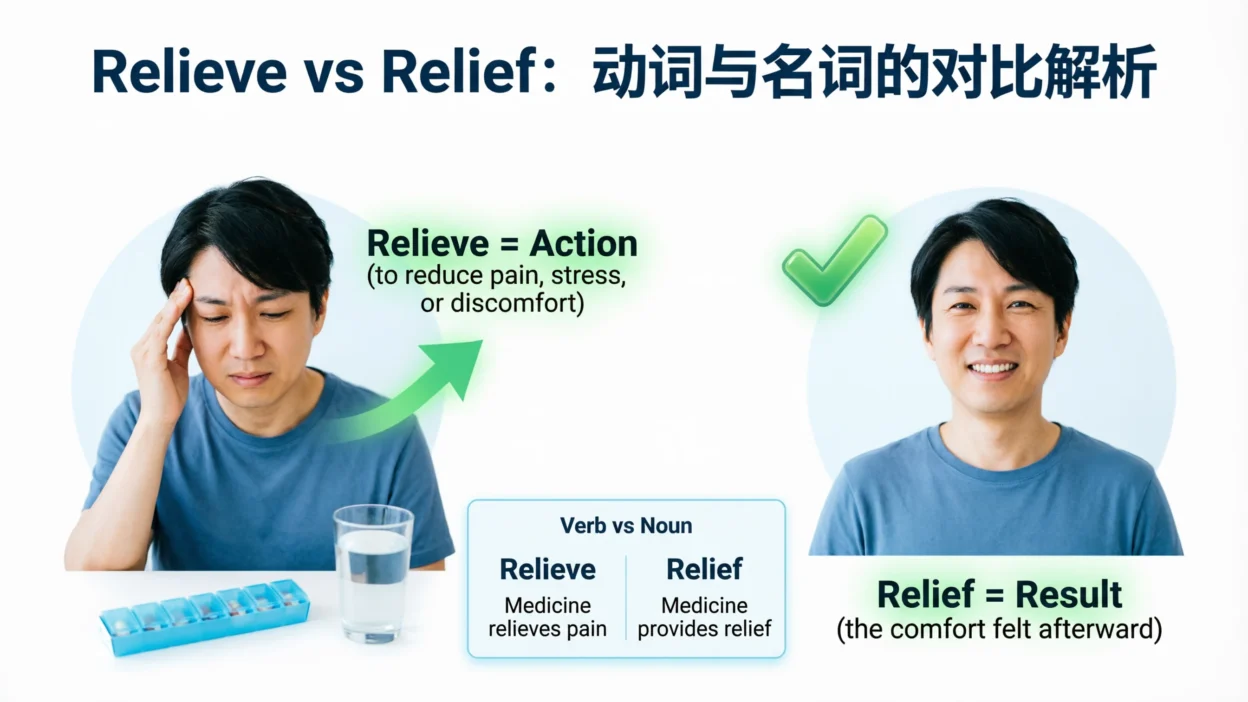
- Relieve ✅ is a verb that means to reduce, ease, or remove pain, stress, or discomfort.
- Relief ✅ is a noun that refers to the feeling or result of having pain, stress, or difficulty reduced.
👉 Relieve is the action. Relief is the result.
What Does “Relieve” Mean?
The word relieve is a verb. It describes the action of making something less severe, painful, stressful, or difficult.
Simple definition:
Relieve = to reduce or remove discomfort, pain, stress, or pressure
Examples:
- This medicine can relieve headaches.
- A short walk helped relieve her stress.
- Deep breathing exercises may relieve anxiety.
In each example, relieve describes an action that improves a situation.
What Does “Relief” Mean?
The word relief is a noun. It refers to the comfort, ease, or improvement experienced after a problem, pain, or stress has been reduced.
Simple definition:
Relief = the feeling of comfort after pain, stress, or worry is reduced
Examples:
- She felt great relief after receiving the good news.
- The medication provided immediate relief.
- It was a relief to finish the project on time.
Here, relief is the outcome or feeling that follows the action.
Relieve vs Relief: Key Differences
| Feature | Relieve ✅ | Relief ✅ |
|---|---|---|
| Part of Speech | Verb | Noun |
| Meaning | To reduce pain, stress, or discomfort | The comfort that follows |
| Function | Action | Result |
| Example | The medicine relieves pain. | The medicine provides relief. |
| Question Answered | What happens? | What is experienced? |
Why Do People Confuse Relieve and Relief?
These words are commonly confused because they:
- Have nearly identical spellings
- Share the same root meaning
- Often appear in the same context
- Relate to pain, stress, comfort, and assistance
Example:
- The treatment relieved my pain.
- The treatment brought relief from pain.
Both sentences discuss the same situation but use different parts of speech.
Common Mistakes to Avoid
Mistake 1: Using “relief” as a verb
❌ Incorrect:
- This medicine will relief your headache.
✅ Correct:
- This medicine will relieve your headache.
Mistake 2: Using “relieve” as a noun
❌ Incorrect:
- I felt a huge relieve after the exam.
✅ Correct:
- I felt a huge relief after the exam.
Mistake 3: Mixing action and result
Remember:
- Relieve = what happens
- Relief = what you feel
How to Use “Relieve” Correctly
Use relieve whenever you’re talking about reducing or easing a problem.
Physical pain:
- The cream helps relieve muscle soreness.
- Ice packs can relieve swelling.
Emotional stress:
- Talking to a friend can relieve anxiety.
- Vacation time helps relieve work pressure.
Pressure or burden:
- Hiring additional staff may relieve the workload.
How to Use “Relief” Correctly
Use relief when referring to the feeling or benefit that results from improvement.
Emotional relief:
- I felt relief when the test results arrived.
- Her smile showed obvious relief.
Medical relief:
- The medication offered quick relief.
- Patients seek relief from chronic pain.
Financial relief:
- The program provided financial relief to families.
Synonyms and Related Words (LSI Keywords)
Including related words can improve understanding and SEO relevance.
Synonyms for Relieve:
- Ease
- Reduce
- Alleviate
- Lessen
- Mitigate
- Comfort
Synonyms for Relief:
- Comfort
- Ease
- Reassurance
- Assistance
- Support
- Alleviation
Related phrases:
- Pain relief
- Stress relief
- Financial relief
- Relieve pressure
- Relieve symptoms
- Relief fund
American vs British English Differences
There is no significant difference between American and British English for these words.
American English:
- Relieve
- Relief
British English:
- Relieve
- Relief
The spelling, meaning, and usage remain the same in both varieties of English.
When Should You Use “Relieve”?
Use relieve when:
- An action is being performed
- Something is being reduced or eased
- You’re describing a process
Examples:
- This treatment may relieve discomfort.
- Exercise helps relieve stress.
When Should You Use “Relief”?
Use relief when:
- Referring to a feeling or result
- Talking about comfort after difficulty
- Describing assistance or support
Examples:
- The news brought relief.
- We experienced immediate relief.
Memory Trick to Remember the Difference
Here’s a simple trick:
👉 Relieve ends with “-eve” = an event or action.
👉 Relief ends with “-ief” = the feeling you experience afterward.
Think:
- Relieve = action
- Relief = result
FAQs About Relieve vs Relief
1. What is the difference between relieve and relief?
Relieve is a verb meaning to reduce pain or stress, while relief is the noun describing the comfort that follows.
2. Is it “pain relieve” or “pain relief”?
The correct phrase is pain relief.
3. Can relief be used as a verb?
No. Relief is a noun.
4. Can relieve be used as a noun?
No. Relieve is a verb.
5. Which comes first: relieve or relief?
Usually, something relieves a problem, which then creates relief.
6. What are common examples of relief?
- Stress relief
- Pain relief
- Financial relief
- Emotional relief
7. Is “relief” always positive?
Generally, yes. It refers to reduced difficulty, discomfort, or worry.
8. How can I remember the difference?
Remember: Relieve is the action. Relief is the feeling afterward.
Final Summary
The difference between relieve vs relief is mainly grammatical. Relieve is a verb that means to reduce pain, stress, discomfort, or pressure. Relief is a noun that describes the comfort, ease, or improvement that follows. While the words are closely connected, they cannot be used interchangeably.
Understanding this distinction helps you write more accurately and naturally in both personal and professional communication. Whether you’re discussing medical treatment, emotional stress, or financial support, choosing the correct word improves clarity and confidence.
Actionable Takeaway
Next time you’re writing:
- ✅ Use relieve when describing an action that reduces a problem.
- ✅ Use relief when describing the comfort or benefit that results.
- ❌ Don’t use relief as a verb or relieve as a noun.
Remember: something relieves you, and then you feel relief.