Have you ever described someone as “undecisive” and then wondered if that was actually a real word? You’re not alone. Many English speakers mix up “indecisive” and “undecisive” because both seem logical and appear to mean the same thing.
However, only one of these words is widely accepted in standard English. In this guide, you’ll learn the difference between indecisive vs undecisive, their meanings, examples, common mistakes, and which word you should use in everyday and professional writing.
Quick Answer
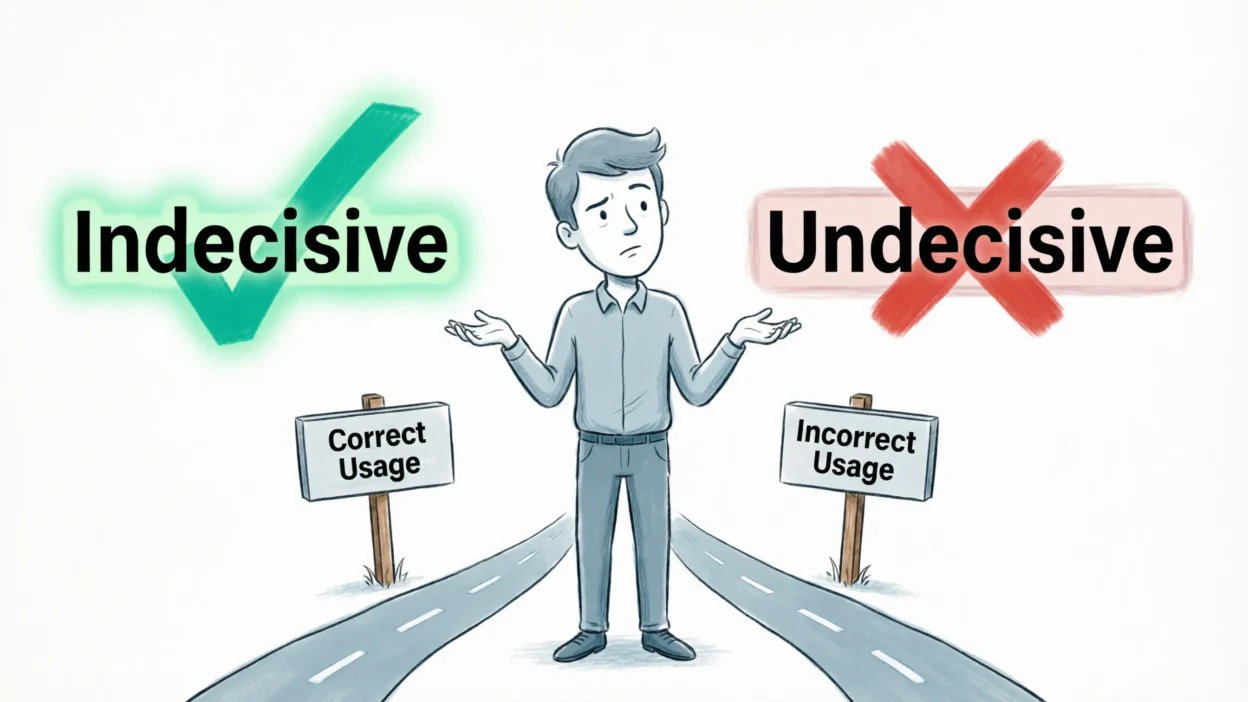
- “Indecisive” ✅ is the correct and standard English word.
- “Undecisive” ❌ is generally considered incorrect or nonstandard.
👉 If you’re describing someone who struggles to make decisions, always use “indecisive.”
What Does “Indecisive” Mean?
The word “indecisive” is an adjective used to describe a person who has difficulty making decisions or choosing between options.
Simple definition:
Indecisive = unable or unwilling to make decisions quickly
Examples:
- She is very indecisive when ordering food.
- His indecisive nature made the project take longer.
- I’m feeling indecisive about which laptop to buy.
The word is commonly used in:
- Everyday conversations
- Psychology and personality discussions
- Workplace and leadership contexts
What About “Undecisive”?
The word “undecisive” occasionally appears in speech and writing, but it is generally considered nonstandard English.
Important:
Most dictionaries, style guides, editors, and grammar checkers recommend using “indecisive” instead.
Why does it exist?
People often assume that since words like:
- happy → unhappy
- certain → uncertain
- clear → unclear
follow the un- pattern, the opposite of “decisive” should naturally be “undecisive.”
However, English already has an established word for that meaning: indecisive.
Indecisive vs Undecisive: Key Differences
| Feature | Indecisive ✅ | Undecisive ❌ |
|---|---|---|
| Correct word? | Yes | Generally no |
| Dictionary acceptance | Widely accepted | Limited or nonstandard |
| Meaning | Unable to make decisions easily | Intended to mean the same thing |
| Professional writing | Recommended | Avoid |
| Grammar checkers | Accept | Often flag as incorrect |
Why Do People Confuse “Indecisive” and “Undecisive”?
This confusion happens because English uses several negative prefixes.
Common negative prefixes:
- in- (indecisive, inaccurate)
- un- (unhappy, unfair)
- dis- (disagree, disconnect)
Since there’s no simple rule that applies to every word, learners often guess incorrectly.
Examples:
- decisive → indecisive ✅
- accurate → inaccurate ✅
- fair → unfair ✅
English vocabulary often follows historical usage rather than strict logic.
Is “Undecisive” Ever Correct?
In modern standard English, “undecisive” is generally avoided.
While you may occasionally encounter it:
- In informal speech
- In older texts
- In regional usage
it is not the preferred form.
Best practice:
Always choose “indecisive.”
Common Mistakes to Avoid
Mistake 1: Using “undecisive” in formal writing
❌ Incorrect:
- The manager was undecisive during the meeting.
✅ Correct:
- The manager was indecisive during the meeting.
Mistake 2: Assuming both words are equally accepted
❌ Incorrect assumption:
- “Undecisive” is just another spelling.
✅ Correct:
- “Indecisive” is the standard and preferred word.
How to Use “Indecisive” Correctly
1. Describing personality traits:
- He is naturally indecisive.
- An indecisive leader can create confusion.
2. Talking about choices:
- I’m indecisive about where to travel this year.
- She felt indecisive between the two job offers.
3. In professional settings:
- Being overly indecisive can slow decision-making.
Synonyms and Related Words (LSI Keywords)
Using related words can strengthen your writing and improve readability.
Synonyms:
- Hesitant
- Uncertain
- Wavering
- Unsure
- Vacillating
- Ambivalent
Related phrases:
- Difficulty making decisions
- Unable to choose
- Lack of decisiveness
- Decision-making struggles
- Hesitation
Example:
- He was indecisive about the purchase.
- He was hesitant about the purchase.
American vs British English Differences
There is no significant difference between American and British English here.
- ✅ Indecisive is the accepted standard spelling in both.
- ❌ Undecisive is generally considered nonstandard in both.
Regardless of where you’re writing, indecisive is the safest choice.
When Should You Use “Indecisive”?
Use “indecisive” when describing:
- Difficulty making choices
- Hesitation between options
- Lack of confidence in decisions
Common contexts:
- Personal relationships
- Career decisions
- Shopping choices
- Leadership and management
- Academic discussions
Memory Trick to Remember the Difference
Here’s an easy trick:
👉 “Indecisive” is in the dictionary and in common usage.
Think:
- IN = accepted IN English
- UN = usually not accepted here
When in doubt, choose indecisive.
FAQs About Indecisive vs Undecisive
1. Is “undecisive” a real word?
It appears in some usage, but it is generally considered nonstandard and should be avoided.
2. Which is correct: indecisive or undecisive?
Indecisive is the correct and widely accepted word.
3. What does “indecisive” mean?
It means having difficulty making decisions or choosing between options.
4. Why do people say “undecisive”?
Because they assume the opposite of “decisive” should use the prefix un-.
5. Is “undecisive” grammatically wrong?
In standard English, it is generally viewed as incorrect or nonstandard.
6. Can I use “undecisive” in professional writing?
No. Use indecisive instead.
7. What are synonyms for “indecisive”?
Hesitant, uncertain, wavering, unsure, and ambivalent.
8. Is there a British English version of “undecisive”?
No. Both British and American English prefer indecisive.
Final Summary
The difference between indecisive vs undecisive is straightforward. “Indecisive” is the correct, standard English word used to describe someone who struggles to make decisions. It is accepted by dictionaries, style guides, and grammar experts across both American and British English.
While “undecisive” may occasionally appear in conversation or informal writing, it is generally considered nonstandard and should be avoided. Choosing indecisive will make your writing clearer, more professional, and grammatically accurate.
Actionable Takeaway
Next time you’re describing someone who can’t make up their mind:
- ✅ Use “indecisive” in all forms of writing
- ❌ Avoid “undecisive” in professional, academic, and formal contexts
Remember: the standard English word is always “indecisive.”