If you’ve ever wondered whether to use “sitting” or “seating,” you’re not alone. These two words are closely related and often appear in similar contexts involving chairs, people, and arrangements. Because of this, many English learners and native speakers occasionally mix them up.
The good news is that the distinction is fairly simple. Understanding when to use sitting and when to use seating can make your writing sound more natural and professional. In this guide, we’ll explain the meanings, provide examples, highlight common mistakes, and help you confidently choose the right word every time.
Quick Answer
- Sitting ✅ refers to the act of being seated or remaining in a seated position.
- Seating ✅ refers to the arrangement, capacity, or act of providing seats.
👉 Use sitting when talking about a person’s position and seating when talking about seats or seating arrangements.
What Does “Sitting” Mean?
The word sitting is the present participle of the verb sit. It describes someone who is in a seated position.
Simple definition:
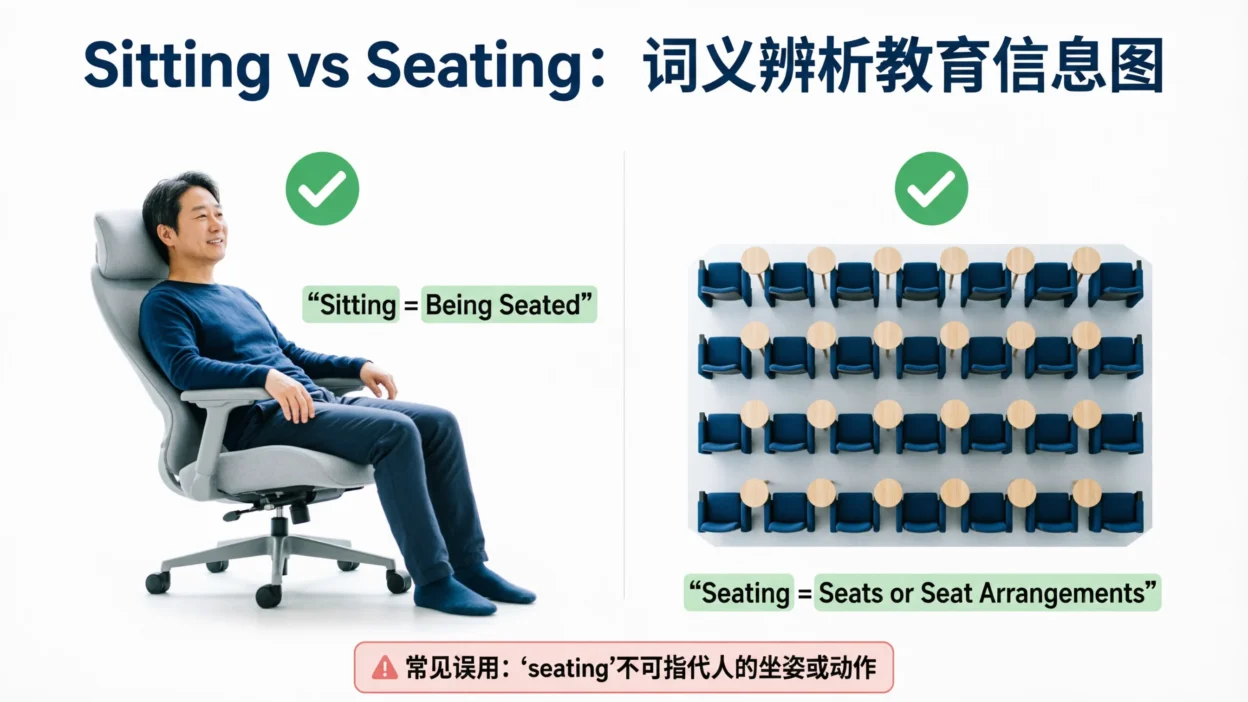
Sitting = being seated or remaining seated
Examples:
- She is sitting by the window.
- We were sitting quietly during the presentation.
- The cat is sitting on the sofa.
In these examples, sitting describes the position of a person or animal.
What Does “Seating” Mean?
The word seating usually refers to seats, seating arrangements, or the capacity of a place.
Simple definition:
Seating = seats, seat availability, or the arrangement of seats
Examples:
- The restaurant has outdoor seating.
- Stadium seating can accommodate 50,000 people.
- Reserved seating is available for VIP guests.
It can also refer to the act of guiding someone to a seat:
- The hostess was seating guests at the entrance.
Sitting vs Seating: Key Differences
| Feature | Sitting ✅ | Seating ✅ |
|---|---|---|
| Meaning | Being in a seated position | Seats or seat arrangements |
| Part of Speech | Verb (present participle) | Noun or verb |
| Focus | Person’s position | Availability or arrangement of seats |
| Example | She is sitting down. | The seating is comfortable. |
| Common Context | People and posture | Venues, events, restaurants |
Why Do People Confuse Sitting and Seating?
The confusion happens because both words come from the verb sit and are related to chairs and positions.
Common reasons:
1. Similar meanings
Both words involve people being seated.
2. Shared root word
Since both derive from sit, they often appear in similar situations.
3. Event-related language
At weddings, conferences, and restaurants, you might see both words used together.
Example:
- Guests were sitting according to the seating chart.
Common Mistakes to Avoid
Mistake 1: Using “seating” when referring to a person’s position
❌ Incorrect:
- She is seating near the door.
✅ Correct:
- She is sitting near the door.
Mistake 2: Using “sitting” when discussing seat arrangements
❌ Incorrect:
- The theater offers comfortable sitting.
✅ Correct:
- The theater offers comfortable seating.
Mistake 3: Confusing “seating chart” and “sitting chart”
❌ Incorrect:
- Please check the sitting chart.
✅ Correct:
- Please check the seating chart.
How to Use “Sitting” Correctly
1. Describing position:
- He is sitting at his desk.
- They were sitting together.
2. Continuous actions:
- I’m sitting in traffic right now.
- We are sitting outside enjoying the weather.
3. Informal expressions:
- Don’t just keep sitting there!
- She’s been sitting on that decision for weeks.
How to Use “Seating” Correctly
1. Referring to seat arrangements:
- The wedding seating plan is finalized.
- Conference seating is assigned.
2. Referring to capacity:
- The arena has seating for 20,000 people.
- Limited seating is available.
3. Referring to placing people in seats:
- Staff members were seating guests quickly.
- The usher began seating attendees.
Synonyms and Related Words (LSI Keywords)
Including related words can improve understanding and SEO relevance.
Synonyms for Sitting:
- Seated
- Resting
- Perched
- Positioned
Synonyms for Seating:
- Seats
- Accommodation
- Arrangement
- Capacity
Related phrases:
- Seating chart
- Reserved seating
- Seating capacity
- Sitting position
- Sitting area
American vs British English Differences
There are no major spelling differences between American and British English for these words.
American English:
- Sitting
- Seating
British English:
- Sitting
- Seating
Both forms are used the same way in standard English across regions.
When Should You Use “Sitting”?
Use sitting when:
- Describing a person’s position
- Talking about remaining seated
- Referring to an ongoing action
Examples:
- The students are sitting quietly.
- He was sitting in the front row.
When Should You Use “Seating”?
Use seating when:
- Discussing seat arrangements
- Talking about venue capacity
- Referring to available seats
Examples:
- The restaurant’s outdoor seating is popular.
- Check the event’s seating plan before arrival.
Memory Trick to Remember the Difference
Here’s an easy way to remember:
👉 Sitting = Someone is sitting.
👉 Seating = Seats are involved.
Think:
- Sitting = Person’s position
- Seating = Seats and arrangements
FAQs About Sitting vs Seating
1. What is the difference between sitting and seating?
Sitting refers to being seated, while seating refers to seats or seat arrangements.
2. Is it “sitting area” or “seating area”?
Usually seating area is correct when referring to a place with seats.
3. Can “seating” be a verb?
Yes. Example: “The staff is seating guests.”
4. Is “sitting” a noun?
Yes, in some contexts. For example, a parliamentary sitting or a photography sitting.
5. What is a seating chart?
A diagram showing where people should sit at an event.
6. Is “sitting arrangement” correct?
While understandable, seating arrangement is much more common.
7. Can I say “the seating is full”?
Yes. It means all available seats are occupied.
8. Which is more common in event planning?
Seating is more common because it refers to seat assignments and arrangements.
Final Summary
The difference between sitting vs seating comes down to focus. Sitting describes a person’s position or action of being seated, while seating refers to seats, seating capacity, or seat arrangements. Although both words relate to sitting down, they serve different grammatical purposes and should not be used interchangeably.
Understanding this distinction can improve your writing, especially when discussing events, restaurants, venues, workplaces, or everyday situations. By choosing the correct word, you’ll communicate more clearly and naturally.
Actionable Takeaway
Next time you’re writing:
- ✅ Use sitting when describing someone who is seated.
- ✅ Use seating when discussing seats, capacity, or arrangements.
- ❌ Don’t use them interchangeably.
Remember: people are sitting, but venues provide seating.