The difference between farther vs further confuses many English speakers because the two words are extremely similar in spelling, pronunciation, and meaning. In everyday conversation, people often use them interchangeably without noticing. However, traditional grammar rules do distinguish between the two.
If you have ever paused while writing a sentence like “We need to discuss this further” or “The store is farther away,” you are not alone. Understanding the subtle difference can improve your writing clarity and help you sound more polished in academic, professional, and casual communication.
In this guide, you will learn the meanings of “farther” and “further,” discover when each word should be used, explore practical examples, avoid common grammar mistakes, and understand how American and British English handle these terms today.
Quick Answer
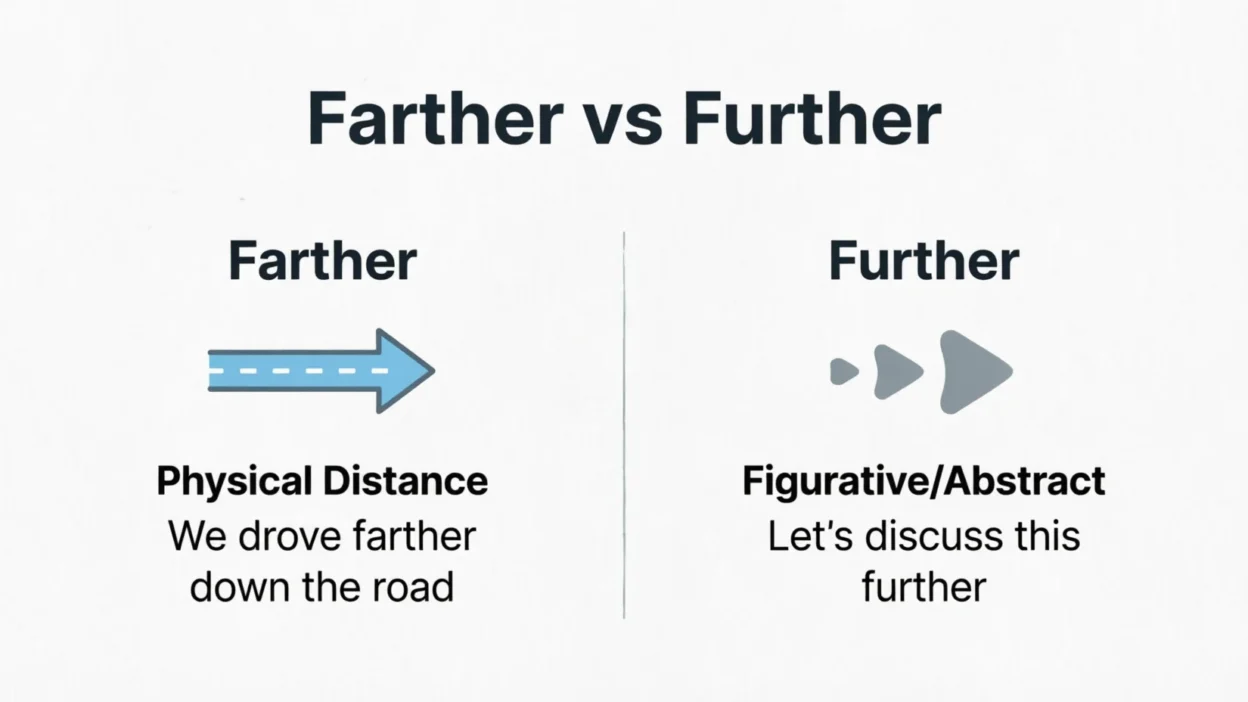
Traditionally, farther refers to physical distance, while further refers to figurative distance, additional information, or advancement.
Examples:
- The park is farther from here. ✅
- We need to discuss this further. ✅
However, in modern English, “further” is often accepted in both situations.
What Does “Farther” Mean?
“Farther” traditionally refers to measurable physical distance.
You use it when talking about:
- locations
- travel
- movement
- geographic space
- measurable distances
Examples of Farther
- The gas station is farther down the road.
- She ran farther than her brother.
- Our hotel was farther from the beach than expected.
- Can you throw the ball farther?
Easy Memory Tip
“Farther” contains the word “far,” which helps remind you that it relates to physical distance.
What Does “Further” Mean?
“Further” usually refers to:
- additional information
- figurative distance
- advancement
- continuation
- deeper discussion
It often means:
- more
- additional
- beyond this point
Examples of Further
- We need further explanation.
- The investigation continued further.
- For further information, contact customer service.
- She wants to further her education.
Common Uses of Further
“Further” can function as:
- adjective
- adverb
- verb
Examples:
- further discussion
- move further ahead
- further your career
Farther vs Further Comparison Table
| Word | Main Meaning | Usage Type | Example |
|---|---|---|---|
| Farther | Physical distance | Literal | The school is farther away |
| Further | Additional or figurative distance | Figurative/Abstract | We need further details |
The Traditional Grammar Rule
Many grammar guides teach this simple distinction:
Use “Farther” for Physical Distance
Correct:
- The mountain is farther away than we thought.
Use “Further” for Figurative or Abstract Ideas
Correct:
- Let’s discuss this further.
This rule works well in most situations and helps writers choose confidently.
Why People Mix Up Farther and Further
The confusion happens for several reasons.
Similar Pronunciation
The words sound extremely similar in spoken English.
Overlapping Meanings
Modern English increasingly allows “further” in situations involving physical distance.
Example:
- The cabin is further down the road. ✅
This is widely accepted today.
Regional and Style Differences
Different style guides treat the words differently. Some enforce the traditional distinction strictly, while others allow flexibility.
Modern Usage Trends
Today, “further” is becoming more common overall.
In Everyday English
Many native speakers use “further” for both literal and figurative meanings.
Examples:
- We drove further than expected.
- We discussed the issue further.
In Formal Writing
Professional and academic writers often still follow the traditional distinction for clarity.
Examples of Farther in Sentences
Using “farther” correctly becomes easier with practice.
Distance Examples
- Their new house is farther from downtown.
- He walked farther than anyone else.
- The river is farther north.
- We traveled farther this summer.
Sports and Measurement Examples
- She jumped farther than her competitor.
- Can this drone fly farther?
Examples of Further in Sentences
“Further” works naturally in many abstract contexts.
Discussion and Information
- We need further evidence.
- No further questions were asked.
- Please provide further clarification.
Personal Growth and Progress
- She hopes to further her career.
- The course helped further his knowledge.
Continuation
- Further delays are possible.
- We will review the matter further tomorrow.
Common Mistakes With Farther vs Further
Understanding mistakes helps improve writing quickly.
Mistake 1: Using Farther for Abstract Ideas
Incorrect:
- We need farther information. ❌
Correct:
- We need further information. ✅
Mistake 2: Overthinking Every Sentence
In modern English, “further” is acceptable in many distance contexts.
So while:
- farther = traditional physical distance
“Further” is not usually considered wrong.
Mistake 3: Using Further as a Verb Incorrectly
Correct:
- She wants to further her studies.
Incorrect:
- She wants to farther her studies. ❌
Only “further” works as a verb.
Practical Example Paragraphs
Real examples make the distinction easier to understand naturally.
Example Using Farther
After checking the map, we realized the campsite was much farther away than expected. Even though the hike became tiring, the mountain views made the extra distance worthwhile.
Example Using Further
The manager requested further information before approving the project. She wanted further clarification about the timeline and overall budget.
Placement and Grammar Rules Table
| Word/Phrase | Sentence Placement | Tone | Example Sentence |
|---|---|---|---|
| Farther | Physical distance references | Neutral | The station is farther away |
| Further information | Formal and professional writing | Formal | Please send further details |
| Further discussion | Academic/business usage | Professional | Further discussion is needed |
| Further as verb | Advancement/progress | Formal | Education can further careers |
American vs British English Differences
Both American and British English use “farther” and “further,” but usage patterns vary slightly.
American English
American style guides often preserve the traditional distinction more strongly:
- farther = physical distance
- further = figurative meaning
British English
British English tends to use “further” more broadly, even for physical distance.
Example:
- The shop is further down the street. ✅
This is common and accepted in the UK.
Synonyms and Related Words
Using related words improves vocabulary variety and SEO naturally.
Synonyms for Farther
- more distant
- farther away
- beyond
- more remote
Synonyms for Further
- additional
- extra
- supplementary
- continued
- advanced
Related Grammar Searches
People searching for “farther vs further” also often search for:
- affect vs effect
- onto vs on to
- anyway vs anyways
- farther or further away
- less vs fewer
Helpful Memory Trick
A quick memory trick can help you remember the difference instantly.
Farther = Far
Since “farther” contains “far,” use it for physical distance.
Example:
- The beach is farther away.
Further = Further Discussion
Think of:
- further information
- further explanation
- further progress
These are abstract ideas rather than measurable distances.
Why Correct Usage Matters
Choosing the right word improves:
- clarity
- professionalism
- readability
- writing precision
This matters especially in:
- academic writing
- business communication
- journalism
- blog posts
- professional emails
Even small grammar improvements can strengthen reader trust and understanding.
FAQs About Farther vs Further
What is the difference between farther and further?
“Farther” traditionally refers to physical distance, while “further” refers to figurative or additional ideas.
Can further refer to distance?
Yes. Modern English often accepts “further” for physical distance too.
Which is more formal: farther or further?
Both are formal, but “further” appears more often in professional and academic writing.
Is farther still necessary?
Yes. Many writers still use it to create clearer distinctions in meaning.
Can I say “further away”?
Yes. It is widely accepted in modern English.
Is “farther” used in British English?
Yes, but British English often prefers “further” overall.
Which word should I use in essays?
Following the traditional rule is usually safest in formal writing.
Final Thoughts
The difference between farther vs further becomes much easier once you understand the traditional grammar rule. “Farther” usually refers to physical distance, while “further” relates to abstract ideas, additional information, or progress. Still, modern English increasingly accepts “further” in both contexts.
Using these words correctly can make your writing clearer and more professional. Whether you are writing emails, essays, reports, or blog articles, understanding this distinction helps improve communication and confidence.
Actionable Takeaway
Use farther when discussing measurable physical distance and further when talking about ideas, discussion, progress, or additional information. When unsure, remember:
- farther = far distance
- further = further discussion
This simple trick will help you choose the correct word naturally.