English spelling mistakes often happen because words sound alike even when they follow different grammar rules. One common confusion is laid out vs layed out. Many people naturally type “layed out” because it seems to follow the regular “-ed” verb pattern found in words like “played” or “stayed.”
However, the verb “lay” is irregular, which changes the spelling completely in the past tense. That means “laid out” is the correct phrase, while “layed out” is considered incorrect in standard English.
Whether you are writing a business email, social media caption, school assignment, or professional report, using the correct phrase helps your writing appear polished and trustworthy. In this guide, you will learn the difference between “laid out” and “layed out,” understand the grammar rule behind the phrase, see practical examples, avoid common mistakes, and gain confidence using the correct spelling naturally.
Quick Answer
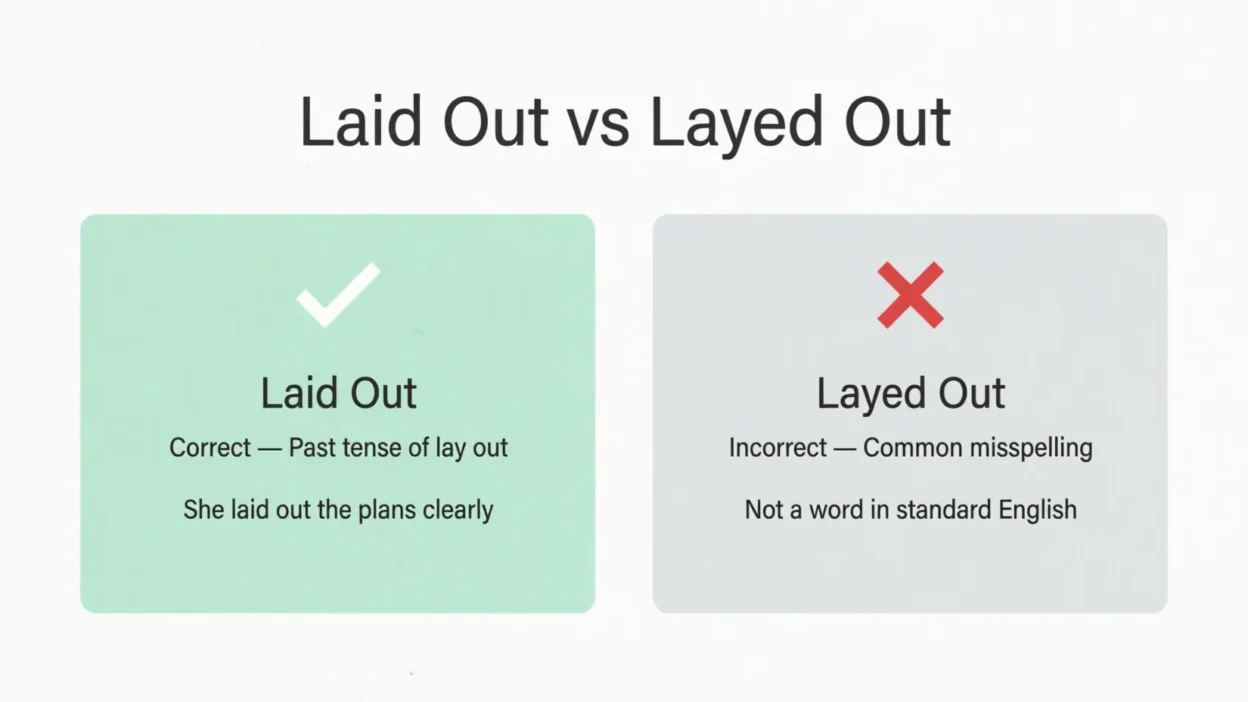
“Laid out” is the correct phrase. “Layed out” is a spelling mistake in modern standard English.
Correct:
- She laid out the documents clearly. ✅
Incorrect:
- She layed out the documents clearly. ❌
What Does “Laid Out” Mean?
“Laid out” is the past tense form of the phrasal verb “lay out.”
The phrase can mean:
- arranged something carefully
- explained something clearly
- placed items in order
- designed or organized something
- stretched out physically
Examples of “Laid Out”
- He laid out the tools on the table.
- The manager laid out the company’s goals clearly.
- She laid out her clothes the night before.
- The architect laid out the building plans.
Verb Forms
| Tense | Form |
|---|---|
| Present | lay out |
| Past | laid out |
| Past Participle | laid out |
Because “lay” is irregular, it changes to “laid.”
Why “Layed Out” Is Incorrect
Many people assume “layed” should be the past tense because regular English verbs add “-ed.”
Examples:
- play → played
- stay → stayed
- delay → delayed
But “lay” does not follow this rule.
Correct:
- lay → laid
Incorrect:
- lay → layed ❌
So:
- laid out ✅
- layed out ❌
Laid Out vs Layed Out Comparison Table
| Phrase | Correct? | Meaning | Example |
|---|---|---|---|
| Laid out | Yes | Arranged or explained | She laid out the schedule |
| Layed out | No | Misspelling | Incorrect in standard English |
Common Meanings of “Laid Out”
The phrase “laid out” has several useful meanings in English.
1. Arranged Carefully
- The chef laid out the ingredients neatly.
- They laid out the decorations before the event.
2. Explained Clearly
- The lawyer laid out the legal options.
- She laid out her concerns during the meeting.
3. Designed or Planned
- Engineers laid out the new highway route.
- The website was laid out professionally.
4. Physically Stretched Out
- He was laid out on the couch after work.
- The injured player was laid out on the field.
Why People Make This Mistake
The confusion between “laid out” and “layed out” is extremely common.
Sound-Based Spelling
Both phrases sound almost identical when spoken quickly.
Irregular Verb Confusion
English learners often expect every verb to use “-ed” in the past tense.
Informal Internet Usage
Misspellings spread online because people repeat incorrect spellings in comments, posts, and casual writing.
Autocorrect Limitations
Spellcheck tools may not always catch “layed” immediately because it occasionally appears in online databases.
How to Use “Laid Out” Correctly
Understanding sentence structure makes usage much easier.
Common Structures
- laid out + object
- laid out clearly
- laid out carefully
- laid out plans
Examples
- The teacher laid out the assignment instructions.
- We laid out blankets for the picnic.
- The consultant laid out a new strategy.
- She laid out everything step by step.
Professional Usage
“Laid out” often appears in:
- business communication
- legal writing
- design projects
- presentations
- planning documents
Common Mistakes With Laid Out vs Layed Out
Avoiding these errors improves writing quality significantly.
Mistake 1: Writing “Layed Out”
Incorrect:
- He layed out the schedule yesterday. ❌
Correct:
- He laid out the schedule yesterday. ✅
Mistake 2: Confusing “Lay” and “Lie”
English speakers frequently confuse:
- lay
- lie
- laid
- lain
This confusion contributes to spelling errors.
Mistake 3: Using Incorrect Grammar in Professional Writing
Spelling mistakes can weaken credibility in:
- resumes
- work emails
- proposals
- academic papers
Correct grammar supports professionalism.
Mistake 4: Assuming Spoken English Reflects Spelling
English pronunciation often hides spelling differences. Always check irregular verbs carefully.
Practical Example Paragraphs
Real-world examples help the grammar feel more natural.
Correct Example Paragraph
Before the presentation began, Sarah laid out all the printed reports neatly across the conference table. She also laid out a clear timeline so everyone could understand the project goals easily.
Incorrect Example Paragraph
Incorrect:
- The designer layed out the website beautifully. ❌
Correct:
- The designer laid out the website beautifully. ✅
Placement and Grammar Rules Table
| Phrase | Sentence Placement | Tone | Example Sentence |
|---|---|---|---|
| Laid out | After subject | Neutral/Formal | She laid out the documents |
| Has laid out | Present perfect tense | Professional | He has laid out the proposal |
| Was laid out | Passive voice | Neutral | The room was laid out well |
| Layed out | Incorrect spelling | Nonstandard | Incorrect in formal English |
American vs British English Differences
There is no spelling difference between American and British English for this phrase.
Both varieties use:
- laid out ✅
And reject:
- layed out ❌
American English Example
- The team laid out a marketing strategy.
British English Example
- The organisers laid out the seating plan.
The grammar rule remains the same in both regions.
Synonyms and Related Phrases
Learning similar expressions improves vocabulary naturally.
Synonyms for “Laid Out”
- arranged
- organized
- explained
- presented
- displayed
- positioned
- mapped out
Related Phrases
- laid down
- set up
- mapped out
- spelled out
- arranged clearly
Related Grammar Searches
People searching for “laid out vs layed out” also often search for:
- laid vs layed
- laid off vs layed off
- payed vs paid
- setup vs set up
- make do vs make due
Helpful Memory Trick
A quick memory trick can make this easy forever.
Think of “Paid”
Just like:
- pay → paid
You also have:
- lay → laid
Neither word adds “-ed.”
So:
- laid out ✅
- layed out ❌
Why Correct Spelling Matters
Correct spelling improves:
- professionalism
- readability
- trustworthiness
- writing quality
This is especially important in:
- workplace communication
- resumes
- online content
- school assignments
- presentations
- client communication
Even small grammar mistakes can distract readers from your message.
FAQs About Laid Out vs Layed Out
Is “layed out” ever correct?
No. In standard English, “layed out” is considered incorrect.
What does “laid out” mean?
It usually means arranged, explained, organized, or presented clearly.
Why is “laid out” correct?
Because “laid” is the proper past tense of “lay.”
Is “laid out” formal English?
Yes. It works in both professional and casual writing.
Do Americans and British people both use “laid out”?
Yes. Both forms of English use “laid out.”
How can I remember the correct spelling?
Think:
- pay → paid
- lay → laid
Can “laid out” mean exhausted?
Yes. Informally, “laid out” can describe someone physically exhausted or knocked down.
Final Thoughts
The difference between laid out vs layed out becomes simple once you understand the irregular verb pattern. “Laid out” is the correct phrase because “laid” is the proper past tense of “lay.” Meanwhile, “layed out” is considered a spelling mistake in standard English.
Mastering grammar details like this helps your writing appear more polished, accurate, and professional. Whether you are writing emails, reports, blog posts, or social media captions, using “laid out” correctly strengthens your communication and confidence.
Actionable Takeaway
Whenever you need the past tense of “lay out,” always choose laid out. A simple memory trick is:
- pay → paid
- lay → laid
Remembering this irregular verb pattern will help you avoid a very common English spelling mistake.