English spelling can feel frustrating sometimes, especially when two words sound exactly alike. One of the most common grammar and spelling confusions is laid vs layed. Many people naturally assume “layed” should be correct because regular English verbs usually form the past tense by adding “-ed.”
However, English includes many irregular verbs, and “lay” is one of them. That means the correct past tense does not follow the standard spelling pattern. As a result, “laid” is correct in standard English, while “layed” is almost always considered a spelling mistake.
Understanding this difference is important for professional writing, academic work, emails, resumes, blog posts, and everyday communication. In this guide, you will learn the meaning of “laid,” why “layed” is incorrect, grammar rules, examples, common mistakes, pronunciation tips, and simple memory tricks to help you remember the correct spelling forever.
Quick Answer
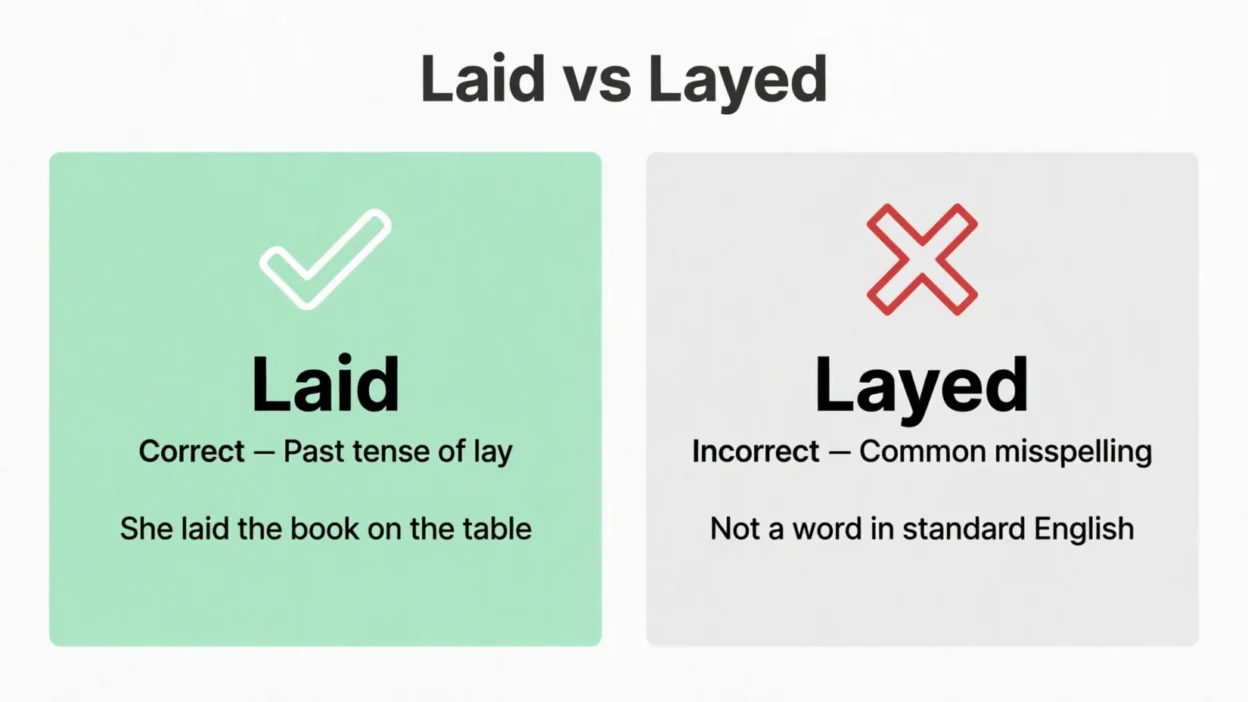
“Laid” is the correct spelling and the proper past tense of “lay.” “Layed” is generally incorrect in standard English.
Correct:
- She laid the book on the desk. ✅
Incorrect:
- She layed the book on the desk. ❌
What Does “Laid” Mean?
“Laid” is the past tense and past participle form of the verb “lay.”
The verb “lay” means:
- to place something down
- to set something somewhere
- to position an object carefully
Examples of “Laid”
- He laid the keys on the table.
- The workers laid new tiles in the kitchen.
- She laid the baby in the crib.
- They laid the foundation for the building.
Verb Forms
| Tense | Form |
|---|---|
| Present | lay |
| Past | laid |
| Past Participle | laid |
Because “lay” is irregular, it changes to “laid,” not “layed.”
Is “Layed” Ever Correct?
In almost all modern English writing, “layed” is considered incorrect.
However, there are very rare historical or nautical uses connected to:
- laying rope
- preparing surfaces
- maritime terminology
Still, these uses are extremely uncommon today.
For normal writing and speech:
- laid ✅
- layed ❌
Why People Confuse Laid and Layed
This mistake happens for understandable reasons.
Most Verbs Add “-ed”
English learners often expect:
- play → played
- stay → stayed
- delay → delayed
So naturally, many assume:
- lay → layed ❌
But “lay” does not follow that pattern.
Pronunciation Sounds the Same
“Laid” and “layed” sound identical when spoken aloud. Because of this, many people spell the word based on sound rather than grammar rules.
Autocorrect Sometimes Misses It
Since “layed” occasionally appears in online content, some spellcheck systems fail to flag it immediately.
Laid vs Layed Comparison Table
| Word | Correct? | Meaning | Example |
|---|---|---|---|
| Laid | Yes | Past tense of lay | She laid the blanket down |
| Layed | Usually no | Nonstandard spelling | Incorrect in normal usage |
How to Use “Laid” Correctly
“Laid” is used whenever you describe placing or positioning something in the past.
Common Sentence Structures
- laid + object
- has/have laid
- was laid
Examples
- The chef laid the plates on the counter.
- Workers have laid fresh concrete.
- The documents were laid on the desk.
- He carefully laid the painting against the wall.
Common Contexts
You often see “laid” in:
- home improvement
- construction
- parenting
- business communication
- storytelling
- legal writing
Common Mistakes With Laid vs Layed
Understanding common errors helps you avoid them naturally.
Mistake 1: Writing “Layed” Automatically
Incorrect:
- She layed the phone beside her bed. ❌
Correct:
- She laid the phone beside her bed. ✅
Mistake 2: Confusing “Lay” and “Lie”
Many people mix up:
- lay
- lie
- laid
- lain
This is one of the most confusing grammar areas in English.
Basic Difference
- Lay = place something
- Lie = recline/rest
Examples:
- I lay the book down.
- I lie down to rest.
Mistake 3: Using “Layed” in Professional Writing
Misspellings can hurt credibility in:
- resumes
- business emails
- reports
- academic papers
Correct spelling helps writing appear polished and trustworthy.
Practical Example Paragraphs
Real examples make grammar easier to understand.
Correct Example Paragraph
After unpacking the groceries, Maria carefully laid the vegetables on the kitchen counter. She then laid the fresh bread beside the fruit basket before preparing dinner.
Incorrect Example Paragraph
Incorrect:
- He layed the documents on my desk yesterday. ❌
Correct:
- He laid the documents on my desk yesterday. ✅
Placement and Grammar Rules Table
| Phrase/Form | Sentence Placement | Tone | Example Sentence |
|---|---|---|---|
| Laid | After subject | Neutral/Formal | She laid the folder down |
| Has laid | Present perfect tense | Formal | He has laid the groundwork |
| Was laid | Passive voice | Neutral | The carpet was laid yesterday |
| Layed | Incorrect spelling | Nonstandard | Incorrect in formal writing |
American vs British English Differences
There is no major spelling difference between American and British English for this word.
Both varieties use:
- laid ✅
And both reject:
- layed ❌
American English Example
- Workers laid asphalt on the road.
British English Example
- The gardener laid fresh turf in the garden.
The spelling rule remains the same worldwide.
Related Grammar Confusions
People who search for “laid vs layed” often struggle with other irregular verbs too.
Similar Grammar Pairs
- paid vs payed
- laid off vs layed off
- setup vs set up
- dreamed vs dreamt
- affect vs effect
Related Vocabulary
- placed
- positioned
- arranged
- set down
- installed
- positioned carefully
Helpful Memory Trick
A simple trick makes this grammar rule easier to remember.
Think of “Paid”
Just like:
- pay → paid
You also have:
- lay → laid
Neither word adds “-ed.”
So:
- laid ✅
- layed ❌
This comparison helps many learners remember the correct spelling instantly.
Why Correct Spelling Matters
Using proper spelling improves:
- readability
- professionalism
- trustworthiness
- communication clarity
This matters especially in:
- business writing
- job applications
- social media posts
- school assignments
- blog content
- online publishing
Even small spelling mistakes can distract readers and weaken your message.
FAQs About Laid vs Layed
Is “layed” a real word?
It exists in rare historical or nautical contexts, but it is considered incorrect in normal modern English.
Which is correct: laid or layed?
“Laid” is the correct standard spelling.
Why is “laid” irregular?
English contains many irregular verbs that do not simply add “-ed.”
Is “laid” the past tense of lay?
Yes. “Laid” is both the past tense and past participle form of “lay.”
Do Americans and British people both use “laid”?
Yes. Both forms of English use “laid” as the correct spelling.
How can I remember the correct spelling?
Think:
- pay → paid
- lay → laid
Is “laid down” correct?
Yes. “Laid down” is a very common and grammatically correct phrase.
Final Thoughts
The difference between laid vs layed becomes simple once you understand the irregular verb pattern. “Laid” is the correct past tense of “lay,” while “layed” is generally considered a spelling mistake in standard English writing.
Mastering grammar details like this can significantly improve your confidence and communication skills. Whether you are writing professionally, academically, or casually, using “laid” correctly helps your English appear more polished, accurate, and credible.
Actionable Takeaway
Whenever you need the past tense of “lay,” always choose laid. A quick memory trick is:
- pay → paid
- lay → laid
If you remember this pattern, you will avoid one of the most common English spelling mistakes.