English spelling can be surprisingly tricky, especially when two words look similar and sound almost identical. One of the most confusing examples is payed vs paid. Many people accidentally type “payed” when writing emails, invoices, school assignments, captions, or professional documents because it seems like the natural past tense of “pay.”
However, English grammar does not always follow predictable patterns. While “played,” “stayed,” and “delayed” all add “-ed,” the verb “pay” is irregular. That means its correct past tense changes differently.
Understanding the difference between “payed” and “paid” can help you avoid a very common grammar mistake and make your writing look more polished, professional, and trustworthy. In this guide, you will learn the correct spelling, grammar rules, meanings, examples, exceptions, and memory tricks to use the right word confidently every time.
Quick Answer
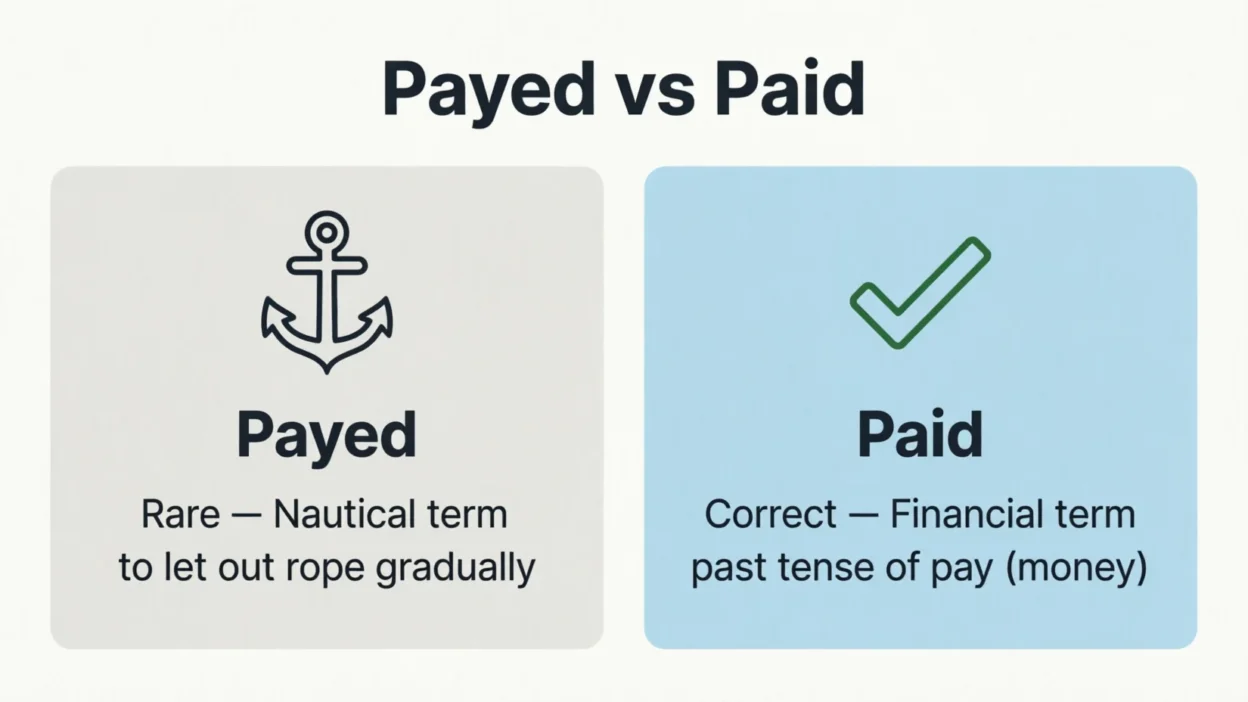
“Paid” is the correct spelling in almost all everyday situations involving money, salaries, bills, or payments. “Payed” exists, but it is only used in rare nautical and maritime contexts.
Correct:
- I paid the bill yesterday. ✅
Incorrect for normal usage:
- I payed the bill yesterday. ❌
What Does “Paid” Mean?
“Paid” is the correct past tense and past participle form of the verb “pay.”
It refers to:
- giving money
- settling bills
- receiving wages
- compensating someone
- completing a financial obligation
Examples of “Paid”
- She paid the rent on time.
- I already paid for dinner.
- The company paid its employees early.
- He paid the invoice yesterday.
- We paid cash for the tickets.
Why “Paid” Is Correct
“Pay” is an irregular verb.
Verb forms:
- Present tense: pay
- Past tense: paid
- Past participle: paid
Because of this irregular pattern, English does not use “payed” for standard financial meanings.
What Does “Payed” Mean?
“Payed” is a real word, but it is very rare.
It is mainly used in nautical and maritime language, where it refers to:
- sealing a ship with tar or pitch
- letting out rope or chain slowly
Rare Maritime Examples
- The sailors payed out the rope carefully.
- The crew payed the deck seams with tar.
Outside these specialized meanings, “payed” is generally considered incorrect.
Payed vs Paid Comparison Table
| Word | Correct for Money? | Meaning | Example |
|---|---|---|---|
| Paid | Yes | Past tense of pay | She paid the bill |
| Payed | No (usually) | Nautical term | The crew payed out the rope |
Why People Confuse Payed and Paid
This spelling mistake happens for several understandable reasons.
Regular Verb Assumption
Most English verbs form the past tense by adding “-ed.”
Examples:
- play → played
- stay → stayed
- clean → cleaned
So many people naturally assume:
- pay → payed ❌
But “pay” is irregular.
Pronunciation Similarity
Both words sound nearly identical in conversation, making the spelling harder to remember.
Typing and Autocorrect Errors
Spellcheck tools may not always catch “payed” because it technically exists as a valid English word.
Understanding the Grammar Rule
The key is remembering that “pay” belongs to a group of irregular verbs.
Common Irregular Verbs
| Present | Past |
|---|---|
| say | said |
| lay | laid |
| pay | paid |
| make | made |
Notice the pattern:
- pay → paid
Not:
- pay → payed
Common Situations Where “Paid” Is Used
You will see “paid” in many forms of daily communication.
Workplace Communication
- The company paid bonuses this month.
- Employees were paid weekly.
Banking and Finance
- I paid my credit card bill.
- She paid in cash.
Shopping and Services
- We paid for the repairs.
- Have you paid the invoice yet?
Online Payments
- The subscription has been paid.
- Customers paid electronically.
Common Mistakes With Payed vs Paid
Learning the common mistakes helps you avoid them naturally.
Mistake 1: Using “Payed” for Financial Transactions
Incorrect:
- I payed my taxes yesterday. ❌
Correct:
- I paid my taxes yesterday. ✅
Mistake 2: Assuming “Payed” Is Modern English
Many people believe “payed” is an alternative spelling. In reality, it is only correct in specialized nautical contexts.
Mistake 3: Using the Wrong Word in Professional Writing
Misspelling “paid” in invoices, resumes, or business emails may affect credibility.
Correct spelling matters in professional communication.
Mistake 4: Confusing Verb Forms
Incorrect:
- I have payed the bill. ❌
Correct:
- I have paid the bill. ✅
Practical Example Paragraphs
Real-world examples make grammar rules easier to understand.
Correct Example Paragraph
After receiving her first paycheck, Maria paid all her monthly bills immediately. She also paid for groceries and saved some money for future expenses.
Incorrect Example Paragraph
Incorrect:
- He payed for the hotel online. ❌
Correct:
- He paid for the hotel online. ✅
Placement and Grammar Rules Table
| Word/Phrase | Sentence Placement | Tone | Example Sentence |
|---|---|---|---|
| Paid | Standard financial contexts | Neutral/Formal | She paid the contractor |
| Paid for | Common conversational structure | Informal/Neutral | We paid for lunch |
| Fully paid | Business and legal contexts | Formal | The invoice is fully paid |
| Payed | Nautical usage only | Specialized | Sailors payed out the rope |
American vs British English Differences
There is no major difference between American and British English regarding “paid.”
Both varieties use:
- paid ✅
And both generally avoid:
- payed ❌
American English Example
- He paid the parking fee.
British English Example
- She paid the electricity bill.
The spelling rule stays the same in both forms of English.
Synonyms and Related Words
Using related terms can improve vocabulary and writing variety.
Synonyms for Paid
- compensated
- reimbursed
- settled
- rewarded
- financed
- funded
- remunerated
Related Financial Terms
- payment
- invoice
- salary
- transaction
- receipt
- payroll
- compensation
Related Grammar Searches
People searching for “payed vs paid” also often search for:
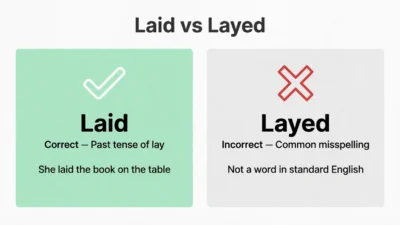
- laid vs layed
- setup vs set up
- affect vs effect
- anyway vs anyways
- make do vs make due
Helpful Memory Trick
A simple trick makes this rule much easier to remember.
Think of “Said”
Just like:
- say → said
You also have:
- pay → paid
Both words drop the “y” and change spelling irregularly.
So:
- paid ✅
- payed ❌
Why Correct Spelling Matters
Correct grammar and spelling help your writing appear:
- professional
- accurate
- credible
- polished
This matters especially in:
- invoices
- resumes
- emails
- business communication
- academic writing
- online content
Even small spelling mistakes can distract readers and reduce trust.
FAQs About Payed vs Paid
Is “payed” ever correct?
Yes, but only in rare nautical or maritime contexts involving ropes, ships, or sealing seams.
Which is correct: paid or payed?
“Paid” is correct for all normal financial situations.
Why is “paid” irregular?
English contains many irregular verbs that do not follow standard “-ed” spelling patterns.
Is “payed” acceptable in professional writing?
No, unless you are specifically writing about maritime activities.
Do Americans and British people both use “paid”?
Yes. Both American and British English use “paid” as the correct standard spelling.
How can I remember the correct spelling?
Think:
- say → said
- pay → paid
Is “paid off” also correct?
Yes. “Paid off” is grammatically correct and commonly used.
Final Thoughts
The difference between payed vs paid becomes simple once you understand the grammar rule behind the verb “pay.” In nearly every everyday situation involving money, bills, salaries, or purchases, “paid” is the correct spelling. “Payed” exists only in specialized maritime language and is rarely used outside that field.
Learning these small spelling distinctions can dramatically improve your writing quality and confidence. Whether you are writing business emails, financial documents, academic papers, or social media captions, using “paid” correctly helps your communication sound polished and professional.
Actionable Takeaway
Whenever you write about money, payments, salaries, or bills, always choose paid. A quick memory trick is:
- say → said
- pay → paid
If it involves finances, “paid” is almost always the right choice.

Fenwick Quentin is a creative blogging author known for his analytical yet engaging writing style.
He explores topics such as innovation, digital culture, and personal development with depth and clarity.
Through his articles, Fenwick encourages readers to think critically and embrace continuous growth.