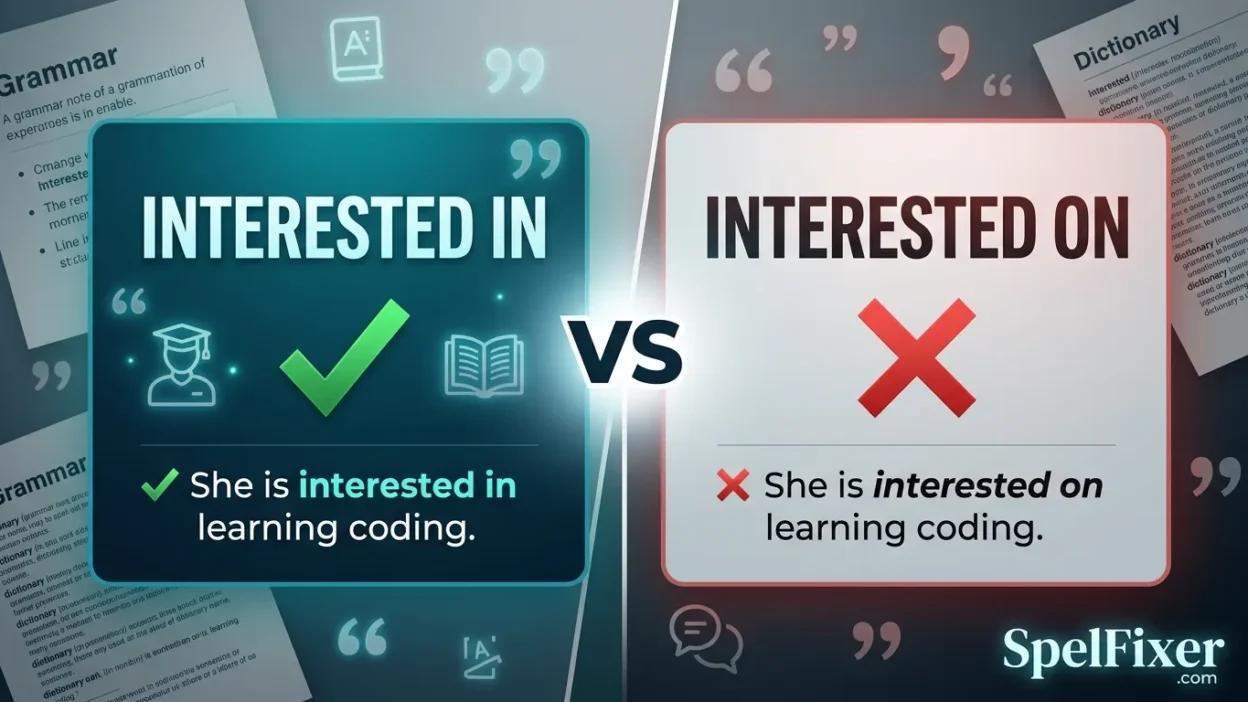
When you want to say that someone likes, wants to learn about, or wants to know more about something, the correct expression is usually “interested in.” For example, you should say, “I am interested in photography,” not “I am interested on photography.” The preposition in naturally follows interested when you talk about a subject, activity, person, or field.
The confusion between interested in and interested on is common, especially for English learners because on is frequently used with many other expressions.
However, these two phrases are not interchangeable. In standard English, interested on is generally incorrect when on is being used to introduce the thing that interests someone. In this guide, you will learn the difference, see practical examples, understand common mistakes, and discover an easy way to remember which preposition to use.
Quick Answer
“Interested in” is the correct and standard expression. Use it before a person, subject, activity, topic, hobby, or field that attracts your attention or curiosity. “Interested on” is generally incorrect in this meaning. For example: “She is interested in science,” and “I’m interested in learning Spanish.”
Why Do People Confuse It?
People often confuse interested in and interested on because both in and on are common English prepositions.
However, prepositions do not always translate directly from one language to another. English has many fixed combinations, and interested in is one of them.
The important pattern is:
interested + in + something/someone
Examples:
- interested in music
- interested in sports
- interested in history
- interested in you
- interested in learning
- interested in a new job
First Word: “Interested In”
Interested in means having curiosity, attention, enthusiasm, or a desire to know more about something or someone.
Examples
- I am interested in photography.
- She is interested in learning French.
- They are interested in the new project.
- He is interested in science.
- Are you interested in football?
You can use interested in with:
- Nouns: interested in music
- Pronouns: interested in it
- People: interested in her
- Gerunds (-ing forms): interested in reading
- Fields of study: interested in biology
Second Word: “Interested On”
Interested on is generally not correct when you mean that someone has curiosity or enthusiasm about something.
For example:
❌ I am interested on history.
✅ I am interested in history.
❌ She is interested on painting.
✅ She is interested in painting.
❌ He is interested on this subject.
✅ He is interested in this subject.
The word on can be correct in a sentence near interested, but it normally has a different grammatical function.
For example:
I am interested in the information on the website.
Here, in belongs with interested, while on describes where the information appears.
Interested In vs Interested On: Comparison Table
| Expression | Correct? | Meaning | Example |
| Interested in | ✅ Yes | Curious about or attracted to something | I am interested in history. |
| Interested on | ❌ Generally no | Not the standard preposition after interested | I am interested on history. |
| Information on | ✅ Yes | Information about a subject | I need information on history. |
| Focused on | ✅ Yes | Giving attention to something | She is focused on her studies. |
When Should You Use “Interested In”?
Use interested in whenever you want to identify the person, subject, activity, or thing that attracts someone’s attention or curiosity.
Use “interested in” with subjects
- I am interested in mathematics.
- She is interested in history.
- He is interested in psychology.
Use it with hobbies
- They are interested in photography.
- I am interested in cooking.
- She is interested in gardening.
Use it with activities
- He is interested in learning English.
- We are interested in visiting Japan.
- She is interested in playing tennis.
Use it with people
- He is interested in her.
- She seems interested in him.
- Are you interested in meeting them?
Use it with opportunities
- I am interested in the position.
- She is interested in the course.
- We are interested in your proposal.
10+ Examples of “Interested In”
- I am interested in learning English.
- She is interested in modern art.
- Are you interested in science?
- He became interested in photography.
- They are interested in starting a business.
- My brother is interested in computers.
- We are interested in your idea.
- She has always been interested in history.
- I am very interested in this course.
- He is interested in playing football.
- The students are interested in environmental science.
- She is interested in reading English books.
Common Mistakes
Mistake 1: Using “interested on” before a subject
❌ I am interested on biology.
✅ I am interested in biology.
Mistake 2: Using “interested on” before an activity
❌ He is interested on learning Spanish.
✅ He is interested in learning Spanish.
Mistake 3: Forgetting the preposition
❌ She is interested photography.
✅ She is interested in photography.
Mistake 4: Using “interest” and “interested” in the same way
These structures are different:
- I am interested in music.
- Music interests me.
You can also say:
- I have an interest in music.
But when using the adjective interested, use in.
Memory Trick
Think of interested in as looking inside a subject because you want to know more about it.
Interested → IN
I am interested in English.
She is interested in art.
They are interested in technology.
A simple rule to remember:
If something catches your curiosity, you are interested IN it.
American vs British English
There is no important American-versus-British difference here.
Both American English and British English normally use:
interested in
For example:
- American English: “I’m interested in history.”
- British English: “I’m interested in history.”
Interested on is not a standard alternative in either variety when on is intended to mean the subject of interest.
Similar Words
Several expressions have meanings related to interested in, but their prepositions can differ.
Interested in
Means curious about or attracted to something.
She is interested in astronomy.
Curious about
Means wanting to know more about something.
I am curious about the results.
Focused on
Means giving attention to something.
He is focused on his studies.
Excited about
Means feeling enthusiastic about something.
They are excited about the trip.
Concerned about
Means worried or thoughtful about something.
She is concerned about the situation.
Notice that English expressions often require different prepositions. That is why it is better to learn the complete phrase rather than translating each preposition separately.
Final Verdict
Interested in is the correct choice when you want to say that someone is curious about, attracted to, or enthusiastic about a person, subject, activity, or thing.
Interested on is generally incorrect in this context.
The easiest rule is:
Interested + in + person, thing, subject, or activity
So write “I am interested in English,” not “I am interested on English.”
FAQs
Is “interested in” grammatically correct?
Yes. Interested in is the standard grammatical expression used to describe curiosity, attention, enthusiasm, or attraction toward something or someone.
Is “interested on” ever correct?
Not normally when you mean “curious about” or “wanting to know more about.” In that meaning, use interested in.
Which is correct: “interested in” or “interested on”?
Interested in is correct. For example, “She is interested in music.”
Should I say “interested in learning” or “interested on learning”?
Say “interested in learning.” After interested in, an activity can be expressed using an -ing form.
Can I say “I am interested in you”?
Yes. Interested in you can mean that you are curious about someone, want to know them better, or have personal attraction toward them, depending on the context.
What preposition comes after “interested”?
The standard preposition is in.
interested in something
interested in someone
interested in doing something
Is “interested in” the same in American and British English?
Yes. Both American and British English use interested in in this context.
Remember This
Interested IN = correct
- interested in English
- interested in sports
- interested in reading
- interested in science
- interested in the job
- interested in her
Interested ON = generally incorrect
When interested means curious, enthusiastic, or attracted to something, choose in, not on.
Conclusion
The difference between interested in and interested on is simple once you learn the standard word combination. When someone has curiosity or enthusiasm about a person, subject, activity, or thing, use interested in. This applies to both American and British English.
Avoid interested on when on is meant to introduce the thing that interests someone. Remember the simple pattern interested + in: “I’m interested in music,” “She’s interested in learning,” and “They’re interested in the project.” Learning this fixed expression will help you sound more natural and grammatically accurate in everyday English.