The confusion between per se vs per say is incredibly common because both phrases sound almost identical when spoken aloud. Many people hear the expression in conversations, podcasts, movies, or meetings and naturally assume it is spelled “per say.” However, only one version is grammatically correct in English.
If you have ever typed “per say” in an email, essay, or social media post, you are definitely not alone. The phrase “per se” comes from Latin, which makes its spelling less intuitive for English speakers. Understanding the correct form can instantly improve your writing clarity and help you sound more polished in both casual and professional communication.
In this guide, you will learn the meaning of “per se,” why “per say” is incorrect, grammar rules, pronunciation tips, practical examples, common mistakes, and easy memory tricks to help you use the phrase confidently every time.
Quick Answer
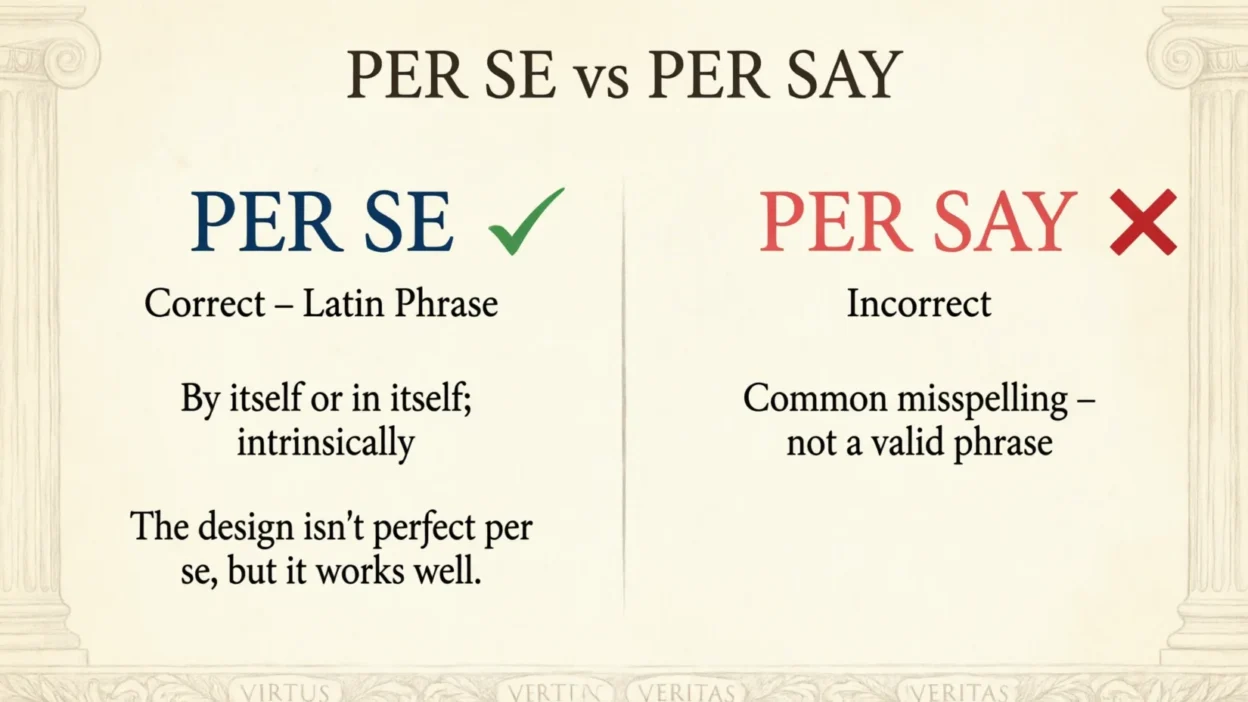
“Per se” is the correct phrase.
“Per say” is a common misspelling and should not be used in formal or standard English.
Example:
- The movie was not bad per se, but it felt too long. ✅
- The movie was not bad per say, but it felt too long. ❌
What Does “Per Se” Mean?
“Per se” is a Latin phrase meaning:
- by itself
- inherently
- intrinsically
- in and of itself
It is used to clarify that something is not exactly the issue itself but may relate indirectly to the issue being discussed.
Examples of Per Se
- Money is not evil per se.
- The idea is not wrong per se, but it needs improvement.
- Working remotely is not difficult per se.
- The food was not bad per se, just overpriced.
Is “Per Say” a Real Phrase?
No. “Per say” is not a correct English phrase.
It is simply:
- a phonetic misspelling
- a misunderstanding of pronunciation
- an informal writing error
Because “per se” sounds like “per say” when spoken, many writers accidentally spell it incorrectly.
Per Se vs Per Say Comparison Table
| Phrase | Correct or Incorrect | Meaning | Usage |
|---|---|---|---|
| Per se | Correct | By itself/inherently | Formal and informal English |
| Per say | Incorrect | No accepted meaning | Misspelling |
Why People Confuse Per Se and Per Say
The confusion mainly happens because:
- “per se” is borrowed from Latin
- pronunciation sounds identical to “per say”
- people learn the phrase through speech before seeing it written
Pronunciation
“Per se” is pronounced:
- per SAY
That pronunciation leads many people to spell it the way it sounds.
How to Use “Per Se” Correctly
Use “per se” when:
- clarifying meaning
- softening criticism
- distinguishing the main issue from related concerns
Correct Examples
- The policy is not unfair per se.
- Exercise is not painful per se.
- Technology is not harmful per se.
- His comments were not offensive per se.
Tone and Style
“Per se” often sounds:
- professional
- thoughtful
- analytical
- formal
It commonly appears in:
- academic writing
- business communication
- journalism
- debates
- legal discussions
Common Mistakes With Per Se vs Per Say
Many writers unknowingly misuse the phrase.
Mistake 1: Writing “Per Say”
Incorrect:
- I do not dislike the movie per say. ❌
Correct:
- I do not dislike the movie per se. ✅
Mistake 2: Using Per Se Incorrectly
Some people use “per se” without proper context.
Incorrect:
- She per se likes coffee. ❌
Correct:
- Coffee is not unhealthy per se. ✅
Mistake 3: Overusing the Phrase
Using “per se” too often can make writing sound overly formal or repetitive.
Practical Example Paragraphs
Example Using Per Se Correctly
The manager explained that remote work was not the problem per se. Instead, the issue was poor communication and unclear expectations among team members.
Incorrect Example Using Per Say
The presentation was not confusing per say. ❌
Corrected version:
- The presentation was not confusing per se. ✅
Placement and Grammar Rules Table
| Phrase | Sentence Placement | Tone | Example Sentence |
|---|---|---|---|
| Per se | Middle or end of sentence | Formal/Neutral | The idea is not bad per se |
| Not ___ per se | Clarifying phrase | Analytical | The issue is not money per se |
| Per se usage | Academic/professional | Formal | The method is not flawed per se |
American vs British English Differences
There are no major spelling differences between American and British English for this phrase.
In Both Variations
The correct spelling is always:
- per se
“Per say” remains incorrect in:
- American English
- British English
- Canadian English
- Australian English
Origins of Per Se
The phrase comes directly from Latin.
Latin Meaning
- per = through/by
- se = itself
Combined meaning:
- by itself
English has adopted many Latin phrases, including:
- vice versa
- ad hoc
- bona fide
- per capita
“Per se” belongs to this group of borrowed expressions.
Synonyms and Similar Expressions
Sometimes you can replace “per se” with simpler wording.
Synonyms for Per Se
- inherently
- by itself
- intrinsically
- fundamentally
- in itself
Examples
- The idea is not wrong inherently.
- The issue is not the cost itself.
Why Correct Usage Matters
Using “per se” correctly improves:
- professionalism
- writing clarity
- grammatical accuracy
- reader trust
Using “per say” may:
- look careless
- weaken credibility
- distract educated readers
This is especially important in:
- resumes
- academic essays
- professional emails
- blogs
- business writing
Per Se in Everyday Conversation
Even though “per se” sounds formal, people use it regularly in speech.
Casual Examples
- I am not tired per se, just stressed.
- The restaurant is not bad per se.
- The project is not difficult per se.
Professional Examples
- The strategy is not ineffective per se.
- Social media is not harmful per se.
Helpful Memory Trick
A simple trick can help you remember the correct spelling forever.
Remember the Latin Origin
“Per se” is Latin, so its spelling looks unusual.
Think:
- “se” = self
Meaning:
- by itself
Another Easy Tip
If you can replace the phrase with:
- “in itself”
Then “per se” is likely correct.
Related Grammar Searches
People searching for “per se vs per say” also search for:
- affect vs effect
- anyway vs anyways
- insure vs ensure
- farther vs further
- segue vs segway
FAQs About Per Se vs Per Say
Is per say correct?
No. “Per say” is incorrect.
What does per se mean?
“Per se” means:
- by itself
- inherently
- intrinsically
Why do people spell it per say?
Because “per se” sounds like “per say” when spoken aloud.
Is per se formal?
Yes, though it also appears in casual conversation.
Can I use per se in essays?
Absolutely. It is common in academic and professional writing.
Is per se Latin?
Yes. It comes from Latin.
How do you pronounce per se?
It is pronounced:
- per SAY
Final Thoughts
The difference between per se vs per say is simple once you understand the phrase’s origin and meaning. “Per se” is the correct Latin expression meaning “by itself” or “inherently,” while “per say” is merely a common spelling mistake caused by pronunciation confusion.
Learning the correct form helps your writing appear more polished, credible, and professional. Whether you are writing emails, essays, blog posts, or business documents, using “per se” correctly shows attention to detail and language accuracy.
Actionable Takeaway
Remember this quick rule:
- “per se” = correct
- “per say” = incorrect
Easy memory trick:
- “per se” means “by itself,” so think of the “se” in “self.”
That simple connection can help you spell the phrase correctly every time.

Fenwick Quentin is a creative blogging author known for his analytical yet engaging writing style.
He explores topics such as innovation, digital culture, and personal development with depth and clarity.
Through his articles, Fenwick encourages readers to think critically and embrace continuous growth.