If you’ve ever written “layed off” and paused, unsure if it’s right, you’re not alone. This phrase comes up often in workplace conversations, job updates, and professional writing—so getting it right really matters.
The confusion between layed off vs laid off is common because English spelling rules can feel inconsistent.
But once you understand the grammar behind it, the correct form becomes easy to remember and use with confidence.
Quick Answer
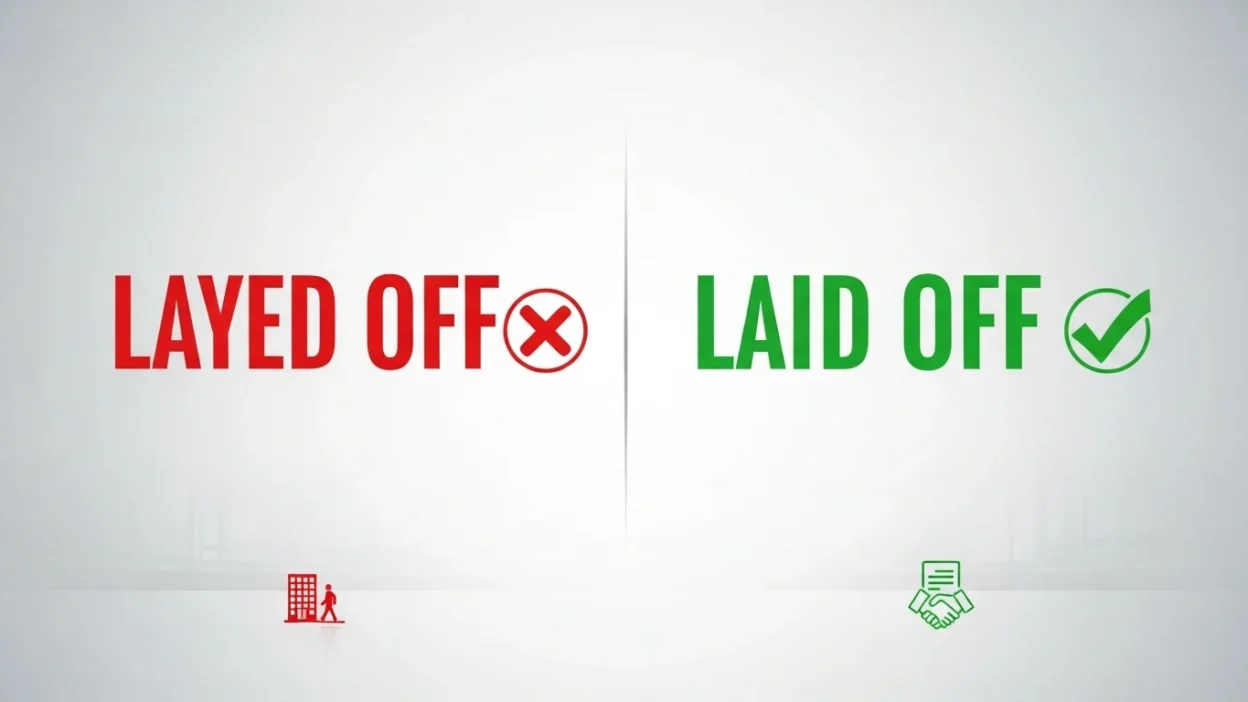
- ❌ Layed off is incorrect
- ✅ Laid off is the correct phrase
- Always use laid off when referring to job termination or temporary dismissal
What Does “Laid Off” Mean?
The phrase laid off is the past tense of “lay off”, a phrasal verb commonly used in employment contexts.
Core meanings:
- To terminate someone’s job (usually due to business reasons)
- To temporarily suspend workers
- To stop using or relying on something
Examples:
- She was laid off due to company downsizing.
- Many workers were laid off during the recession.
- He has been laid off for two months.
LSI keywords and related phrases:
- job termination
- workforce reduction
- downsizing
- redundancy
- furlough
- unemployment
These help improve SEO and keep your content relevant.
What Is “Layed Off”? Is It Ever Correct?
Let’s be clear: “layed off” is not correct English.
It’s a misspelling of “laid off.”
Why people write “layed off”:
- Confusion with regular verbs (play → played)
- Misunderstanding irregular verb forms
- Mixing spelling rules
Important:
- ❌ Layed off → Incorrect
- ✅ Laid off → Correct
Always use laid off in professional and casual writing.
Layed Off vs Laid Off: Side-by-Side Comparison
| Feature | Layed Off ❌ | Laid Off ✅ |
|---|---|---|
| Valid phrase | No | Yes |
| Grammar | Incorrect spelling | Correct |
| Meaning | None | Job termination or suspension |
| Usage | Never correct | Standard English |
| Example | ✖ He was layed off | ✔ He was laid off |
Why “Laid Off” Is the Correct Form
The key lies in understanding the verb “lay.”
Rule:
👉 Lay is an irregular verb
- Present: lay
- Past: laid
- Past participle: laid
So when forming the phrasal verb:
- lay off → laid off
Memory trick:
👉 Think: “Lay becomes laid, even in phrases.”
Similar irregular patterns:
- pay → paid
- say → said
These help reinforce the pattern.
How to Use “Laid Off” Correctly
The phrase laid off is widely used in professional, business, and everyday contexts.
1. Employment situations
- The company laid off 50 employees.
- She was laid off after the merger.
2. Temporary layoffs
- Workers were laid off during the off-season.
- He was laid off but rehired later.
3. Passive voice
- Many employees were laid off unexpectedly.
4. Non-work usage (less common)
- He decided to lay off junk food.
- She was told to lay off the criticism.
Tip:
Use laid off when referring to past actions involving job loss.
Common Mistakes to Avoid
Here are the most frequent errors:
1. Using “layed off”
- ❌ He was layed off
- ✅ He was laid off
2. Confusing tense
- ❌ He is lay off yesterday
- ✅ He was laid off yesterday
3. Mixing with “lay” and “lie”
- ❌ I layed the worker off
- ✅ I laid the worker off
4. Incorrect verb agreement
- ❌ They has laid off
- ✅ They have been laid off
Tip:
Always double-check irregular verbs in writing.
Lay vs Lie: Why It Causes Confusion
Understanding lay vs lie helps prevent mistakes like “layed off.”
Lay:
- Means to place something
- Requires an object
- Past tense: laid
Lie:
- Means to recline
- Does not need an object
- Past tense: lay
Example:
- She laid the book down
- He lay on the couch
👉 This overlap is why confusion happens.
American vs British English Differences
There is no difference in this case.
- ✅ Laid off is correct in both American and British English
- ❌ Layed off is incorrect everywhere
Key takeaway:
The rule applies globally.
Synonyms and Alternatives for “Laid Off”
To improve variety and SEO, consider these alternatives:
Employment context:
- dismissed
- terminated
- let go
- made redundant (British English)
- furloughed
Examples:
- He was laid off → He was dismissed
- She was laid off → She was made redundant
These alternatives help avoid repetition.
Real-Life Usage Examples
Here’s how laid off appears in real situations:
Workplace:
- Hundreds of workers were laid off last year.
News context:
- The company announced it would lay off staff.
Personal experience:
- I was laid off, but I found a better job later.
Economic context:
- Many people were laid off during economic downturns.
These examples show how common and important the phrase is.
FAQs About Layed Off vs Laid Off
Is “layed off” ever correct?
No, it is always incorrect.
What is the correct phrase?
The correct phrase is laid off.
Why is “layed off” wrong?
Because “lay” is an irregular verb and becomes “laid,” not “layed.”
What does “laid off” mean?
It means losing a job due to business reasons.
Is “laid off” formal or informal?
It is used in both formal and informal contexts.
Is there a British vs American difference?
No, both use “laid off.”
What is the present form?
The present form is lay off.
How can I remember the correct form?
Think: lay → laid, so lay off → laid off.
Summary:
The difference between layed off vs laid off is straightforward once you understand the grammar.
Laid off is the correct phrase, while layed off is a common spelling mistake that should be avoided.
Because “lay” is an irregular verb, its past tense becomes “laid,” not “layed.” This rule applies even when the verb is part of a phrase like “lay off.” Mastering this small detail can significantly improve your writing accuracy.
Actionable Takeaway
Here’s your simple rule:
👉 Always write laid off, never layed off
Before sending emails, updating your resume, or writing professionally, take a moment to proofread. Small corrections like this make your communication clearer and more polished.