Have you ever paused while writing and wondered whether it’s “tieing” or “tying”? You’re not alone.
This small spelling confusion trips up many writers because it doesn’t follow the usual “add -ing” pattern we expect in English.
The good news? Once you understand the rule behind tieing vs tying, it becomes easy to remember.
In this guide, you’ll learn the correct spelling, why it works that way, examples, common mistakes, and practical tips to avoid errors in your writing.
Quick Answer
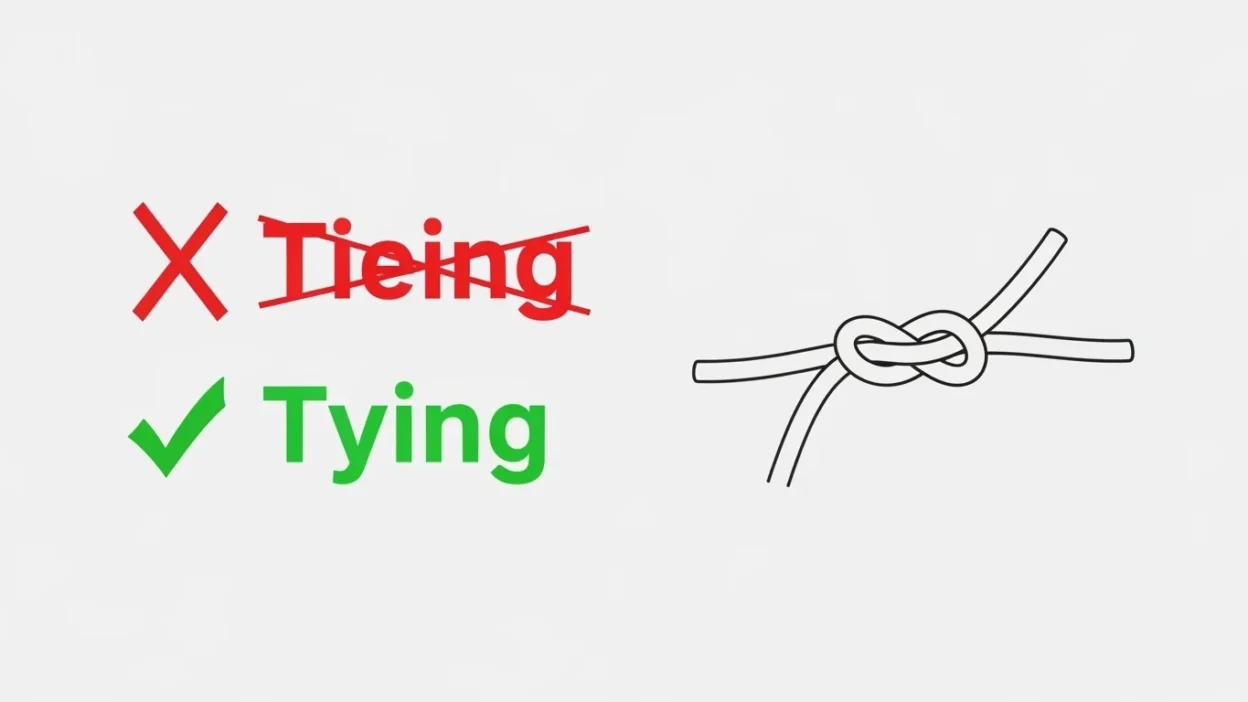
- ❌ Tieing is incorrect
- ✅ Tying is the correct spelling
- Always use tying as the present participle of “tie”
What Does “Tying” Mean?
The word tying is the present participle of the verb tie, which means to fasten, attach, secure, or connect something using a knot or similar method.
Core meanings:
- Fastening something with a knot
- Connecting or linking
- Securing objects together
Examples:
- She is tying her shoelaces.
- He is tying the rope to the pole.
- They are tying decorations for the event.
LSI keywords and related phrases:
- fastening
- securing
- binding
- knotting
- attaching
- linking
These variations improve SEO and enrich your content naturally.
What Is “Tieing”? Is It Ever Correct?
Let’s clear the confusion: “tieing” is not a correct spelling in standard English.
Even though it seems logical (tie + ing), English spelling rules sometimes change the base word before adding “-ing.”
Why people write “tieing”:
- Applying the usual “add -ing” rule
- Not knowing irregular spelling patterns
- Typing quickly without checking
Important:
- ❌ Tieing → Incorrect
- ✅ Tying → Correct
Always use tying in both formal and informal writing.
Tieing vs Tying: Side-by-Side Comparison
| Feature | Tieing ❌ | Tying ✅ |
|---|---|---|
| Valid word | No | Yes |
| Grammar | Incorrect spelling | Correct |
| Meaning | None | Fastening or securing |
| Usage | Never correct | Standard English |
| Example | ✖ Tieing shoes | ✔ Tying shoes |
Why “Tying” Is the Correct Form
Here’s where it gets interesting. The verb tie follows a special spelling rule when adding “-ing.”
Rule:
👉 When a verb ends in -ie, it changes to -y before adding “-ing”
So:
- tie → tying
- die → dying
- lie → lying
Memory trick:
👉 Think: “IE becomes Y before ING”
This simple rule will help you avoid similar mistakes.
How to Use “Tying” Correctly
The word tying is used in many everyday contexts.
1. Physical actions
- She is tying her hair back.
- He is tying the package with string.
2. Symbolic or abstract use
- The story is tying everything together.
- The theme is tying the ideas into one concept.
3. Events and decorations
- They are tying ribbons on gifts.
- We’re tying balloons for the party.
4. Sports and competitions
- The teams are tying the score.
Tip:
Use tying whenever you describe an ongoing action of fastening or connecting.
Common Mistakes to Avoid
Here are the most frequent errors with tieing vs tying:
1. Adding “-ing” directly
- ❌ Tieing
- ✅ Tying
2. Forgetting the “-ie to -y” rule
This rule applies to several verbs, not just “tie.”
3. Confusing with similar words
- lie → lying (not lieing)
- die → dying (not dieing)
4. Skipping proofreading
Always double-check tricky words.
Tying vs Tie: Understanding the Difference
These two forms serve different grammatical roles.
Tie:
- Base verb
- Example: I will tie my shoes
Tying:
- Present participle
- Example: I am tying my shoes
👉 Use tying for ongoing actions.
American vs British English Differences
There is no difference between American and British English here.
- ✅ Tying is correct in both
- ❌ Tieing is incorrect in both
Key takeaway:
The spelling rule is universal across English varieties.
Synonyms and Alternatives for “Tying”
To improve variety and engagement, consider these alternatives:
Physical context:
- fastening
- knotting
- binding
Abstract context:
- connecting
- linking
- joining
Examples:
- Tying a rope → Fastening a rope
- Tying ideas → Connecting ideas
These synonyms enhance readability and SEO.
Real-Life Usage Examples
Let’s look at how tying appears in everyday situations:
Daily life:
- She is tying her shoelaces before leaving.
Work:
- He is tying loose ends in the project.
Events:
- They are tying decorations for the wedding.
Sports:
- The match is tying at halftime.
These examples show how versatile the word is.
FAQs About Tieing vs Tying
Is “tieing” ever correct?
No, it is always incorrect.
What is the correct spelling?
The correct spelling is tying.
Why does “tie” become “tying”?
Because verbs ending in “-ie” change to “-y” before adding “-ing.”
Are there other words like this?
Yes, such as lying and dying.
Is “tying” used in formal writing?
Yes, it is standard in all contexts.
Is there a British vs American difference?
No, both use “tying.”
What is the past tense of “tie”?
The past tense is tied.
How can I remember the rule?
Think: IE → Y before ING.
Summary: Tieing vs Tying Made Simple
The difference between tieing vs tying is all about understanding a simple spelling rule.
Tying is the correct form, while tieing is a common mistake that occurs when people apply the wrong pattern.
By remembering that verbs ending in “-ie” change to “-y” before adding “-ing,” you can avoid this error and improve your writing instantly.
It’s a small adjustment that makes a big difference in clarity and professionalism.
Actionable Takeaway
Here’s your simple rule:
👉 Always write tying, never tieing
Before finishing your writing, take a moment to check tricky words. Mastering small spelling rules like this will boost your confidence and make your writing more polished.