Have you ever typed “layed out” and hesitated, wondering if it looked right? You’re not alone. This small but common mistake shows up in emails, assignments, and even professional writing more often than you might think.
Understanding layed out vs laid out is easier than it seems once you know the grammar rule behind it.
In this guide, you’ll learn the correct spelling, meanings, examples, common mistakes, and simple tricks to help you use the right phrase confidently every time.
Quick Answer
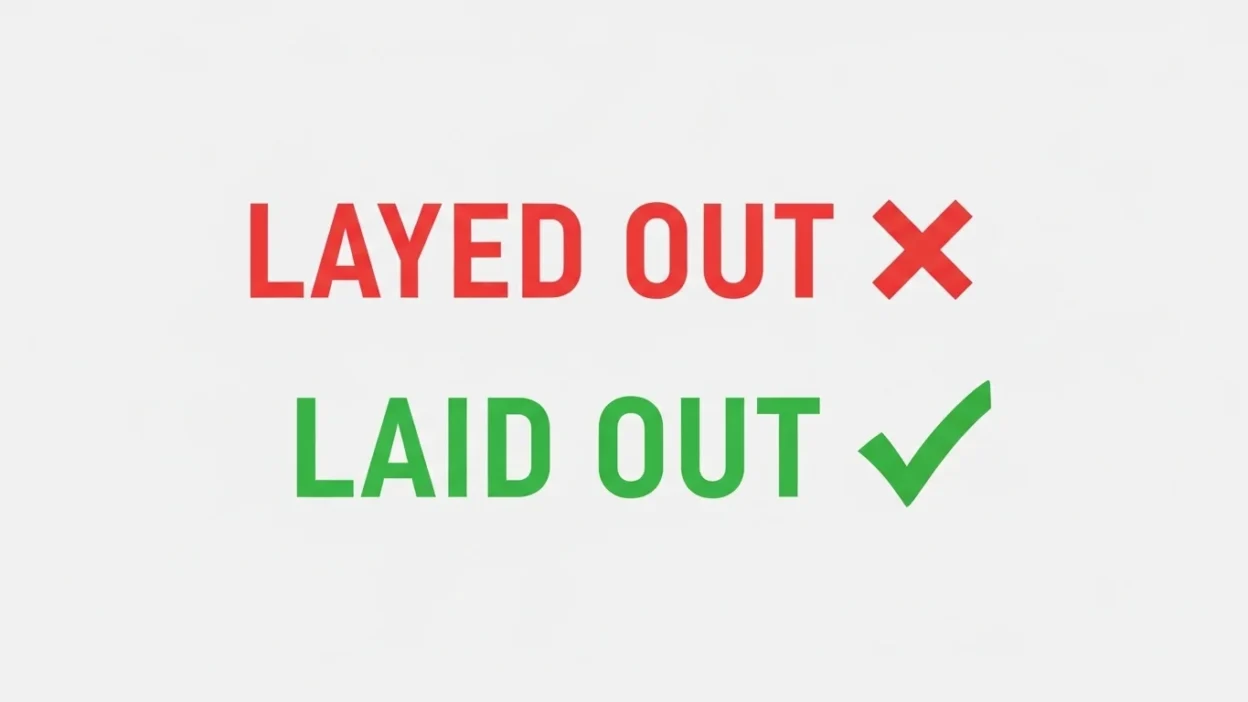
- ❌ Layed out is incorrect
- ✅ Laid out is the correct phrase
- Always use laid out when referring to arranging, explaining, or placing something
What Does “Laid Out” Mean?
The phrase laid out is the past tense of “lay out,” a common phrasal verb with several meanings depending on context.
Core meanings:
- To arrange or organize something
- To explain something clearly
- To place something down carefully
- To design or plan something
Examples:
- She laid out the clothes for tomorrow.
- He laid out his ideas during the meeting.
- The architect laid out the building plan.
- They laid out all the documents on the table.
LSI keywords and related phrases:
- arranged
- organized
- explained
- presented
- planned
- displayed
These help improve SEO and readability.
What Is “Layed Out”? Is It Ever Correct?
Let’s be clear: “layed out” is not correct English.
It’s a misspelling of “laid out.”
Why people write “layed out”:
- Confusion with regular verbs (play → played)
- Not knowing “lay” is irregular
- Typing quickly without proofreading
Important:
- ❌ Layed out → Incorrect
- ✅ Laid out → Correct
Always use laid out in both formal and informal writing.
Layed Out vs Laid Out: Side-by-Side Comparison
| Feature | Layed Out ❌ | Laid Out ✅ |
|---|---|---|
| Valid phrase | No | Yes |
| Grammar | Incorrect spelling | Correct |
| Meaning | None | Arranged or explained |
| Usage | Never correct | Standard English |
| Example | ✖ He layed out plans | ✔ He laid out plans |
Why “Laid Out” Is the Correct Form
The answer comes down to the verb “lay.”
Rule:
👉 Lay is an irregular verb
- Present: lay
- Past: laid
- Past participle: laid
So when forming the phrase:
- lay out → laid out
Memory trick:
👉 Think: “Lay becomes laid—even in phrases.”
Similar patterns:
- pay → paid
- say → said
This pattern helps reinforce the correct form.
How to Use “Laid Out” Correctly
The phrase laid out is very versatile and used in different contexts.
1. Arranging objects
- She laid out the tools on the table.
- He laid out the ingredients before cooking.
2. Explaining ideas
- The teacher laid out the lesson clearly.
- She laid out her arguments step by step.
3. Planning or designing
- The team laid out a strategy for growth.
- The city was carefully laid out by planners.
4. Presenting information
- The report laid out all the findings.
Tip:
Use laid out whenever something is being organized, explained, or placed.
Common Mistakes to Avoid
Here are the most frequent errors with layed out vs laid out:
1. Using “layed out”
- ❌ He layed out the documents
- ✅ He laid out the documents
2. Confusing verb tense
- ❌ She has layed out the plan
- ✅ She has laid out the plan
3. Mixing up “lay” and “lie”
- ❌ He layed down the book
- ✅ He laid down the book
4. Assuming all verbs use “-ed”
Not all verbs follow regular patterns.
Lay vs Lie: Why It Gets Confusing
The confusion often comes from mixing up lay and lie.
Lay:
- Means to place something
- Needs an object
- Past tense: laid
Lie:
- Means to recline
- No object needed
- Past tense: lay
Example:
- She laid the book down
- He lay on the couch
👉 This overlap leads to spelling mistakes like “layed.”
American vs British English Differences
There is no difference between American and British English in this case.
- ✅ Laid out is correct in both
- ❌ Layed out is incorrect everywhere
Key takeaway:
The rule applies globally.
Synonyms and Alternatives for “Laid Out”
To make your writing more engaging, try these alternatives:
Organization context:
- arranged
- organized
- set up
Explanation context:
- explained
- outlined
- presented
Planning context:
- designed
- structured
- mapped out
Examples:
- Laid out a plan → Outlined a plan
- Laid out items → Arranged items
These variations improve flow and SEO.
Real-Life Usage Examples
Here’s how laid out is used in everyday situations:
Daily life:
- She laid out her outfit for the next day.
Work:
- The manager laid out expectations clearly.
Education:
- The professor laid out the course structure.
Projects:
- The team laid out a roadmap for success.
These examples show how practical and common the phrase is.
FAQs About Layed Out vs Laid Out
Is “layed out” ever correct?
No, it is always incorrect.
What is the correct phrase?
The correct phrase is laid out.
Why is “layed out” wrong?
Because “lay” is an irregular verb and becomes “laid,” not “layed.”
What does “laid out” mean?
It means arranged, explained, or placed.
Is “laid out” formal or informal?
It is used in both formal and informal contexts.
Is there a British vs American difference?
No, both use “laid out.”
What is the present form?
The present form is lay out.
How can I remember the correct spelling?
Think: lay → laid, so lay out → laid out.
Summary: Layed Out vs Laid Out Made Simple
The difference between layed out vs laid out is simple once you understand the rule. Laid out is the correct phrase used when something is arranged, explained, or planned, while layed out is a common spelling mistake.
Because “lay” is an irregular verb, its past tense is “laid,” not “layed.” This rule applies even when used in phrases like “lay out.” Learning this pattern will help you avoid similar mistakes in the future.
Actionable Takeaway
Here’s your simple rule:
👉 Always write laid out, never layed out
Before finalizing your writing, take a moment to proofread for common errors. Fixing small mistakes like this can make your communication clearer, more professional, and more effective.