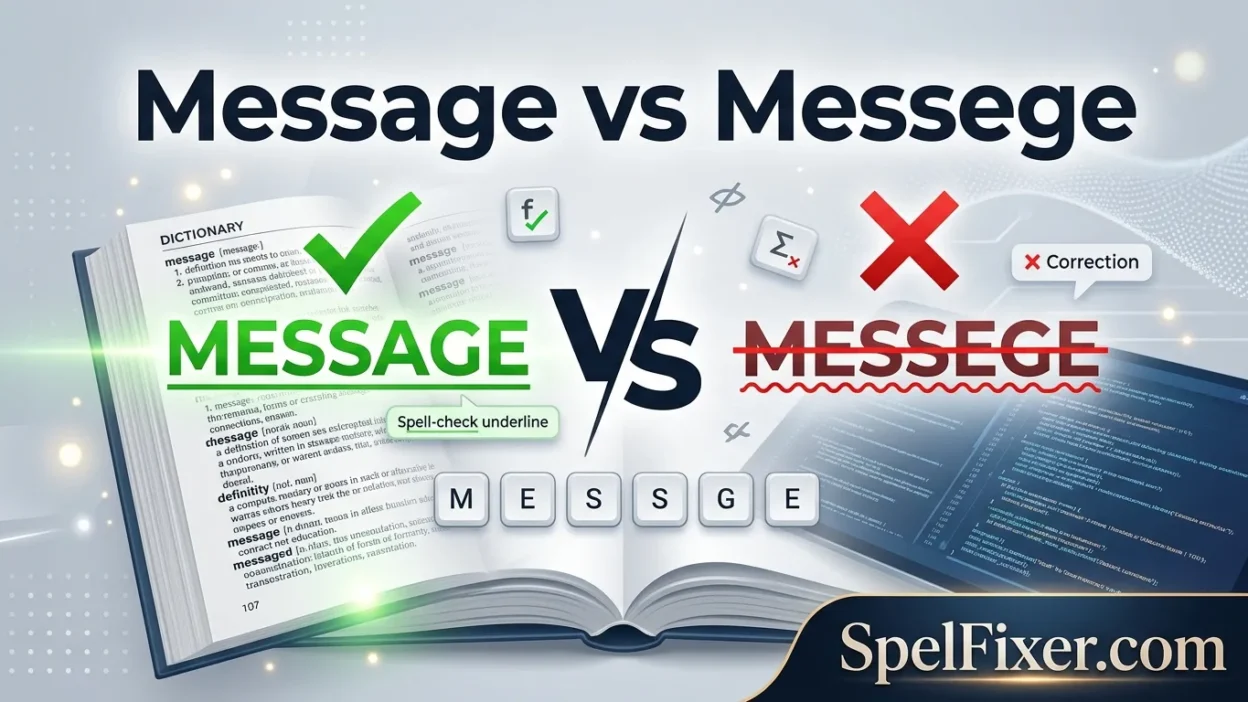
If you are wondering whether “message” or “messege” is correct, the answer is simple: message is the correct English spelling. Messege is a common spelling mistake and is not the standard spelling of the word.
English learners often confuse these two spellings because message does not sound exactly the way it looks. The letters -age at the end can make the spelling easy to forget, especially when typing quickly. If you have ever written “messege” in a text, email, assignment, or social media post, you are certainly not alone.
In this guide, you will learn the correct spelling, meaning, pronunciation, examples, common mistakes, and an easy memory trick to help you remember message every time.
Quick Answer
Message is the correct spelling. Messege is incorrect. A message is a piece of information sent or given to someone, such as a text, email, note, or verbal communication. Remember the spelling as M-E-S-S-A-G-E, with “age” at the end.
Why Do People Confuse “Message” and “Messege”?
People commonly write messege because the pronunciation of message can make the spelling confusing.
The word is pronounced approximately “MESS-ij”, so when people hear it, they may not immediately remember that it is spelled message.
Another reason is typing speed. When writing quickly, it is easy to switch the a and e and accidentally create messege.
The important point is:
- ✅ message — correct
- ❌ messege — incorrect
First Word: Message
Message is the correct English word.
It can be a noun or a verb.
Message as a noun
A message is information communicated to another person.
Examples:
- I received a message from my friend.
- She left a message for her teacher.
- Your message was very clear.
- I sent him a text message.
Message as a verb
Message can also mean to communicate with someone, especially through a messaging service.
Examples:
- You can message me later.
- She messaged her brother.
- I will message you when I arrive.
Second Word: Messege
Messege is not the standard English spelling.
It is usually a misspelling of “message.”
For example:
- ❌ I sent you a messege.
- ✅ I sent you a message.
If you are writing an email, school assignment, professional document, or social media post, always use message.
Message vs. Messege: Comparison Table
| Word | Correct? | Meaning | Example |
| Message | ✅ Yes | Information communicated to someone | I received your message. |
| Messege | ❌ No | Common misspelling of “message” | ❌ I received your messege. |
When Should You Use “Message”?
Use message whenever you are referring to information communicated from one person or source to another.
You can use it for:
- Text messages
- Emails
- Written notes
- Voice messages
- Social media messages
- Verbal communication
- An important idea or point
For example:
Please leave a message after the tone.
You can also use message as a verb:
Message me when you are free.
10+ Examples of “Message”
Here are some simple examples to show the correct usage:
- I received your message this morning.
- She sent me a message yesterday.
- Please read my message carefully.
- He left a message on my phone.
- I will message you later.
- Did you get my message?
- Your message made me happy.
- She messaged her teacher about the assignment.
- I forgot to reply to your message.
- The manager sent an important message to the team.
- Please send me a message when you arrive.
- His speech had a powerful message.
Notice that the spelling remains message whether the word is being used as a noun or a verb.
Common Mistakes With “Message”
The most common mistake is replacing the a with an e:
❌ messege
✅ message
Other mistakes can happen when adding endings:
❌ messeged
❌ messeging
Correct forms include:
✅ messaged
✅ messaging
Example
❌ I am messeging you now.
✅ I am messaging you now.
Memory Trick: Remember “AGE”
A simple way to remember message is to focus on the ending:
MESS + AGE = MESSAGE
Think:
MESSAGE = MESS + AGE
The word ends with -age, not -ege.
So whenever you are unsure, remember:
M-E-S-S-A-G-E
American vs. British English
There is no spelling difference between American and British English for this word.
Both use:
- message ✅
American English:
I sent her a message.
British English:
I sent her a message.
Messege is not the standard spelling in either variety.
Similar Words
Several words are related to message and can appear in similar contexts.
Text
A text is a written message, especially one sent through a mobile phone.
I sent him a text.
Note
A note is a short written piece of information.
She left a note on my desk.
Communication
Communication is the broader process of sharing information or ideas.
Good communication is important in a team.
Notification
A notification is an alert that tells you something has happened.
I received a notification from the app.
Memo
A memo is a short official or business communication.
The manager sent a memo to the employees.
Final Verdict
Message is the correct spelling, while messege is a misspelling.
If you are writing the word in an essay, email, text, website, or professional document, use message.
The easiest way to remember it is:
MESSAGE = MESS + AGE
Just remember the A before GE, and you will avoid the common messege spelling mistake.
Frequently Asked Questions
Is “messege” a correct spelling?
No. Messege is an incorrect spelling. The correct word is message.
Is it “message” or “messege”?
The correct spelling is message.
Message → ✅ Correct
Messege → ❌ Incorrect
How do you spell message correctly?
Spell it:
M-E-S-S-A-G-E
A useful memory trick is MESS + AGE.
What does “message” mean?
A message is information, an idea, or communication sent or given to another person.
For example:
I received a message from my friend.
Can “message” be used as a verb?
Yes. Message can be used as a verb meaning to communicate with someone, usually electronically.
Message me when you get home.
Is “messege” a typo?
Yes. Messege is generally a spelling error for message.
What is the plural of “message”?
The plural is messages.
Example:
I have three new messages.
Is “message” spelled differently in British English?
No. Message is spelled the same in both American and British English.
Remember This
Message = correct ✅
Messege = incorrect ❌
Memory trick:
MESS + AGE = MESSAGE
Whenever you see or type messege, replace it with message.
The correct spelling is always:
MESSAGE
Conclusion
The difference between message and messege is straightforward: message is the correct English spelling, while messege is a common misspelling. The word message can refer to information communicated to someone and can also be used as a verb for sending someone a communication.
If you often make this spelling mistake, remember MESS + AGE. The final part of message is -age, not -ege. With that simple trick, you can confidently use message in texts, emails, schoolwork, and everyday writing.