Have you ever wondered whether to write informations or information? This is a common question for English learners because many languages allow both singular and plural forms of words that refer to facts, knowledge, or data.
The answer is simpler than you might think. In standard English, information is almost always the correct choice. Understanding why can help you avoid a common grammar mistake and sound more natural in both writing and conversation.
Quick Answer
- Information is correct in standard English.
- Informations is generally incorrect and rarely used in modern English.
Examples:
- I need more information about the project. ✅
- She provided useful information. ✅
- I need more informations about the project. ❌
A simple rule:
👉 Information = correct
👉 Informations = usually incorrect
What Does “Information” Mean?
Definition of Information
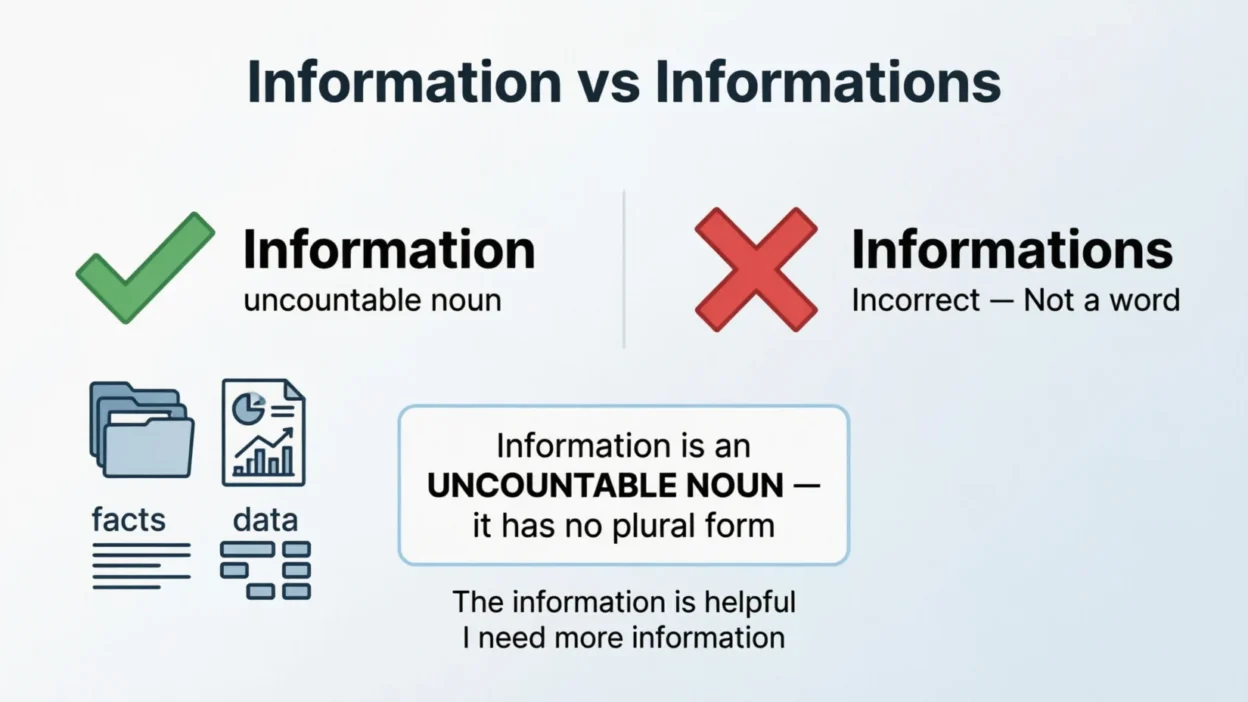
Information refers to facts, details, knowledge, or data about a person, thing, event, or topic.
It is an uncountable noun, which means it does not normally have a plural form.
Examples of Information in Sentences
- The website contains useful information.
- Can you give me more information about the course?
- We received important information from the manager.
- The report includes detailed information about sales.
In each example, information refers to facts or knowledge rather than individual countable items.
Is “Informations” a Real Word?
Standard English Usage
In modern English grammar, informations is generally considered incorrect.
Native speakers almost always use information, regardless of whether they are referring to one fact or many facts.
Incorrect:
- The teacher gave us many informations. ❌
Correct:
- The teacher gave us a lot of information. ✅
Why People Say Informations
Many learners use informations because similar words in their native languages have plural forms.
For example, some languages treat information as a countable noun, but English does not.
Why Information Is Uncountable
What Is an Uncountable Noun?
An uncountable noun refers to something that cannot normally be counted individually.
Examples include:
- Information
- Advice
- Knowledge
- Furniture
- Equipment
- Research
You don’t usually say:
- Informations ❌
- Advices ❌
- Furnitures ❌
Instead, you use the singular form.
Examples
Correct:
- She gave me useful information.
- He offered valuable advice.
- The office purchased new equipment.
Incorrect:
- She gave me useful informations.
- He offered valuable advices.
- The office purchased new equipments.
Information vs Informations: Key Differences
| Feature | Information | Informations |
|---|---|---|
| Standard English | Correct | Usually incorrect |
| Countable? | No | Not normally used |
| Part of Speech | Uncountable noun | Nonstandard plural form |
| Common Usage | Very common | Rare and generally avoided |
| Example | Useful information | Useful informations ❌ |
The safest choice is almost always information.
How to Express Multiple Pieces of Information
Since information is uncountable, English uses other expressions when referring to individual facts.
Piece of Information
Examples:
- She shared a piece of information.
- That’s an important piece of information.
Several Pieces of Information
Examples:
- The report contains several pieces of information.
- We gathered many pieces of information during the investigation.
Bits of Information
Examples:
- He collected useful bits of information.
- The detective discovered several bits of information.
These phrases sound natural and grammatically correct.
Common Examples of Information
In Education
- Course information
- Student information
- Exam information
Examples:
- The university website provides admission information.
- Students received information about the schedule.
In Business
- Customer information
- Financial information
- Product information
Examples:
- The company protects customer information.
- Financial information must remain confidential.
In Everyday Conversation
- Travel information
- Health information
- Contact information
Examples:
- I need travel information before booking the trip.
- Please update your contact information.
Common Mistakes to Avoid
Mistake 1: Adding an S
Incorrect:
- Can you send me the informations?
Correct:
- Can you send me the information?
Mistake 2: Using Many with Information
Incorrect:
- There are many information available.
Correct:
- There is a lot of information available.
Or:
- There are many pieces of information available.
Mistake 3: Treating Information as Countable
Incorrect:
- I received three informations today.
Correct:
- I received three pieces of information today.
Real-Life Examples
Example 1
Correct:
- The brochure contains useful information.
Incorrect:
- The brochure contains useful informations.
Example 2
Correct:
- We need more information before making a decision.
Incorrect:
- We need more informations before making a decision.
Example 3
Correct:
- The police gathered information from witnesses.
Incorrect:
- The police gathered informations from witnesses.
Easy Memory Tricks
Think of Information Like Water
You don’t usually say:
- Waters ❌
Similarly, you don’t say:
- Informations ❌
Both are typically treated as uncountable nouns.
Use “Piece of”
When you want to count information, remember:
- One piece of information
- Two pieces of information
- Several pieces of information
Quick Rule
If you’re tempted to add -s to information, don’t.
Use:
- Information ✅
- Piece of information ✅
Avoid:
- Informations ❌
American vs British English Differences
There is virtually no difference between American and British English regarding information.
American English
- I need more information.
- The information was accurate.
British English
- I need more information.
- The information was accurate.
Both varieties use information as an uncountable noun.
Related Uncountable Nouns
Learning information becomes easier when you understand similar nouns.
| Correct | Incorrect |
|---|---|
| Information | Informations |
| Advice | Advices |
| Furniture | Furnitures |
| Equipment | Equipments |
| Knowledge | Knowledges |
| Research | Researches* |
*Researches is only used in very specific academic contexts and is uncommon in everyday English.
FAQs About Informations vs Information
Is informations grammatically correct?
In standard modern English, no. Information is usually the correct form.
Why is information uncountable?
Because it refers to facts and knowledge as a collective concept rather than individual countable objects.
What is the plural of information?
Information generally has no plural form in standard English.
How do I count information?
Use phrases such as a piece of information or several pieces of information.
Is “many informations” correct?
No. Use much information, a lot of information, or many pieces of information.
Can native English speakers say informations?
In standard usage, they rarely do. It is generally considered incorrect.
Which is correct: information or informations?
Information is correct in nearly all situations.
Is information singular or plural?
It is an uncountable noun that typically takes singular verb agreement.
Example:
- The information is helpful.
Final Summary
When choosing between informations and information, the correct choice in standard English is almost always information. The word is an uncountable noun that refers to facts, details, and knowledge collectively. Because it is uncountable, it does not normally take a plural form.
If you need to refer to individual facts, use expressions such as a piece of information or several pieces of information. Following this rule will make your English sound more natural, accurate, and professional.
Actionable Takeaway
Before writing informations, ask yourself:
Am I talking about facts or knowledge?
If yes, use:
- Information ✅
- A piece of information ✅
- Several pieces of information ✅
Avoid:
- Informations ❌
Remember this simple phrase:
Information is uncountable, so it usually never gets an “s.”

Fenwick Quentin is a creative blogging author known for his analytical yet engaging writing style.
He explores topics such as innovation, digital culture, and personal development with depth and clarity.
Through his articles, Fenwick encourages readers to think critically and embrace continuous growth.