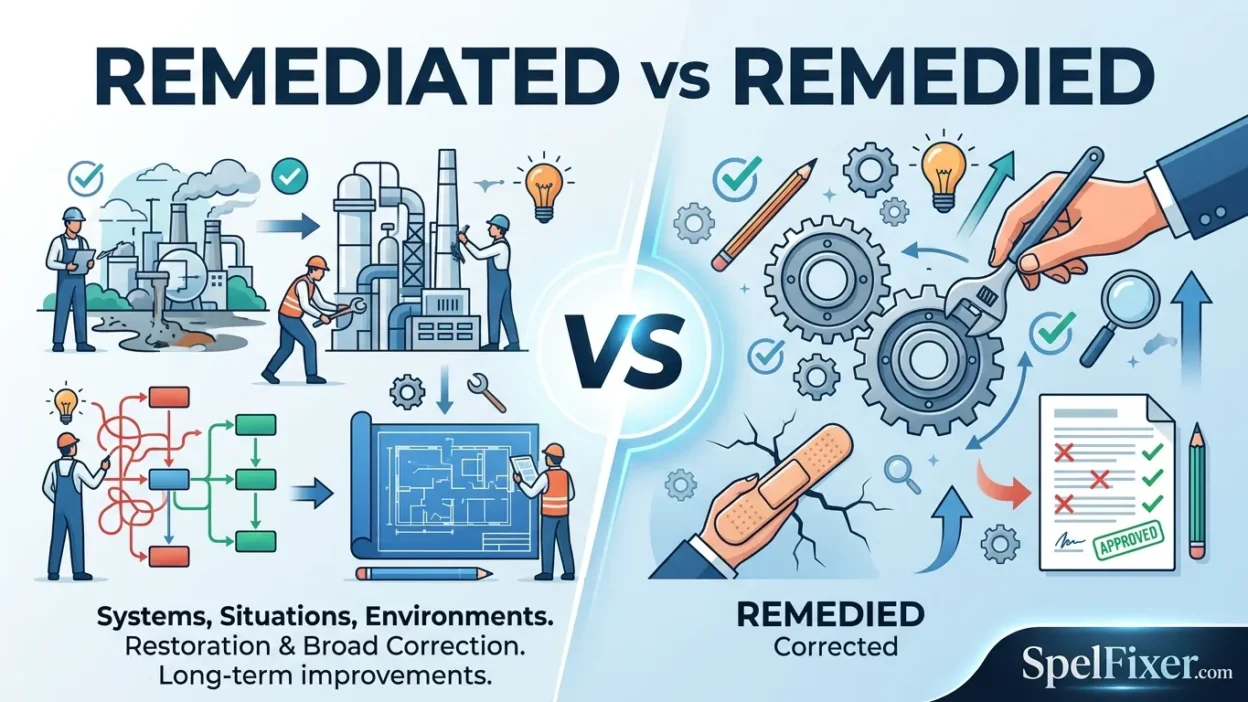
If you have come across “remediated” and “remedied,” you may wonder whether they mean the same thing. Both words are related to fixing a problem, but they are not always interchangeable. The difference becomes clearer when you look at what kind of problem is being addressed and how the word is commonly used.
In everyday English, choosing the right word can make your writing more precise. “Remedied” usually means that a problem, fault, or situation has been corrected, while “remediated” often suggests that a problem has been addressed, treated, or brought under control, especially in technical, environmental, legal, or professional contexts.
Quick Answer:
- Remedied means corrected, fixed, or put right.
- Remediated means addressed, treated, or corrected, often referring to a specific problem or harmful condition.
- Remedied is more common in general everyday English.
- Remediated is especially common in environmental, cybersecurity, IT, education, healthcare, and professional contexts.
- Use remedied when you simply mean that something was fixed.
- Use remediated when the context involves mitigation, treatment, restoration, or systematic correction.
Simple example:
The error was remedied quickly.
The contaminated soil was remediated after testing.
What Does “Remedied” Mean?
Remedied is the past tense and past participle of remedy. It means that something undesirable has been corrected, resolved, or improved.
The word remedy can function as both a verb and a noun. As a verb, it means to take action to correct a problem.
For example:
The company remedied the customer’s complaint.
This means the company took action to resolve the complaint.
Similarly:
The mistake was quickly remedied.
Here, remedied means the mistake was corrected.
Common meanings of “remedied”
Remedied can describe:
- A mistake being corrected
- A problem being resolved
- A defect being fixed
- A complaint being addressed
- A difficult situation being improved
- A deficiency being corrected
It is a flexible word and works well in both formal and everyday writing.
What Does “Remediated” Mean?
Remediated is the past tense and past participle of remediate. It means that a problem, harmful condition, or deficiency has been addressed through some form of corrective action.
The word is particularly common when fixing or reducing the effects of something problematic rather than simply saying “fixed.”
For example:
The company remediated the security vulnerability.
This suggests that the company took technical measures to address the vulnerability.
Another example:
The polluted land was remediated before construction began.
Here, remediated refers to treating or cleaning up environmental contamination.
Common contexts for “remediated”
You are likely to encounter remediated in areas such as:
- Environmental cleanup
- Cybersecurity
- Information technology
- Education
- Healthcare
- Engineering
- Risk management
- Regulatory compliance
For example:
The cybersecurity team remediated the vulnerability.
The site was remediated to reduce environmental risks.
Students received remediated instruction to address learning gaps.
Remediated vs Remedied: Key Difference
The main distinction is usage and context.
Remedied is the broader and more natural word when you simply want to say that something was corrected or resolved.
Remediated tends to sound more specialized. It often describes a deliberate process of addressing a harmful condition, deficiency, risk, or underlying problem.
Think of it this way:
Remedied = fixed or corrected
Remediated = addressed or treated through corrective action
There can be overlap between the two words, but their typical contexts are different.
Comparison Table: Remediated vs Remedied
| Feature | Remedied | Remediated |
| Base verb | Remedy | Remediate |
| Basic meaning | Corrected or fixed | Addressed or treated |
| Common usage | General English | Technical and professional English |
| Tone | General/formal | Often technical/formal |
| Common contexts | Mistakes, complaints, problems | Contamination, vulnerabilities, deficiencies |
| Can mean “fixed”? | Yes | Yes, depending on context |
| Everyday use | Very common | Less common |
| Example | The error was remedied. | The vulnerability was remediated. |
Examples of “Remedied” in Sentences
Here are some natural examples:
- The spelling mistake was remedied before the document was published.
- The company remedied the issue after receiving several complaints.
- The financial problem was eventually remedied.
- The delay was remedied by changing the schedule.
- The software error was remedied in the latest update.
- The disagreement was remedied through open communication.
In each example, remedied focuses on correcting or resolving something that was wrong.
Examples of “Remediated” in Sentences
Now consider these examples:
- The security vulnerability was remediated by the IT department.
- The contaminated area was remediated before redevelopment.
- The organization remediated the compliance issue.
- The affected computers were remediated after the security incident.
- The environmental damage was partially remediated.
- The student received additional instruction to remediate learning deficiencies.
These examples have a more specialized or process-oriented feel.
Can “Remediated” and “Remedied” Be Used Interchangeably?
Sometimes, yes—but not always naturally.
For example:
The problem was remedied.
This sounds perfectly natural in general English.
You could technically say:
The problem was remediated.
This can also be grammatically correct, but it may sound more technical or formal than necessary.
The reverse is also important.
Consider:
The contaminated soil was remediated.
Replacing it with:
The contaminated soil was remedied.
would sound unusual. Remedied is not normally the preferred word for environmental cleanup.
So, while the meanings overlap, context determines which word sounds natural.
Common Mistakes to Avoid
1. Using “remediated” simply to sound more professional
Some writers choose remediated because it sounds technical. That is not always a good reason.
If you are talking about an ordinary mistake or problem, remedied may be clearer.
Instead of:
The minor misunderstanding was remediated.
Prefer:
The minor misunderstanding was remedied.
2. Assuming “remedied” only applies to physical problems
Remedied can describe many kinds of problems, including abstract situations.
For example:
The policy gap was remedied.
The communication problem was remedied.
The financial deficiency was remedied.
3. Treating “remediate” as exactly the same as “repair”
The words can overlap, but remediate often involves addressing a broader harmful condition.
For example, remediation might involve identifying a problem, reducing its effects, cleaning it up, and taking steps to prevent further harm.
4. Confusing “remedy” as a noun and verb
Remedy can be a noun:
The new policy provided a remedy for the problem.
It can also be a verb:
The company remedied the problem.
Recognizing the grammatical role helps you use the word correctly.
Remedied vs Fixed: Are They the Same?
Remedied and fixed can have similar meanings, but their tone differs.
Fixed is more conversational:
We fixed the problem.
Remedied is generally more formal:
We remedied the problem.
In business reports, academic writing, legal documents, and professional communication, remedied may be preferable when you want a formal tone.
Remediated vs Resolved
Resolved usually means that an issue has been settled or brought to a satisfactory conclusion.
Remediated emphasizes corrective action taken to address a problem.
For example:
The customer complaint was resolved.
This suggests the complaint reached a satisfactory conclusion.
The security vulnerability was remediated.
This emphasizes the technical action taken to address the vulnerability.
The distinction is subtle, but useful in professional writing.
American vs British English
There is no major American-versus-British spelling difference between remedied and remediated.
Both forms are used in American and British English.
The bigger difference is frequency and context, not spelling.
Remedied is widely understood in both varieties of English.
Remediated is also used in both, particularly in specialized fields such as environmental science, cybersecurity, education, and compliance.
So you generally do not need to change the word based solely on whether you are writing for an American or British audience.
How to Choose the Right Word
A simple test can help.
Ask yourself:
“Am I simply saying that something was corrected?”
If yes, remedied is often the best choice.
The error was remedied.
“Am I talking about a technical, environmental, educational, security, or other specialized corrective process?”
If yes, remediated may be more appropriate.
The vulnerability was remediated.
When both are grammatically possible, choose the word that sounds most natural for your audience and context. Clear language is usually better than unnecessarily technical language.
FAQs
Is “remediated” the same as “remedied”?
They have overlapping meanings. Both can refer to correcting a problem, but remediated is more commonly used for specialized or technical corrective actions.
Is “remedied” grammatically correct?
Yes. Remedied is the past tense and past participle of remedy.
The problem was remedied.
Is “remediated” a correct word?
Yes. Remediated is the past tense and past participle of remediate.
The environmental problem was remediated.
Which is more common: remedied or remediated?
Remedied is generally more common in general English. Remediated is especially common in specialized professional contexts.
Can I say “the problem was remediated”?
Yes. The sentence is grammatically correct. However, if you simply mean the problem was fixed, “the problem was remedied” may sound more natural.
Should I use “remedied” in formal writing?
Yes. Remedied is perfectly suitable for formal writing. It is especially useful when describing the correction of a mistake, deficiency, complaint, or problem.
What is the opposite of “remedied”?
Depending on the context, possible opposites include worsened, aggravated, unresolved, ignored, or uncorrected.
Which word should I use in everyday English?
Use remedied when you mean that something was corrected or resolved. Reserve remediated for contexts where its more specialized meaning is useful.
Summary
The difference between remediated vs remedied is mainly about context and nuance. Remedied is the broader term and means that something was corrected, fixed, or resolved. It works naturally for everyday problems, mistakes, complaints, deficiencies, and other situations that need correction.
Remediated also involves corrective action, but it often carries a more specialized meaning. It is particularly useful when discussing environmental contamination, cybersecurity vulnerabilities, educational deficiencies, compliance issues, or other conditions requiring a structured remediation process. When you’re unsure, choose remedied for general writing and remediated when the technical context makes the distinction meaningful.
Actionable Takeaway
Remember this simple rule:
Remedied = corrected or fixed.
Remediated = addressed or treated, often through a specialized corrective process.
If your sentence simply says that something was fixed, remedied will usually be the clearer choice. If you’re discussing cleanup, cybersecurity, compliance, environmental restoration, or another technical process, remediated may be the better fit.