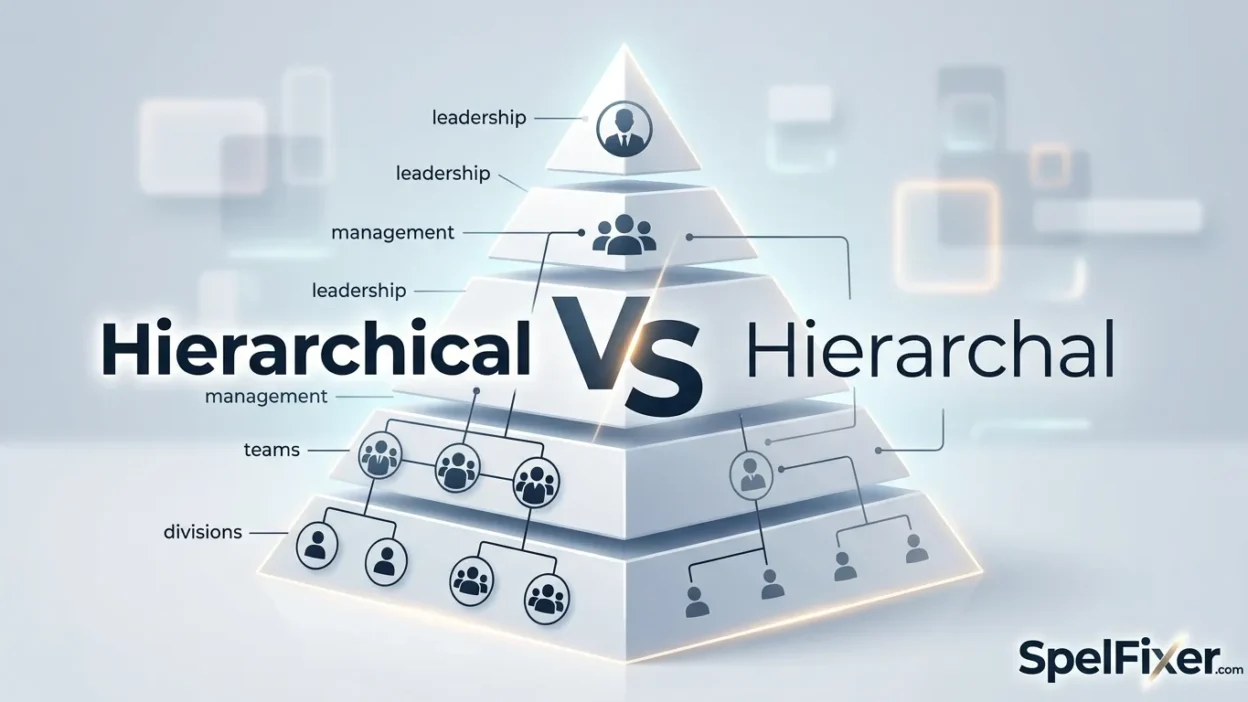
Have you ever wondered whether the correct word is hierarchical or hierarchal? You’re not alone. These two words look almost identical, and both can be used when talking about a hierarchy, ranking, or system of levels. The difference is mainly about usage, familiarity, and style, rather than a completely different meaning.
In most everyday and professional writing, hierarchical is the safer and more widely recognized choice. Hierarchal is also a legitimate word, but it is less common and can sound unusual to many readers. If you’re writing an email, academic paper, website, report, or business document, hierarchical will usually be the better option.
Quick Answer:
Hierarchical and hierarchal are both adjectives related to a hierarchy, meaning a system arranged in levels of importance, authority, status, or rank.
- Hierarchical = relating to or organized according to a hierarchy.
- Hierarchal = also relating to a hierarchy, but less commonly used.
- Most common choice: Hierarchical
- Best for general and professional writing: Hierarchical
- Meaning: The two words are essentially the same.
Example:
The company has a hierarchical management structure.
You could technically use hierarchal in this sentence, but hierarchical sounds more natural to most modern readers.
What Does Hierarchical Mean?
Hierarchical is an adjective describing something arranged in a hierarchy. A hierarchy is a system in which people, groups, positions, or things are organized into different levels.
For example, a company might have a structure in which employees report to managers, managers report to directors, and directors report to executives. This is a hierarchical structure.
The word can describe many different situations, including:
- Organizations
- Management structures
- Social systems
- Government systems
- Classifications
- Computer systems
- Information architecture
- Family relationships
- Organizational charts
- Decision-making processes
Examples of Hierarchical in a Sentence
- The business follows a hierarchical structure.
- The military has a highly hierarchical organization.
- The website uses a hierarchical navigation system.
- Information is arranged in a hierarchical order.
- The company has a traditional hierarchical management system.
- The database uses a hierarchical model.
In each example, hierarchical tells us that something is arranged according to levels or ranks.
What Does Hierarchal Mean?
Hierarchal is also an adjective meaning related to a hierarchy or organized according to hierarchical levels.
In other words, its basic meaning overlaps heavily with hierarchical.
For example:
The organization has a hierarchal structure.
This sentence is understandable and grammatically acceptable. However, many readers are more accustomed to seeing:
The organization has a hierarchical structure.
That difference in familiarity is the main reason hierarchical is generally the preferred choice.
Examples of Hierarchal in a Sentence
- The system has a hierarchal organization.
- The society developed a hierarchal structure.
- The information follows a hierarchal pattern.
- The institution maintained a hierarchal order.
There is nothing inherently wrong with these examples. The issue is simply that hierarchal is less familiar and less frequently preferred in ordinary writing.
Hierarchical vs Hierarchal: Key Differences
| Feature | Hierarchical | Hierarchal |
| Part of speech | Adjective | Adjective |
| Meaning | Related to a hierarchy | Related to a hierarchy |
| Refers to levels/ranks | Yes | Yes |
| Standard English | Yes | Yes |
| Common in modern writing | More common | Less common |
| Suitable for professional writing | Yes | Yes, but less usual |
| Best general choice | Yes | Usually no |
| Meaningfully different? | Not generally | Not generally |
The most important point is that there is usually no major difference in meaning. The choice is primarily one of conventional usage and reader familiarity.
Why Is Hierarchical More Common?
One reason hierarchical feels more natural is that it follows a familiar adjective pattern. English has many words formed with the -ical ending, and hierarchical has become the established form in many fields.
You’ll frequently encounter expressions such as:
- hierarchical structure
- hierarchical system
- hierarchical organization
- hierarchical relationship
- hierarchical model
- hierarchical classification
- hierarchical order
- hierarchical database
Because these combinations are so familiar, hierarchical tends to be the natural choice when describing a system based on levels.
Hierarchal, meanwhile, exists as a valid alternative but has a narrower presence in ordinary contemporary writing.
When Should You Use Hierarchical?
Use hierarchical when you want your writing to sound natural, clear, and familiar to a broad audience.
It is especially useful in:
Business Writing
The company uses a hierarchical leadership structure.
Academic Writing
The study examines hierarchical relationships between social groups.
Technology
The application organizes files using a hierarchical system.
Website Design
A hierarchical navigation structure helps users understand how pages are related.
Everyday Writing
The organization has a fairly hierarchical structure.
If you aren’t sure which form to choose, hierarchical is the safest option.
When Can You Use Hierarchal?
You can use hierarchal when it fits the terminology or writing style of your particular context.
For example:
The researchers analyzed the hierarchal relationships within the organization.
The word is understandable and can be grammatically correct. However, before using it, consider whether hierarchical would sound more natural.
A useful rule is:
If you have no particular reason to choose hierarchal, choose hierarchical.
This is especially helpful when writing for a general audience.
Common Mistakes With Hierarchical and Hierarchal
Mistake 1: Assuming One Is Completely Wrong
It would be inaccurate to automatically treat hierarchal as a spelling mistake. It is an established adjective related to hierarchy.
The real issue is that hierarchical is generally the more familiar and conventional choice.
Mistake 2: Thinking They Have Opposite Meanings
These words do not normally express opposite ideas.
For example:
a hierarchical organization
and
a hierarchal organization
both describe an organization based on levels or ranks.
The difference is primarily usage rather than meaning.
Mistake 3: Using Hierarchal When Hierarchical Sounds Better
Sometimes writers choose hierarchal simply because it is shorter. But shorter doesn’t always mean more natural.
Compare:
The company has a hierarchal structure.
with:
The company has a hierarchical structure.
The second version will generally feel more familiar to readers.
Mistake 4: Confusing the Words With Hierarchy
Remember that hierarchy is the noun.
- Hierarchy = a system of levels or ranks.
- Hierarchical = relating to or organized according to that hierarchy.
- Hierarchal = another adjective with essentially the same basic meaning.
For example:
The company has a clear hierarchy.
The company has a hierarchical structure.
Hierarchical vs Hierarchal in American and British English
There is no major American-versus-British spelling distinction that makes one form exclusively American and the other exclusively British.
Both hierarchical and hierarchal can be found in English varieties on both sides of the Atlantic.
However, hierarchical is generally the more familiar choice in standard modern English, regardless of whether you are writing for an American or British audience.
So, if you’re writing an article, academic assignment, business document, or professional communication, you don’t normally need to change the word based on whether your audience is in the United States or the United Kingdom.
The more important consideration is clarity and conventional usage.
Hierarchical vs Hierarchal Examples
Here are some examples to make the distinction easier to understand:
Hierarchical:
The school has a hierarchical administrative structure.
Hierarchal:
The school has a hierarchal administrative structure.
Both sentences communicate essentially the same idea, but hierarchical is the more natural choice for most readers.
Another example:
Hierarchical:
The software organizes the data in a hierarchical format.
Hierarchal:
The software organizes the data in a hierarchal format.
Again, both can convey the intended meaning, but hierarchical is usually preferable in general-purpose writing.
How to Remember the Difference
A simple way to remember this pair is:
Hierarchy → Hierarchical
If you’re describing something that is structured according to a hierarchy, hierarchical is the form to reach for first.
Think of common phrases such as:
- hierarchical system
- hierarchical structure
- hierarchical organization
- hierarchical model
Because these phrases are widely familiar, choosing hierarchical can make your writing immediately clearer.
Frequently Asked Questions
Is hierarchical or hierarchal correct?
Both hierarchical and hierarchal are valid adjectives related to a hierarchy. However, hierarchical is generally the more common and familiar choice.
Is hierarchal a real word?
Yes. Hierarchal is an established English adjective. It means relating to or organized according to a hierarchy. It is simply less common than hierarchical in many contexts.
Does hierarchical mean the same as hierarchal?
For most purposes, yes. Both words describe something associated with a hierarchy or arranged in hierarchical levels.
Which is better: hierarchical or hierarchal?
Hierarchical is usually the better choice for general, academic, business, and professional writing because it is more familiar to readers.
Is hierarchical more common in American English?
Hierarchical is widely used in American English, but it is not exclusively American. It is also standard and widely recognized in British English.
Can I use hierarchal in academic writing?
Yes, but hierarchical is generally the safer choice if you want conventional wording that will be immediately familiar to most readers.
What is the noun form of hierarchical?
The related noun is hierarchy. For example: The company has a clear hierarchy of authority.
What is the simplest way to choose between them?
Choose hierarchical unless you have a specific reason or established terminology that calls for hierarchal.
Final Summary
Hierarchical vs hierarchal is not a case where one word has a completely different definition from the other. Both adjectives relate to a hierarchy and can describe something arranged according to levels, ranks, or authority. The main practical difference is usage: hierarchical is the more familiar and generally preferred form, while hierarchal is less common.
For everyday communication, professional documents, academic writing, websites, and other situations where clarity matters, hierarchical is usually your best choice. If you encounter hierarchal, don’t automatically assume it is incorrect it is a legitimate word. Just remember that hierarchical will normally sound more natural to a wider audience.
Actionable Takeaway
When you’re unsure which word to use, follow this simple rule:
Hierarchy → hierarchical.
Use hierarchical for the clearest and most conventional wording, and reserve hierarchal for situations where its use is intentional or already established by your context.