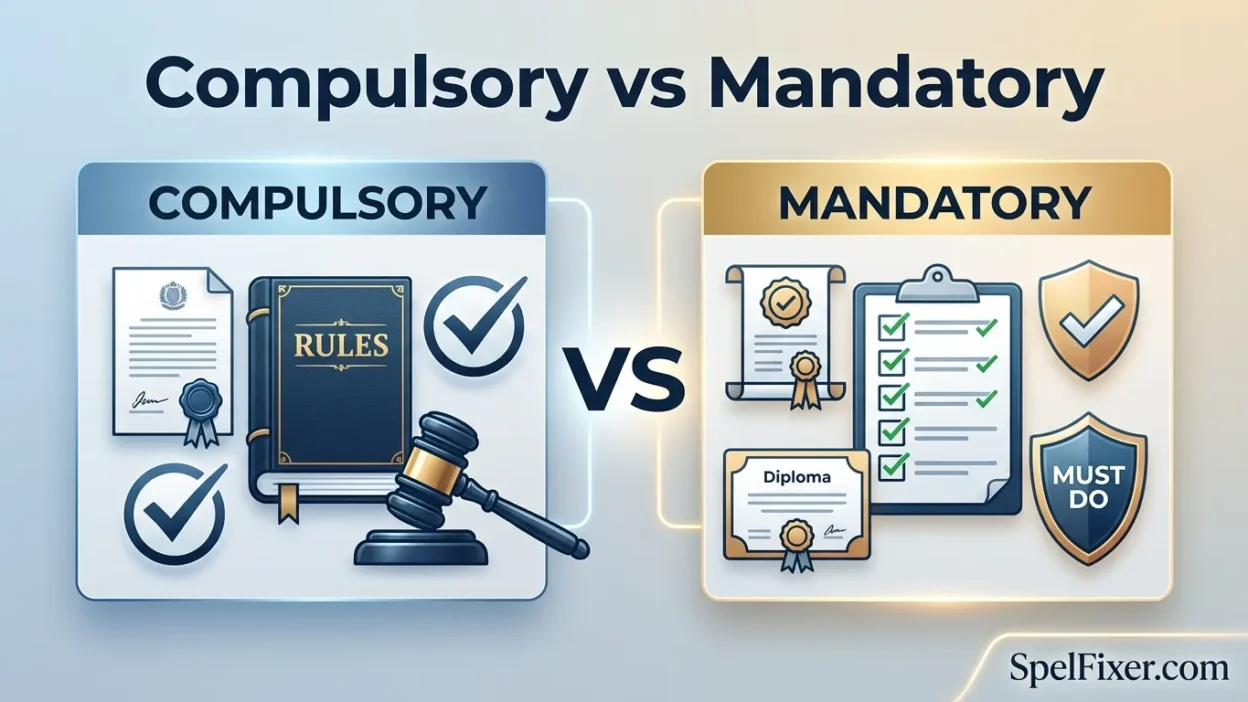
Have you ever wondered whether compulsory vs mandatory means exactly the same thing? You may see both words in school rules, workplace policies, government notices, legal documents, and everyday English. At first glance, they seem interchangeable, and in many situations, they are.
The small difference comes from usage, context, and emphasis. Both words describe something that is required rather than optional, but one may sound more natural than the other depending on the situation. Understanding this distinction can help you write more clearly and choose the right word with confidence.
Quick Answer:
Compulsory and mandatory both mean required or obligatory. If something is compulsory or mandatory, you are expected to do it.
- Compulsory often emphasizes that something is required by a rule, regulation, or established requirement.
- Mandatory also means required, but it is especially common in official, legal, workplace, educational, and administrative contexts.
- In many sentences, they can be used interchangeably without changing the basic meaning.
Example:
- Attendance is compulsory for all students.
- Attendance is mandatory for all students.
Both sentences mean that students are required to attend.
What Does “Compulsory” Mean?
Compulsory is an adjective meaning that something is required and cannot normally be avoided.
It is commonly used for rules, education, training, attendance, subjects, activities, and requirements.
For example:
Wearing a helmet is compulsory on this construction site.
This means workers are required to wear helmets.
Examples of “Compulsory”
- Mathematics is a compulsory subject in the course.
- School attendance is compulsory until a certain age.
- All new employees must complete the compulsory training.
- A safety inspection is compulsory before the equipment can be used.
- English is a compulsory part of the examination.
The word can sometimes sound slightly more formal than everyday alternatives such as required or necessary.
What Does “Mandatory” Mean?
Mandatory is an adjective meaning required by a rule, law, authority, policy, or official requirement.
It is particularly common in formal and professional writing.
For example:
All employees must complete mandatory safety training.
Here, “mandatory” makes it clear that the training is not optional.
Examples of “Mandatory”
- ID cards are mandatory for all visitors.
- The company introduced mandatory training for managers.
- Vaccination records may be mandatory for certain activities.
- The government introduced mandatory reporting requirements.
- A password reset is mandatory after a security incident.
“Mandatory” frequently appears in official instructions because it clearly communicates that compliance is required.
Compulsory vs Mandatory: Key Difference
The main point is that there is no major difference in basic meaning. Both words communicate obligation.
The distinction is mostly about context and common usage.
| Feature | Compulsory | Mandatory |
| Basic meaning | Required; not optional | Required; not optional |
| Part of speech | Adjective | Adjective |
| Formality | Formal | Formal |
| Common with education | Very common | Common |
| Common with workplace policies | Common | Very common |
| Common with laws and regulations | Common | Very common |
| Common in official instructions | Common | Very common |
| Can mean “required”? | Yes | Yes |
| Can usually replace the other? | Often | Often |
So, if you’re deciding between the two, the surrounding context is usually more important than the dictionary definition.
Compulsory vs Mandatory in Real-Life Examples
Seeing the words in similar sentences makes the difference easier to understand.
Education
Compulsory:
Science is a compulsory subject for students in this program.
Mandatory:
Attendance at the orientation session is mandatory.
Both are correct, but compulsory subject is a particularly familiar phrase in educational contexts.
Workplace
Compulsory:
Employees must attend compulsory safety training.
Mandatory:
Employees must complete mandatory safety training.
Both work naturally, although mandatory training is extremely common in workplace and corporate language.
Rules and Regulations
Compulsory:
A license is compulsory for operating this type of vehicle.
Mandatory:
A license is mandatory for operating this type of vehicle.
Both communicate the same basic requirement.
Forms and Applications
Compulsory:
The applicant must provide all compulsory documents.
Mandatory:
The applicant must provide all mandatory documents.
In an application, website form, or administrative setting, mandatory documents or mandatory fields may sound more natural.
When Should You Use “Compulsory”?
Choose compulsory when you want to emphasize that something is required and not optional.
It is especially useful with:
- Education
- Courses and subjects
- Attendance
- Training
- Rules
- Activities
- Requirements
Common combinations include:
- compulsory education
- compulsory subject
- compulsory attendance
- compulsory training
- compulsory requirement
- compulsory examination
For example:
Attendance is compulsory for every class.
This sounds completely natural.
When Should You Use “Mandatory”?
Choose mandatory when discussing an official requirement, particularly in professional, administrative, legal, technical, or organizational settings.
Common combinations include:
- mandatory training
- mandatory attendance
- mandatory requirement
- mandatory field
- mandatory reporting
- mandatory compliance
- mandatory documentation
- mandatory policy
For example:
Completing the security course is mandatory for all employees.
This has a strongly official and policy-oriented tone.
Is “Compulsory” More British Than “Mandatory”?
There is some difference in usage between American and British English, although both words are understood in both varieties.
Compulsory is especially common in British English and other varieties influenced by British English, particularly when discussing education.
For example:
Education is compulsory until a certain age.
In American English, mandatory, required, or obligatory may be preferred depending on the context.
For example:
Attendance is mandatory for all employees.
However, this is not an absolute rule. American speakers use “compulsory,” and British speakers use “mandatory.” The difference is mainly one of frequency and preferred style.
American English
You are more likely to encounter:
- mandatory training
- mandatory attendance
- mandatory requirements
- required documents
British English
You may frequently encounter:
- compulsory education
- compulsory subjects
- compulsory attendance
- compulsory training
If you’re writing for an international audience, either compulsory or mandatory is generally clear.
Compulsory vs Mandatory vs Required
A useful third word to consider is required.
Required is often the simplest and most natural choice.
Compare:
Attendance is compulsory.
Attendance is mandatory.
Attendance is required.
All three mean that attendance is not optional.
However, required is often less formal and more conversational.
For everyday writing, it can be the best option because readers immediately understand it.
For formal policies, mandatory may sound more appropriate.
For educational requirements, particularly in British English, compulsory can be a natural choice.
Common Mistakes to Avoid
1. Assuming the Words Have Completely Different Meanings
A common mistake is thinking that something “compulsory” is somehow more strongly required than something “mandatory.”
Generally, there is no reliable difference in strength. Both indicate obligation.
2. Treating One as Correct and the Other as Incorrect
For many sentences, both versions are grammatically correct.
Incorrect assumption:
“Mandatory” is always correct for official rules.
Better understanding:
Both words can describe official requirements, although “mandatory” is especially common in formal policy language.
3. Using “Compulsory” When “Required” Sounds More Natural
Sometimes writers choose complicated wording when a simple word would be clearer.
Instead of:
Submission of the form is compulsory.
You could write:
The form is required.
The best choice depends on the tone and audience.
4. Confusing “Mandatory” With “Necessary”
These words can overlap, but they are not always identical.
Mandatory means something is officially required.
Necessary means something is needed for a particular purpose or result.
For example:
Wearing an ID badge is mandatory.
This means the organization requires it.
Wearing an ID badge is necessary to enter the secure area.
This explains why it is needed.
Can “Compulsory” and “Mandatory” Be Used Interchangeably?
Often, yes.
For example:
Attendance is compulsory.
and
Attendance is mandatory.
Both mean that attendance is required.
However, replacing one with the other can sometimes make a sentence sound less natural because certain word combinations are more common than others.
For example, compulsory education is a well-established phrase, while mandatory education may sound less natural in some contexts.
Likewise, mandatory reporting is a very common formal expression.
The key is not simply grammar. Natural collocation and context matter.
Why the Difference Matters in Professional Writing
Choosing between compulsory and mandatory is rarely a matter of right versus wrong. Instead, it is about making your writing sound natural and appropriate.
When writing:
- A school policy → compulsory may work very well.
- A corporate policy → mandatory may be more natural.
- A legal or regulatory document → mandatory is common.
- A general explanation → required may be clearest.
- British educational content → compulsory is especially familiar.
This small adjustment can make your writing feel more polished and audience-aware.
Frequently Asked Questions
Is compulsory the same as mandatory?
Yes. In most contexts, compulsory and mandatory mean that something is required and not optional. Their main differences involve usage, context, and regional preference rather than meaning.
Which is stronger, compulsory or mandatory?
Neither word is inherently stronger. Both communicate that something is required. The perceived tone can vary depending on the context, but there is no general rule that one represents a greater obligation.
Is “compulsory” British English?
“Compulsory” is particularly common in British English, especially when discussing education and school requirements. However, it is also used in American English and is widely understood internationally.
Is “mandatory” American English?
“Mandatory” is very common in American English, particularly in workplace, legal, government, and policy contexts. It is also widely used in British English and other varieties of English.
Should I use mandatory or compulsory in a school context?
Both can be correct. Compulsory is especially natural for educational requirements, such as “compulsory subjects” or “compulsory education.” “Mandatory” is also acceptable, particularly for specific school rules or policies.
Is “mandatory” more formal than “compulsory”?
Both are relatively formal words. “Mandatory” is particularly common in official, corporate, administrative, and regulatory language, while “compulsory” has strong usage in education and requirements.
What is the simplest alternative to compulsory and mandatory?
Required is usually the simplest alternative. For example, “Attendance is required” communicates the same basic idea as “Attendance is compulsory” or “Attendance is mandatory.”
Can I use compulsory and mandatory in the same sentence?
You can, but it is usually unnecessary because they have very similar meanings. Using both together may sound repetitive unless they refer to two distinct requirements.
Summary:
The difference between compulsory vs mandatory is mainly about usage rather than meaning. Both words describe something that is required, obligatory, or not optional. Compulsory is especially common in educational contexts and is strongly associated with British English, while mandatory is particularly frequent in workplace, legal, administrative, and policy-related writing.
When choosing between them, consider your audience and the phrase you are writing. If you’re talking about a school subject or education requirement, “compulsory” may sound more natural. If you’re describing an official company rule, regulation, or compliance requirement, “mandatory” may be the better fit. And when you simply want maximum clarity, required is often the easiest choice.
Actionable Takeaway
Remember this simple rule:
Compulsory = required
Mandatory = required
Then consider the context. Use compulsory naturally for education and established requirements, mandatory for official policies and formal obligations, and required when you want simple, direct English.

Fenwick Quentin is a creative blogging author known for his analytical yet engaging writing style.
He explores topics such as innovation, digital culture, and personal development with depth and clarity.
Through his articles, Fenwick encourages readers to think critically and embrace continuous growth.