Have you ever paused mid-sentence wondering whether to write “take effect” or “take affect”? You’re not alone. This confusion is extremely common, especially because effect and affect already cause trouble on their own.
The good news? This is one of those grammar rules that becomes crystal clear once you understand the logic behind it. In this guide, you’ll learn the exact difference, see real examples, avoid common mistakes, and feel confident using the correct phrase every time.
Quick Answer
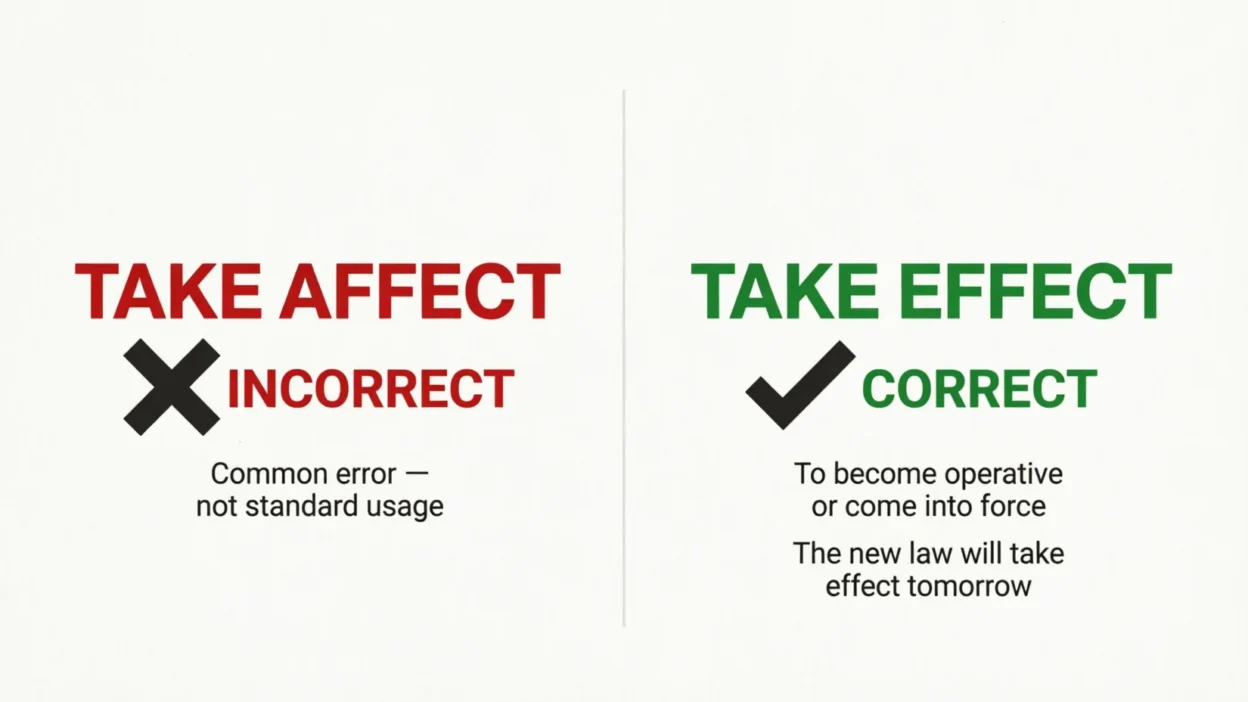
“Take effect” is correct.
“Take affect” is incorrect in standard English and should not be used.
What Does “Take Effect” Mean?
Meaning and Definition
“Take effect” means to begin working, start operating, or become active.
It’s commonly used when talking about:
- Laws
- Rules
- Policies
- Medications
- Changes or decisions
How to Use It
Use “take effect” when something transitions from inactive to active.
Examples
- The new law will take effect next month.
- The medicine started to take effect after 30 minutes.
- The policy changes will take effect immediately.
Key Tip
If you can replace it with “start working,” then “take effect” is correct.
Why “Take Affect” Is Incorrect
Meaning of “Affect”
“Affect” is usually a verb that means:
- To influence something
- To cause a change
Why It Doesn’t Work Here
The phrase “take affect” is incorrect because:
- “Take” needs a noun, not a verb
- “Effect” is the correct noun form
Incorrect Examples
- ❌ The rule will take affect tomorrow.
- ❌ The medicine didn’t take affect quickly.
Corrected Versions
- ✅ The rule will take effect tomorrow.
- ✅ The medicine didn’t take effect quickly.
Effect vs Affect: Quick Grammar Breakdown
Understanding this pair helps eliminate confusion completely.
Effect (Noun)
- Means: result, outcome
- Example: The new system had a positive effect.
Affect (Verb)
- Means: to influence
- Example: Stress can affect your health.
Memory Trick
Affect = Action (both start with A)
Effect = End result
Comparison Table: Take Effect vs Take Affect
| Phrase | Correct? | Meaning | Usage Example |
|---|---|---|---|
| Take effect | ✅ Yes | Begin to work or apply | The law will take effect soon. |
| Take affect | ❌ No | Grammatically incorrect | Incorrect in all standard contexts |
Placement & Grammar Rules Table
| Phrase / Synonym | Sentence Placement | Tone / Formality | Example Sentence |
|---|---|---|---|
| Take effect | After subject + will | Neutral/Formal | The changes will take effect tomorrow. |
| Come into force | End or middle | Formal | The law comes into force in June. |
| Go into effect | End of sentence | Formal/US usage | The rule goes into effect next week. |
| Start working | Flexible | Informal | The plan starts working immediately. |
| Become active | Middle or end | Neutral | The system becomes active at midnight. |
Common Mistakes and How to Avoid Them
Even experienced writers mix these up. Here’s what to watch for:
1. Mixing Up Affect and Effect
Many people assume both words are interchangeable—but they are not.
Fix:
Always remember:
- Affect = verb
- Effect = noun
2. Writing “Take Affect” by Habit
This often happens due to pronunciation similarity.
Fix:
Pause and ask: “Is this something starting?” → Use effect
3. Overthinking the Rule
Sometimes confusion comes from trying too hard.
Fix:
Stick to one rule:
👉 “Take effect” is always correct in this phrase.
4. Using the Wrong Phrase in Formal Writing
Mistakes stand out more in professional contexts.
Fix:
Use alternatives like:
- Go into effect
- Come into force
Practical Example Paragraphs
Example 1: Legal Context
The government announced that the new tax regulations will take effect at the start of the fiscal year. Businesses have been given time to prepare before the rules become active.
Example 2: Medical Context
After taking the medication, it took about 20 minutes to take effect, gradually reducing the patient’s symptoms.
Example 3: Workplace Scenario
The updated company policies will take effect from Monday, ensuring smoother communication across teams.
American vs British English Differences
Interestingly, there’s no major difference between American and British English when it comes to this phrase.
However, alternatives vary slightly:
- American English: “go into effect”
- British English: “come into force”
Both still rely on the correct noun effect, not affect.
Synonyms and Related Phrases
To improve your writing variety, you can use:
- Go into effect
- Come into force
- Become effective
- Start operating
- Be implemented
These all carry a similar meaning depending on context.
FAQs
1. Is “take affect” ever correct?
No. It is always incorrect in standard English.
2. What does “take effect” mean in simple words?
It means something starts working or becomes active.
3. Why do people confuse affect and effect?
Because they sound similar but have different grammatical roles.
4. Can “affect” ever be a noun?
Rarely, in psychology—but not in this phrase.
5. Is “take effect” formal or informal?
It works in both formal and everyday language.
6. What is a synonym for “take effect”?
“Go into effect” or “come into force.”
7. How can I remember the difference quickly?
Use this rule:
👉 Affect = Action
👉 Effect = End result
Final Thoughts
Understanding the difference between “take effect” and “take affect” is easier than it first seems. Once you recognize that “effect” is the correct noun, the confusion disappears completely. This small grammar fix can make a big difference in how polished and professional your writing appears.
The next time you write about laws, policies, or changes, confidently use “take effect.” Keep the simple memory trick in mind, and you’ll avoid this mistake for good.
Actionable Takeaway
- Always use “take effect” when something begins or becomes active
- Avoid “take affect”—it’s incorrect
- Remember: Affect = Action, Effect = Result