Have you ever typed “to bad” and paused, wondering if it looked right? You’re not alone. This is one of the most common spelling mix-ups in everyday English, especially in quick messages, social media, and casual writing.
The confusion between to bad vs too bad happens because both sound identical when spoken. But in writing, only one is correct in most situations. Understanding the difference can make your communication clearer, more professional, and easier to trust.
Quick Answer
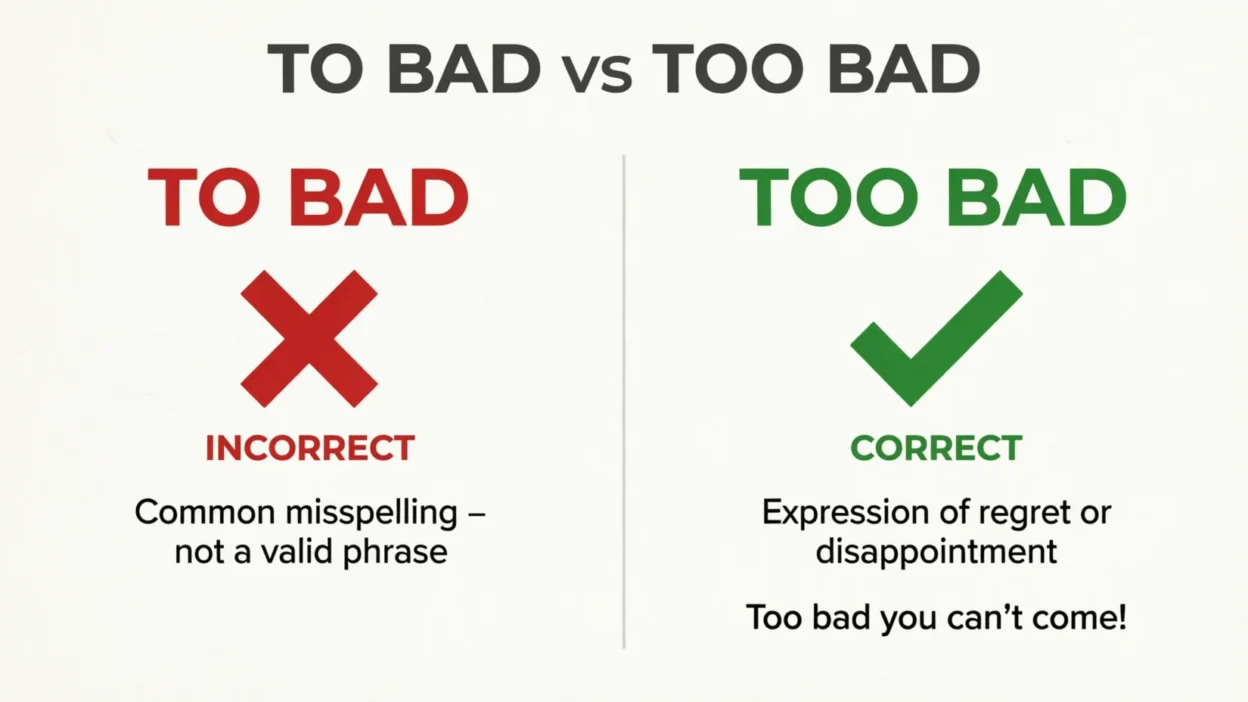
- ❌ To bad is incorrect in most cases
- ✅ Too bad is the correct phrase when expressing disappointment or sympathy
👉 Always use “too bad” when you mean something unfortunate or disappointing.
What Does “Too Bad” Mean?
The phrase “too bad” is commonly used to express disappointment, regret, or sympathy about a situation.
Key meanings:
- Something unfortunate
- Expressing mild regret
- Showing sympathy
Usage rule:
Use “too bad” when reacting to a negative outcome or situation.
Examples:
- It’s too bad you missed the event.
- That’s too bad, I was really hoping you’d come.
- It’s too bad the weather ruined our plans.
LSI keywords and related phrases:
- unfortunate
- disappointing
- what a shame
- regrettable
- unlucky
👉 Tip: Think of “too” as meaning “very” or “excessively.”
What Does “To Bad” Mean?
Let’s be clear:
👉 “To bad” is not correct in standard English.
It’s usually a mistake caused by confusion between the words “to” and “too.”
Why people write “to bad”:
- Typing quickly
- Mishearing the phrase
- Not knowing the rule
- Autocorrect errors
Important:
- ❌ To bad → Incorrect
- ✅ Too bad → Correct
👉 Tip: If you mean “very bad” or “unfortunate,” always use too bad.
To Bad vs Too Bad: Side-by-Side Comparison
| Feature | To Bad ❌ | Too Bad ✅ |
|---|---|---|
| Correct spelling | No | Yes |
| Meaning | None | Unfortunate or disappointing |
| Usage | Incorrect | Common everyday phrase |
| Grammar role | Incorrect combination | Adverb + adjective |
| Example | ✖ That’s to bad | ✔ That’s too bad |
👉 Core idea:
- “Too” = correct
- “To” = wrong in this phrase
Why “Too Bad” Is Correct
The word “too” is an adverb that means:
- “Very”
- “Excessively”
- “Also” (in other contexts)
In “too bad”:
It emphasizes the level of disappointment.
Example:
- It’s too bad → It’s very unfortunate
Why not “to”?
“To” is usually:
- A preposition (go to school)
- Part of an infinitive (to eat, to run)
👉 It doesn’t fit grammatically in this phrase.
Memory trick:
👉 Too = extra “o” = extra meaning (very bad)
How to Use “Too Bad” Correctly
1. Expressing disappointment
- It’s too bad you couldn’t join us.
2. Showing sympathy
- That’s too bad, I hope things get better.
3. Reacting casually
- Oh, too bad!
4. Slightly sarcastic tone (context matters)
- Too bad, you should’ve tried harder.
👉 Tip: Tone changes meaning—be mindful when using it.
Common Mistakes to Avoid
Here are frequent errors people make:
1. Writing “to bad”
❌ That’s to bad
✅ That’s too bad
2. Confusing “to” and “too”
- “To” = direction or action
- “Too” = emphasis
3. Ignoring context
“Too bad” expresses emotion, not direction.
4. Typing without proofreading
Quick messages often lead to this mistake.
5. Overusing the phrase
Try synonyms to keep writing fresh.
Practical Example Paragraphs
Example 1
It’s too bad the meeting was canceled at the last minute. Everyone had prepared carefully, and the change affected the entire schedule.
Example 2
She said it was too bad we couldn’t travel this year, but she understood the situation. Her response felt warm and supportive.
Example 3
Honestly, it’s too bad he didn’t take the opportunity. It could have changed everything for him.
Synonyms and Alternatives for “Too Bad”
To improve your writing variety, consider these alternatives:
Casual tone:
- what a shame
- that’s unfortunate
- that’s sad
Formal tone:
- regrettable
- unfortunate situation
- disappointing outcome
Examples:
- It’s too bad → It’s unfortunate
- That’s too bad → That’s regrettable
👉 Using synonyms enhances readability and SEO.
American vs British English Differences
There is no difference between American and British English in this case.
- ✅ “Too bad” is correct in both
- ❌ “To bad” is incorrect in both
👉 The rule is universal.
When NOT to Use “Too Bad”
Avoid using “too bad” when:
You need a formal tone:
- Instead of “too bad,” use “unfortunate”
The situation is serious:
- “Too bad” may sound insensitive
You need clarity:
- Use more descriptive wording
👉 Example:
- ❌ Too bad about the loss (too casual)
- ✅ It’s deeply unfortunate (more appropriate)
FAQs
Is “to bad” ever correct?
No, it is considered incorrect in standard English.
What does “too bad” mean?
It means something is unfortunate or disappointing.
How do I remember the difference?
Think: “Too = very,” so “too bad” = very bad.
Can “too bad” be rude?
Yes, depending on tone and context.
Is “too bad” formal or informal?
Mostly informal, but acceptable in many situations.
Can I use “too bad” in writing?
Yes, especially in conversational or semi-formal writing.
What is the difference between “too” and “to”?
- “Too” = also or very
- “To” = direction or infinitive marker
Can both appear in one sentence?
Yes:
- It’s too bad I have to go.
Summary:
The difference between to bad vs too bad is simple but important. “Too bad” is the correct phrase used to express disappointment, while “to bad” is just a common spelling mistake.
Using the correct form improves your writing instantly. It shows attention to detail and helps your message feel more natural and polished.
Actionable Takeaway
Here’s the rule you should remember:
👉 Always use “too bad”
👉 Never use “to bad”
Before hitting send or publish, take a quick moment to check for small errors like this. Fixing them can make your writing clearer, more professional, and more impactful.