
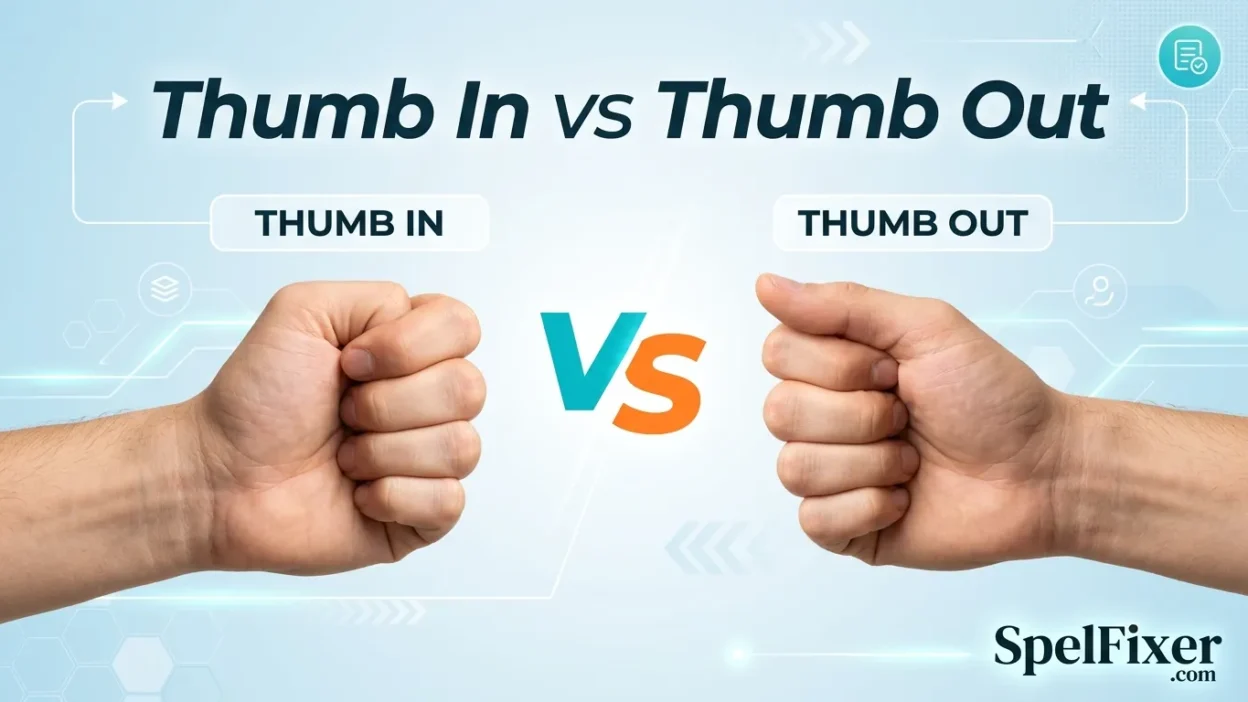
Have you ever heard someone say “thumb in” or “thumb out” and wondered what these phrases actually mean? They can sound confusing because their meaning depends heavily on the physical position of your thumb and the context in which the phrase is used.
In everyday English, thumb in vs thumb out usually describes whether your thumb is positioned inward toward your hand or extended outward away from it.
These expressions can appear in instructions about hand position, body language, exercises, sports, tools, or everyday movements. This guide explains the difference in simple terms, with practical examples so you can use and understand both phrases confidently.
Quick Answer:
Thumb in means the thumb is positioned toward the palm or inside of the hand, while thumb out means the thumb is extended away from the palm or hand.
| Phrase | Basic Meaning | Example |
| Thumb in | Thumb positioned inward or toward the palm | “Keep your thumb in while making a fist.” |
| Thumb out | Thumb positioned outward or away from the palm | “Keep your thumb out when gripping the handle.” |
The exact meaning can vary slightly depending on the activity or instructions, so always consider the surrounding context.
What Does “Thumb In” Mean?
Thumb in generally describes a position where your thumb is turned or held inward toward your palm, fingers, or the center of your hand.
Imagine making a fist. If your thumb rests inside or close to the fingers, you can describe its position as thumb in.
The phrase is commonly used when someone needs to explain a particular hand position clearly and quickly.
Examples of “Thumb In”
- “Keep your thumb in when you close your hand.”
- “Place your thumb in before gripping the object.”
- “With your thumb in, make a gentle fist.”
- “The instructions tell you to keep your thumb in.”
- “His thumb was tucked in against his palm.”
The phrase can describe either a temporary movement or a maintained position.
For example:
“Put your thumb in and close your fingers.”
Here, thumb in tells you where to move the thumb before completing the next action.
What Does “Thumb Out” Mean?
Thumb out describes a position where the thumb is extended outward from the palm or separated from the other fingers.
For example, when giving a thumbs-up, your thumb is pointing outward and away from the rest of your fingers. In a different context, “thumb out” could simply mean keeping the thumb extended while holding something.
Examples of “Thumb Out”
- “Keep your thumb out when holding the handle.”
- “Move your thumb out before opening your hand.”
- “Her thumb was sticking out from the side of her hand.”
- “Keep your thumb out while maintaining your grip.”
- “The coach told the players to keep their thumbs out.”
The important idea is direction. The thumb is positioned away from the palm or other fingers rather than being tucked inward.
Thumb In vs Thumb Out: Main Difference
The simplest way to remember the distinction is:
Thumb in = thumb moves inward.
Thumb out = thumb moves outward.
However, “in” and “out” are relative terms. The precise position can change depending on whether you are talking about the palm, fingers, a particular grip, an exercise, or another movement.
For example, if someone says:
“Put your thumb in.”
They usually want you to bring the thumb closer to the palm or inside the hand position.
If they say:
“Keep your thumb out.”
They usually want you to move or maintain the thumb away from the palm or fingers.
Thumb In vs Thumb Out in Different Contexts
The phrases aren’t limited to ordinary conversation. Their meaning can become more specific depending on the situation.
1. Everyday Hand Instructions
You might hear these phrases when someone is teaching you how to position your hand.
Thumb in:
“Put your thumb in before closing your hand.”
Thumb out:
“Keep your thumb out so you can easily release the grip.”
The goal is usually to make a physical instruction easier to follow.
2. Sports and Physical Activities
Coaches and instructors sometimes use short directional phrases such as thumb in and thumb out when explaining movement or hand positioning.
For instance:
- “Thumb in as you bring your hand toward your body.”
- “Thumb out as you rotate your hand.”
The exact instruction depends on the sport or technique, so these phrases should not be interpreted as universal rules.
3. Exercise Instructions
Exercise instructions may use these terms to describe hand or wrist orientation.
For example:
- “Start with your thumb in.”
- “Rotate your hand until your thumb is out.”
In this context, the words describe the starting and ending positions of the thumb rather than a general English rule.
4. Gripping Objects
When someone explains how to hold an object, thumb in or thumb out may indicate where the thumb should sit.
For example:
“Keep your thumb out when holding the handle.”
This could mean that the thumb should remain outside the fingers or away from the palm.
Because grip instructions differ between activities, the accompanying instructions are important.
Common Mistakes With “Thumb In” and “Thumb Out”
These expressions are simple, but several misunderstandings are common.
Mistake 1: Assuming They Have Only One Exact Position
Thumb in does not always mean that the thumb must be completely hidden inside the palm.
Likewise, thumb out does not necessarily mean that the thumb must point straight outward.
These expressions can describe a general direction.
Mistake 2: Ignoring Context
The meaning of thumb in can change slightly depending on the activity.
For example, a fitness instructor, sports coach, or someone giving everyday instructions may use the phrase differently.
Always look at the complete instruction.
Mistake 3: Confusing “Thumb Out” With “Thumbs Up”
These are not necessarily the same thing.
Thumb out simply describes an outward thumb position. Thumbs up is a specific hand gesture with a conventional meaning.
So:
- Thumb out = a position
- Thumbs up = a recognizable gesture
Mistake 4: Treating “In” and “Out” as Fixed Anatomical Terms
In casual English, in and out are relative directional descriptions. They aren’t always precise anatomical terminology.
If exact positioning matters—for example, in a technical or instructional setting—more specific descriptions may be preferable.
Thumb In vs Thumb Out: Comparison Table
| Feature | Thumb In | Thumb Out |
| Direction | Inward | Outward |
| General position | Toward the palm or fingers | Away from the palm or fingers |
| Common use | Hand-position instructions | Grip and movement instructions |
| Opposite expression | Thumb out | Thumb in |
| Meaning depends on context? | Yes | Yes |
| Example | “Keep your thumb in.” | “Keep your thumb out.” |
American English vs British English
There is no major American-versus-British English difference in the basic meaning of thumb in and thumb out.
Both American English and British English speakers can use these expressions to describe the position or movement of the thumb.
The main difference is more likely to come from context, profession, or activity rather than regional English.
For example, a sports instructor in the United States and one in the United Kingdom could both say:
“Keep your thumb out.”
The intended meaning would generally be understood from the surrounding instructions.
Is “Thumb In” or “Thumb Out” More Common?
Neither expression is universally more common because they are mainly context-dependent instructional phrases.
In ordinary conversation, people may simply describe the position in other ways, such as:
- “Tuck your thumb in.”
- “Keep your thumb tucked.”
- “Extend your thumb.”
- “Move your thumb outward.”
- “Keep your thumb outside.”
These alternatives can sometimes be clearer than the shorter phrases.
Better Alternatives to “Thumb In” and “Thumb Out”
Depending on what you’re trying to communicate, you can use more descriptive language.
Alternatives for “Thumb In”
- Tuck your thumb in
- Keep your thumb tucked
- Move your thumb toward your palm
- Bring your thumb inward
- Place your thumb against your palm
Alternatives for “Thumb Out”
- Extend your thumb
- Keep your thumb extended
- Move your thumb outward
- Hold your thumb away from your palm
- Keep your thumb outside
These alternatives can be particularly useful when giving instructions to someone who might otherwise find in and out ambiguous.
How to Remember the Difference
A simple memory trick is to think of inward and outward.
IN → toward the inside of your hand
OUT → toward the outside of your hand
You can also visualize two basic movements:
Thumb in: ✋ → thumb moves toward the palm
Thumb out: ✋ → thumb moves away from the palm
The exact physical position may differ according to the activity, but the basic directional idea remains the same.
FAQs
1. What does “thumb in” mean?
“Thumb in” generally means keeping or moving your thumb inward, usually toward your palm, fingers, or the center of your hand.
2. What does “thumb out” mean?
“Thumb out” generally means positioning or moving your thumb outward, away from your palm or the other fingers.
3. Are “thumb in” and “thumb out” opposites?
Generally, yes. They describe opposite directions or positions of the thumb, although the exact position depends on context.
4. Is “thumb out” the same as “thumbs up”?
No. Thumb out describes the position of a thumb, while thumbs up usually refers to a specific gesture where the thumb points upward.
5. Do Americans and British speakers use these phrases differently?
Not significantly. The basic meanings are understood in both American and British English. Context determines the precise meaning.
6. Can “thumb in” mean putting the thumb inside your fist?
Yes, in some contexts. It can describe a thumb positioned inside or tucked toward the fingers when making a fist.
7. What is another way to say “thumb in”?
Depending on the situation, you can say “tuck your thumb in,” “move your thumb inward,” or “bring your thumb toward your palm.”
8. What is another way to say “thumb out”?
You can say “extend your thumb,” “move your thumb outward,” or “keep your thumb away from your palm.”
Final Summary
The difference between thumb in vs thumb out is primarily about direction and position. Thumb in generally means that the thumb is tucked or moved inward toward the palm or fingers, while thumb out means that the thumb is extended or positioned outward. These phrases are especially useful when describing hand movements, grips, exercises, and physical instructions.
There is no significant difference between American and British English when it comes to their basic meaning. Because the precise position can depend on context, don’t assume that either phrase always describes one exact anatomical position. When clarity matters, phrases such as “tuck your thumb in” or “extend your thumb outward” can make the instruction easier to understand.
Actionable Takeaway
When you see thumb in, think “move or keep the thumb inward.” When you see thumb out, think “move or keep the thumb outward.” Then use the surrounding instructions to understand the exact position intended.