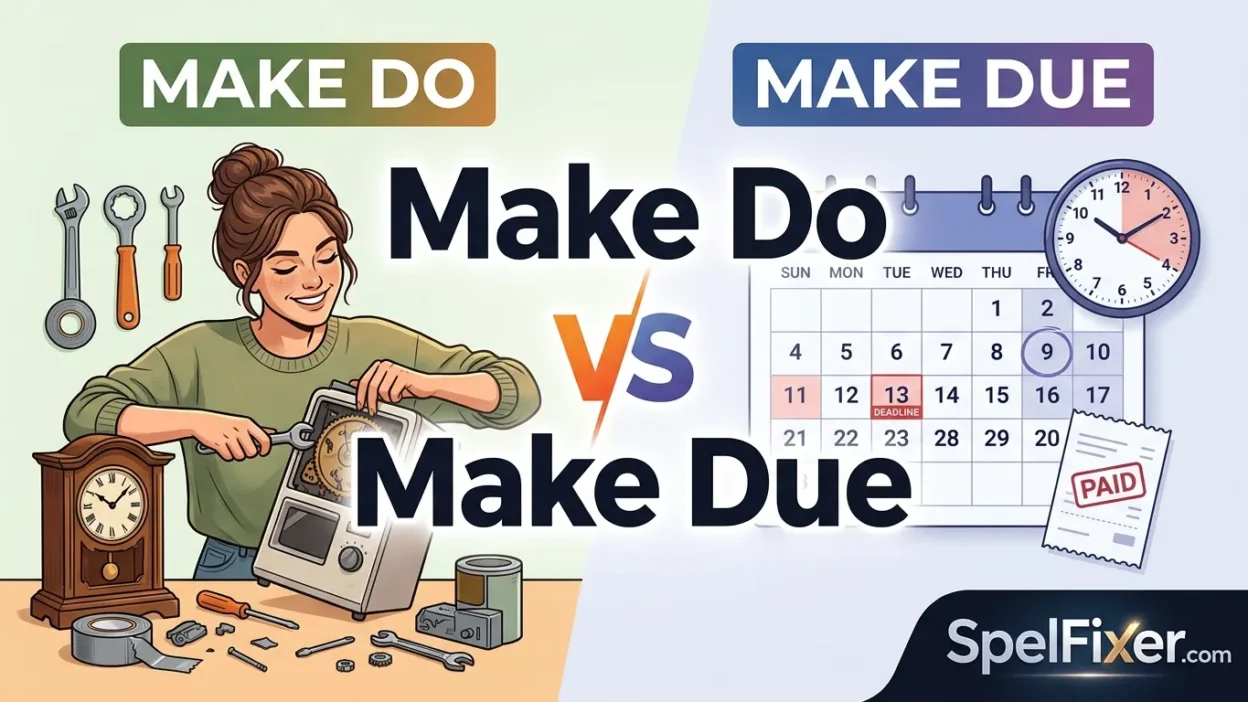
Have you ever written “make due” when you meant “make do”? You’re not alone. These two expressions sound almost identical, but they have very different meanings. If you’re trying to describe getting by with what you have, the correct expression is make do.
The confusion usually comes from the word due, which is a common English word with several meanings. In this guide, we’ll explain make do vs make due, show you how each expression works, provide easy examples, and cover the mistakes that commonly trip people up. By the end, you’ll know exactly which one to use.
Quick Answer:
Make do is the correct expression when you mean to manage with something available, even when it is not ideal.
- ✅ We don’t have enough chairs, so we’ll have to make do.
- ❌ We don’t have enough chairs, so we’ll have to make due.
Make due is generally considered incorrect when used as a substitute for the idiom make do.
The easiest way to remember it is:
Make do = manage with what you have.
What Does “Make Do” Mean?
Make do is an idiomatic expression meaning to manage successfully with limited resources or with something that is not exactly what you wanted or needed.
It often suggests that you have to accept an imperfect situation and find a practical solution.
For example:
We don’t have any butter, so we’ll have to make do with olive oil.
Here, the speaker means they will use what is available rather than going without.
The expression can also appear as make do with something.
Common structure
Make do with + noun
Examples:
- I forgot my charger, so I’ll have to make do with a power bank.
- We don’t have a spare room, so you’ll have to make do with the sofa.
- She couldn’t find her usual ingredients, so she made do with what was available.
- The team had a small budget but made do with the resources they had.
You can also simply say make do when the thing being used is already understood.
“Is this enough food for everyone?”
“It’ll have to do. We’ll make do.”
What Does “Make Due” Mean?
This is where the confusion begins.
Make due is not the standard idiom for “manage with what you have.” In most situations where someone writes make due, they actually mean make do.
The word due has legitimate uses in English, but it normally relates to something that is expected, owed, scheduled, or deserved.
For example:
- The payment is due tomorrow.
- Her baby is due in October.
- He received his due recognition.
- The assignment is due on Friday.
Because due is such a familiar word, people sometimes mistakenly use it in make do.
Is “make due” ever possible?
The individual words make and due can appear together in a sentence when they have their ordinary meanings, but make due is not the standard fixed expression meaning “manage with what you have.”
So, if you’re writing a sentence such as:
We don’t have enough money, but we’ll make ___.
The answer is do, not due.
Make Do vs Make Due: Comparison Table
| Expression | Meaning | Correct as the common idiom? | Example |
| make do | Manage with what is available | ✅ Yes | We’ll have to make do with what we have. |
| make due | Usually a mistaken version of “make do” | ❌ No | Avoid this when you mean “manage.” |
| due | Owed, expected, scheduled, or deserved | ✅ Yes | The payment is due tomorrow. |
| make do with | Manage using a limited or imperfect option | ✅ Yes | I had to make do with an old laptop. |
Why Do People Confuse “Make Do” and “Make Due”?
The main reason is pronunciation.
In many varieties of English, do and due can sound very similar, especially in connected speech. When people hear the expression rather than see it written, they may assume that due is the correct spelling.
There is also a natural tendency to associate due with the idea of something being sufficient or appropriate. However, that isn’t what make do means.
The expression is an established idiom, so it needs to be learned as a complete phrase:
make do = manage with what is available
Thinking of it as one vocabulary unit can make the distinction much easier.
Examples of “Make Do” in Everyday English
Here are some natural examples showing how native speakers use make do.
Example 1: Limited supplies
We ran out of printer paper, so we’ll have to make do with what we have.
The people need to manage using their remaining supplies.
Example 2: Travel
I forgot my headphones, so I had to make do without them.
The speaker managed despite not having the item they wanted.
Example 3: Cooking
We don’t have any eggs, but we can make do with the ingredients in the kitchen.
The available ingredients aren’t necessarily ideal, but they are sufficient.
Example 4: Money
We can’t afford a new table right now, so we’ll make do with the old one.
The old table isn’t the preferred option, but it works.
Example 5: Work
Our usual software isn’t available today, so we’ll have to make do with the basic version.
The basic version is less suitable but still usable.
Example 6: Temporary situation
The guest room isn’t ready yet, so you’ll have to make do with the living room for tonight.
The living room is being used as a temporary alternative.
“Make Do” vs “Make Do With”
Both forms are correct, but they are used slightly differently.
Make do
Use make do when the specific alternative is already obvious from the context.
We don’t have everything we need, but we’ll make do.
Make do with
Use make do with when you want to identify what someone is using as the substitute.
We don’t have a proper table, so we’ll make do with this desk.
This distinction is useful because make do with is especially common when explaining how someone manages a difficult or imperfect situation.
Common Mistakes With “Make Do”
Mistake 1: Writing “make due”
This is the most common error.
❌ We don’t have enough chairs, so we’ll make due.
✅ We don’t have enough chairs, so we’ll make do.
If your intended meaning is “manage with what is available,” always choose make do.
Mistake 2: Writing “make due with”
This mistake is even easier to make because due may seem natural before “with.”
❌ We’ll make due with the old equipment.
✅ We’ll make do with the old equipment.
Remember the fixed expression:
make do with
Mistake 3: Assuming “due” means “suitable”
The word due doesn’t mean “good enough” or “suitable” in the expression make do.
For example:
We’ll make do with this.
means:
We’ll manage with this.
It does not mean that the thing is necessarily perfect or ideal.
Mistake 4: Using “make do” when something is owed
Don’t confuse make do with situations involving payments, deadlines, or obligations.
For example:
The rent is due on Monday.
Here, due is correct because the payment is expected on Monday.
You wouldn’t replace it with do.
Make Do vs “Make It Work”
Make do and make it work can have similar meanings, but they aren’t always interchangeable.
Make do emphasizes managing with limited or imperfect resources.
We don’t have the right tools, but we’ll make do.
Make it work often emphasizes finding a solution despite difficulties.
We don’t have the right tools, but we’ll make it work.
Both can sound natural, but make do specifically carries the idea of accepting what is available.
Other related phrases include:
- get by
- manage
- cope
- use what you have
- work with what you’ve got
- make the best of it
- manage with limited resources
American vs British English: Is There a Difference?
There is no major American vs. British English difference in the spelling or basic meaning of make do.
Both American and British English use make do to mean managing with something less than ideal.
For example:
American English:
We’ll have to make do with the old computer.
British English:
We’ll have to make do with the old computer.
The spelling remains the same in both varieties.
The confusion between do and due is therefore not a US-versus-UK spelling difference. It’s primarily a matter of hearing the words incorrectly or confusing two different words.
How to Remember “Make Do”
Here’s a simple memory trick:
Do = manage or act.
When you make do, you are making something work with the resources you have.
Think:
Make do = do with what you’ve got.
If you’re talking about something being owed, expected, or scheduled, that’s when due belongs.
For example:
- Make do with what you have. ✅
- The bill is due tomorrow. ✅
This quick distinction can prevent most spelling mistakes.
When Should You Use “Due”?
Learning when due is correct can also help you avoid confusing it with do.
Due can mean:
Expected or scheduled
The train is due at 8 p.m.
Owed
The payment is due next week.
Deserved
He received his due reward.
Expected to give birth
Her baby is due in December.
None of these meanings relates to the idiom make do.
FAQs
Is “make do” or “make due” correct?
Make do is correct when you mean “manage with what is available.” Make due is generally an error when used with this meaning.
What does “make do” mean?
Make do means to manage with something available, even if it isn’t ideal or exactly what you wanted.
Is “make do with” correct grammar?
Yes. Make do with is a standard and common expression.
We’ll have to make do with the supplies we have.
Why do people say “make due”?
People often confuse do and due because they can sound similar. The mistake is especially common when someone has learned the phrase by hearing it rather than reading it.
Is “make due” ever grammatically correct?
The words make and due can occur next to each other in other grammatical contexts, but make due is not the standard idiom meaning “manage with what you have.” For that meaning, use make do.
Is “make do” used in American English?
Yes. Make do is common in American English and British English.
What is another way to say “make do”?
Depending on the context, you can say manage, get by, cope, work with what you have, or make the best of the situation.
How can I remember the correct spelling?
Remember: make do = manage with what you have. If you’re talking about something being owed, expected, or scheduled, use due.
Summary:
The difference between make do vs make due is straightforward once you connect each expression with its meaning. Make do is the correct idiom when you mean managing with limited, imperfect, or available resources. For example, “We’ll have to make do with the old equipment” means that the old equipment will have to be used because nothing better is available.
Make due is generally a spelling mistake when someone intends to use this idiom. The word due is still a perfectly valid English word, but it has different meanings, such as something being owed, expected, scheduled, or deserved. The best practical rule is simple: when you mean “manage with what you have,” write “make do.”
Actionable Takeaway
Before writing make due, stop and ask yourself:
“Do I mean manage with what I have?”
- If yes → make do ✅
- If you’re talking about something being owed, expected, scheduled, or deserved → due ✅
Correct: “We’ll have to make do with what we have.”
Incorrect for this meaning: “We’ll have to make due with what we have.”

Fenwick Quentin is a creative blogging author known for his analytical yet engaging writing style.
He explores topics such as innovation, digital culture, and personal development with depth and clarity.
Through his articles, Fenwick encourages readers to think critically and embrace continuous growth.