
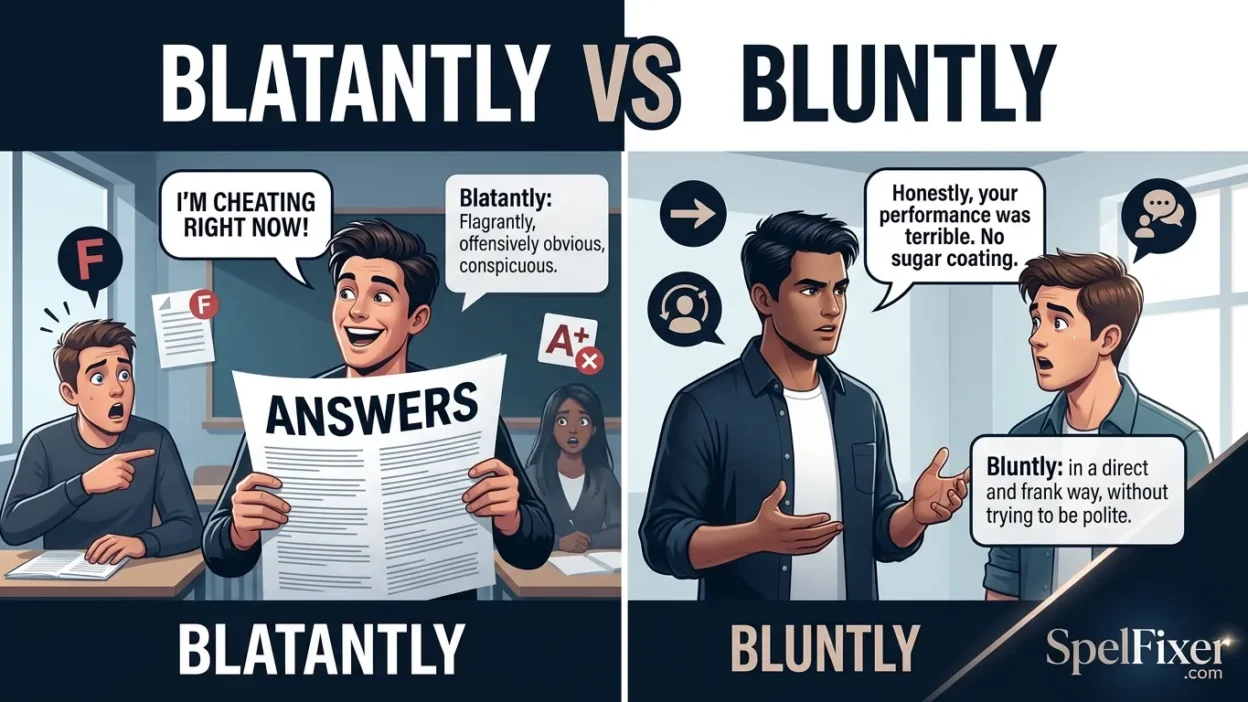
Have you ever wanted to describe someone as being very direct, only to hesitate between blatantly vs bluntly? These two adverbs can both describe something that is obvious or straightforward, but they do not express the same idea. Choosing the wrong one can subtly change the meaning of your sentence.
The key difference is simple: blatantly usually means something is done or said in an obvious, often shameless or offensive way, while bluntly means speaking in a direct, plain, and sometimes insensitive manner. Once you understand the difference, using each word naturally becomes much easier.
Quick Answer:
Blatantly means openly, obviously, or in a way that is difficult to ignore, often with a negative implication.
Bluntly means directly, frankly, or without trying to soften what you are saying.
| Word | Basic Meaning | Typical Tone | Example |
| Blatantly | Obviously or openly, often in a wrong or offensive way | Usually negative | He blatantly ignored the rules. |
| Bluntly | Directly and frankly, without softening words | Direct, sometimes harsh | She bluntly told him the truth. |
Easy memory trick:
- Blatantly = obviously and openly
- Bluntly = directly and frankly
What Does Blatantly Mean?
Blatantly is an adverb derived from the adjective blatant. It describes something that is extremely obvious, conspicuous, or openly done, particularly when the behavior is inappropriate, dishonest, unfair, or unacceptable.
When something happens blatantly, there is often a sense that the person is not even trying to hide what they are doing.
For example:
He blatantly copied the answers during the test.
This sentence suggests that the copying was obvious and perhaps shameless. The person was not making much effort to conceal it.
Common meanings of blatantly
Depending on the context, blatantly can mean:
- Obviously
- Openly
- Shamelessly
- Clearly
- Unmistakably
- In an obvious and offensive way
The word commonly appears with negative actions or situations.
Examples of blatantly
- She blatantly ignored the warning.
- The company blatantly violated the agreement.
- He blatantly lied about what happened.
- They blatantly broke the rules.
- The advertisement was blatantly misleading.
- He blatantly copied his friend’s work.
Notice that these examples focus on the obvious nature of an action, rather than the way someone communicates.
What Does Bluntly Mean?
Bluntly comes from the adjective blunt. When someone speaks bluntly, they communicate their thoughts or feelings in a very direct way without using polite expressions, indirect language, or unnecessary softening.
For example:
She bluntly told me that my idea would not work.
The sentence focuses on how she communicated the message. She was straightforward rather than diplomatic.
Being blunt is not necessarily dishonest or wrong. A person can be blunt while still telling the truth and trying to help. However, blunt communication can sometimes sound rude, insensitive, or harsh.
Common meanings of bluntly
Bluntly can mean:
- Directly
- Frankly
- Honestly
- Plainly
- Without hesitation
- Without softening the message
It is especially common when introducing an uncomfortable truth or an opinion.
Examples of bluntly
- He bluntly refused the offer.
- She bluntly explained why she disagreed.
- To put it bluntly, we need more time.
- The manager bluntly criticized the proposal.
- I will say it bluntly: this plan needs improvement.
- He bluntly asked whether they were serious.
Here, the important point is the speaker’s direct manner of expression.
Blatantly vs Bluntly: The Main Difference
The easiest way to distinguish these words is to ask what you are describing.
If you are describing how obvious or openly wrong something is, use blatantly.
If you are describing how directly someone speaks or communicates, use bluntly.
Compare these sentences:
He blatantly lied to his customers.
This means the lie was obvious or shameless.
He bluntly told his customers that the product had problems.
This means he communicated the information directly, without trying to make it sound nicer.
The words can sometimes appear in similar situations, but their emphasis is different.
Blatantly focuses on the obviousness of an action.
Bluntly focuses on the directness of communication.
Blatantly vs Bluntly Examples
Seeing the words in different contexts can make the distinction much clearer.
Example 1: Breaking rules
The player blatantly broke the rules.
The violation was obvious and possibly deliberate.
The referee bluntly explained the penalty.
The referee communicated the decision directly.
Example 2: Telling the truth
He bluntly told her that the proposal needed major changes.
The focus is on his straightforward way of speaking.
The company blatantly ignored customer complaints.
The focus is on the company’s obvious disregard for the complaints.
Example 3: Dishonesty
She blatantly lied about her qualifications.
Her dishonesty was obvious or shameless.
The interviewer bluntly asked whether she had exaggerated her experience.
The interviewer asked the question in a very direct way.
Can Blatantly and Bluntly Be Used Interchangeably?
Usually, no.
Although both words can sometimes occur in negative situations, replacing one with the other can change the meaning.
Consider:
He blatantly insulted his colleague.
This suggests the insult was openly or obviously delivered, perhaps without concern for the consequences.
Now consider:
He bluntly insulted his colleague.
This emphasizes the direct or unfiltered way he expressed the insult.
The first sentence highlights openness and obviousness. The second highlights directness and lack of tact.
That distinction is small but important.
Common Mistakes With Blatantly and Bluntly
Because both words can describe unpleasant behavior, they are sometimes confused. Here are some common mistakes to avoid.
Mistake 1: Using blatantly when you mean directly
Incorrect or awkward:
She blatantly explained her concerns.
If the intended meaning is that she spoke very directly, bluntly is usually more appropriate.
Better:
She bluntly explained her concerns.
Mistake 2: Using bluntly when something is simply obvious
Consider:
The company blatantly violated the law.
Here, blatantly works because the violation is open and obvious.
Using bluntly would suggest a manner of speaking, which is not the main idea.
Mistake 3: Assuming blatantly always means loudly
Blatantly does not mean “loudly.” Something can be blatant without making any noise.
For example:
The website blatantly copied another company’s design.
The issue is that the copying is obvious, not that anyone is speaking loudly.
Mistake 4: Assuming bluntly always means rudely
A blunt person may sound rude, but bluntly primarily means direct or frank.
For example:
To put it bluntly, we need to change our strategy.
The speaker is being straightforward. That does not automatically mean they intend to be disrespectful.
Blatantly vs Bluntly in Professional Writing
Choosing between these words matters in workplace, academic, and professional communication.
Bluntly can be useful when you want to signal that you are giving an honest assessment:
Bluntly, the current strategy is not producing the expected results.
However, it can sound confrontational, so professional writers may sometimes choose softer alternatives such as frankly, directly, or honestly.
Blatantly is stronger and often carries criticism:
The report contains a blatantly false claim.
Because of its negative tone, it should generally be used when the evidence supports the strong characterization.
In formal writing, avoid using blatantly simply to make a statement sound stronger. Clear evidence and precise wording are more effective.
Blatantly vs Bluntly in American and British English
There is no major American-versus-British English difference in the basic meanings of blatantly and bluntly.
Both words are standard in American English and British English, and their core meanings remain essentially the same.
You may encounter differences in preferred vocabulary or tone depending on the speaker, publication, or context, but neither word belongs exclusively to one variety of English.
For learners, the important distinction is therefore meaning and usage, rather than regional spelling or grammar.
Synonyms for Blatantly
Depending on the sentence, possible alternatives to blatantly include:
- Obviously
- Openly
- Clearly
- Shamelessly
- Unmistakably
- Conspicuously
- Brazenly
Not every synonym has exactly the same emotional tone. For instance, obviously is often more neutral, while shamelessly and brazenly are more strongly negative.
Synonyms for Bluntly
Possible alternatives to bluntly include:
- Directly
- Frankly
- Honestly
- Plainly
- Candidly
- Straightforwardly
- Unreservedly
Again, context matters. Frankly can sound relatively neutral, while bluntly often suggests that the speaker has little concern about softening the message.
A Simple Trick to Remember the Difference
Think of these two questions:
Is the action obvious?
→ Use blatantly.
Is the person speaking directly?
→ Use bluntly.
For example:
He blatantly ignored the warning.
Ask: Was his behavior obvious? Yes.
She bluntly rejected the suggestion.
Ask: Was she direct about her response? Yes.
This simple test works in most everyday situations.
Frequently Asked Questions
Is blatantly positive or negative?
Blatantly is usually negative because it often describes behavior that is obviously wrong, inappropriate, dishonest, or offensive. However, context can affect its tone.
Is bluntly a synonym for honestly?
They can overlap, but they are not exact synonyms. Bluntly emphasizes direct communication, while honestly emphasizes truthfulness.
Someone can be honest without being blunt.
Is it correct to say “blatantly obvious”?
Yes. Blatantly obvious is a common phrase used to emphasize that something is extremely clear or unmistakable. However, in some contexts, simply saying obvious may be more concise.
Is blatantly the same as openly?
Not always. Openly means something is done publicly or without concealment. Blatantly adds the idea that something is especially obvious, often with a negative or critical tone.
Is bluntly rude?
Not necessarily. Being blunt means being direct and unfiltered. It can sound rude or insensitive depending on the situation, but directness itself is not automatically rude.
Can I use bluntly for actions?
Usually, bluntly is most natural when describing communication, such as speaking, answering, stating, asking, or explaining.
Can blatantly describe speech?
Yes. For example:
He blatantly lied during the interview.
Here, blatantly describes the obvious or shameless nature of the lie rather than simply the speaker’s directness.
Which is stronger: blatantly or bluntly?
Neither is universally “stronger.” They emphasize different things. Blatantly can sound strongly critical because it often suggests obvious wrongdoing, while bluntly can sound harsh because it emphasizes direct communication.
Summary:
The difference between blatantly vs bluntly becomes much easier once you focus on what each word modifies. Blatantly describes something done in an obvious, open, or often shameless way. It commonly appears with negative actions such as lying, cheating, ignoring, violating, or copying. Bluntly, on the other hand, describes a direct and frank manner of speaking or communicating, especially when someone does not soften an uncomfortable message.
Remember the simplest rule: blatantly = obviously and openly, while bluntly = directly and frankly. If you are talking about the obvious nature of an action, choose blatantly. If you are talking about someone’s straightforward way of communicating, choose bluntly. Keeping that distinction in mind will help you use both words naturally and accurately in everyday and professional English.
Actionable Takeaway
Before choosing the word, ask yourself:
- Is it obvious or shameless? → Blatantly
- Is it direct or frank? → Bluntly