If you’ve ever typed “Thursdays” and paused, wondering whether it should be “Thursday’s,” you’re definitely not alone. This tiny apostrophe creates a surprisingly big confusion, especially in everyday writing like emails, schedules, and social media posts.
The truth is, once you understand how plurals and possessives work, this becomes one of the easiest grammar rules to master.
In this guide, you’ll learn the exact difference between Thursdays vs Thursday’s, see real-life examples, avoid common mistakes, and write with confidence every time.
Quick Answer
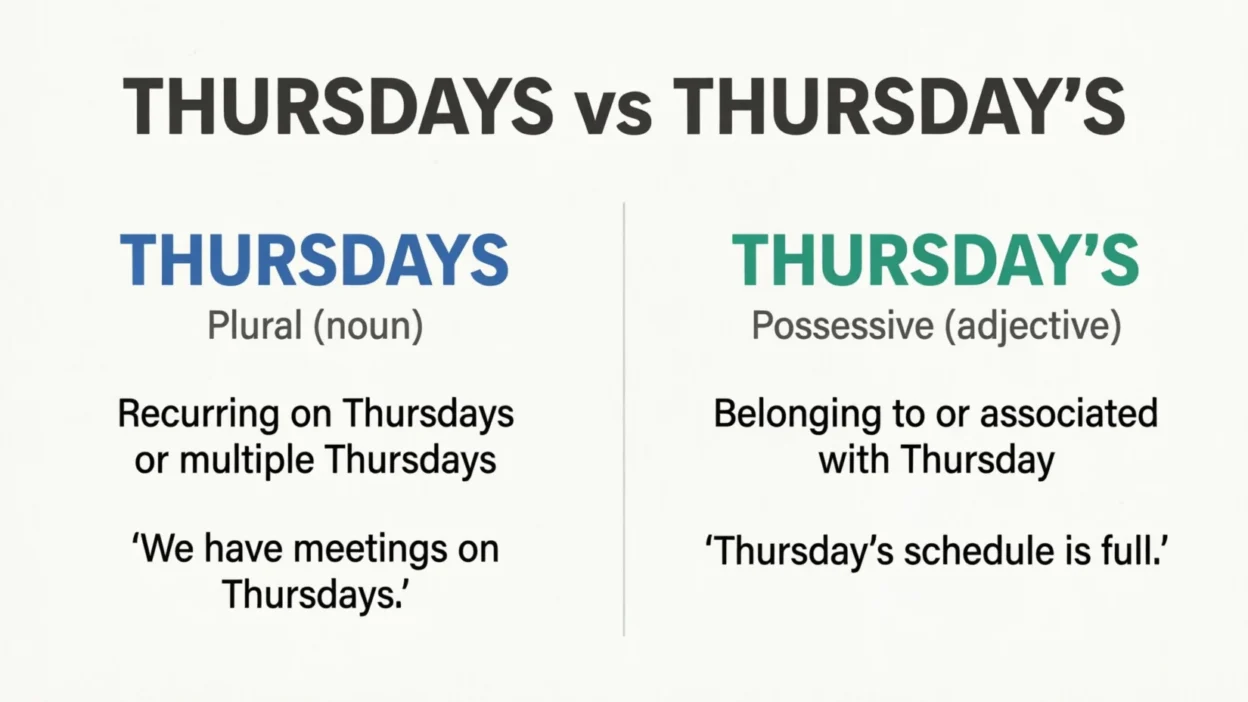
“Thursdays” is plural (more than one Thursday).
“Thursday’s” is possessive (something belongs to one Thursday).
What Does “Thursdays” Mean?
Meaning and Definition
“Thursdays” is the plural form of “Thursday,” meaning more than one occurrence of the day Thursday.
How to Use It
Use “Thursdays” when referring to:
- Repeated weekly events
- Multiple Thursdays
- General schedules
Examples
- I go to the gym on Thursdays.
- The class meets every Thursdays (better: every Thursday or on Thursdays).
- We have meetings on Thursdays throughout the month.
Key Tip
If you can replace it with “every week on that day,” then “Thursdays” is correct.
What Does “Thursday’s” Mean?
Meaning and Definition
“Thursday’s” is the possessive form of “Thursday,” meaning something belongs to or is associated with a specific Thursday.
How to Use It
Use “Thursday’s” when showing:
- Ownership
- A specific day’s event or feature
Examples
- Thursday’s meeting has been postponed.
- I’m preparing for Thursday’s presentation.
- Thursday’s weather looks sunny.
Key Tip
If you can say “of Thursday,” then “Thursday’s” is correct.
Thursdays vs Thursday’s: Key Differences Explained
| Term | Type | Meaning | Example Sentence |
|---|---|---|---|
| Thursdays | Plural noun | More than one Thursday | We meet on Thursdays every week. |
| Thursday’s | Possessive | Belonging to one specific Thursday | Thursday’s event is fully booked. |
This distinction is essential for clear scheduling, professional writing, and everyday communication.
When to Use Thursdays’ (Advanced but Useful)
Many people overlook the plural possessive form: Thursdays’
Meaning
It shows possession for multiple Thursdays.
Examples
- The Thursdays’ sessions are always full.
- We reviewed the Thursdays’ attendance records.
Quick Breakdown
- Thursdays → plural
- Thursday’s → one day owns something
- Thursdays’ → multiple days share ownership
Placement & Grammar Rules Table
| Phrase/Form | Sentence Placement | Tone/Formality | Example Sentence |
|---|---|---|---|
| Thursdays | Subject or object | Neutral | Thursdays are my busiest days. |
| Thursday’s | Before noun (possessive) | Neutral/Formal | Thursday’s meeting is canceled. |
| Thursdays’ | Before noun (plural possessive) | Formal | Thursdays’ classes are fully booked. |
| Every Thursday | Time expression | Neutral | We meet every Thursday at noon. |
| On Thursdays | Time expression | Neutral | The office closes early on Thursdays. |
Common Mistakes and How to Avoid Them
1. Using Thursday’s Instead of Thursdays
❌ I work on Thursday’s.
✅ I work on Thursdays.
Fix:
If you mean repeated days, never use an apostrophe.
2. Forgetting the Apostrophe for Possession
❌ Thursdays meeting is important.
✅ Thursday’s meeting is important.
Fix:
Add ’s when referring to something belonging to a specific day.
3. Confusing Plural and Possessive Forms
❌ Thursdays schedule is packed.
✅ Thursday’s schedule is packed.
Fix:
Ask: Is it one day or many days?
4. Overusing Apostrophes
Apostrophes are not for plurals.
❌ Monday’s, Tuesday’s (when meaning plural)
✅ Mondays, Tuesdays
Practical Example Paragraphs
Example 1: Work Schedule
Our team holds meetings on Thursdays, but Thursday’s session this week has been moved to Friday due to a public holiday.
Example 2: Academic Setting
The professor schedules lectures on Thursdays, and Thursday’s lecture will cover advanced grammar concepts.
Example 3: Everyday Conversation
I usually relax on Thursdays, but Thursday’s plan includes a family dinner.
American vs British English Differences
There is no difference between American and British English when using:
- Thursdays
- Thursday’s
- Thursdays’
The rules for plurals and possessives are identical.
However, style differences may appear:
- American English prefers concise phrasing
- British English may sound slightly more formal
Still, grammar usage remains the same.
Synonyms and Related Time Expressions
To improve variety and clarity, you can use:
- Every Thursday
- Weekly on Thursday
- On a Thursday
- Each Thursday
- Thursday sessions
These alternatives help avoid repetition and improve readability in longer writing.
FAQs
1. What is the difference between Thursdays and Thursday’s?
“Thursdays” is plural, while “Thursday’s” shows possession for one specific day.
2. When should I use Thursdays’?
Use it when something belongs to multiple Thursdays.
3. Is “Thursday’s” ever used for plural?
No. It is always singular possessive.
4. Can I say “every Thursdays”?
No. Use “every Thursday” or “on Thursdays.”
5. How do I remember the difference?
- No apostrophe = plural
- ’s = one owner
- s’ = multiple owners
6. Is this rule the same in American and British English?
Yes, completely the same.
7. Why do people confuse these forms?
Because they sound identical but serve different grammatical purposes.
Final Thoughts
The difference between Thursdays vs Thursday’s comes down to one simple rule: plural vs possession. Once you understand how apostrophes work, the confusion fades away. This small grammar detail can make your writing clearer and more professional.
Whether you’re writing schedules, emails, or content, using the correct form builds credibility and avoids misunderstandings. With a little practice, you’ll use these forms naturally and confidently.
Actionable Takeaway
- Use Thursdays for repeated or multiple days
- Use Thursday’s for something belonging to one Thursday
- Use Thursdays’ for something belonging to multiple Thursdays
- Remember: apostrophes show possession—not plural

Fenwick Quentin is a creative blogging author known for his analytical yet engaging writing style.
He explores topics such as innovation, digital culture, and personal development with depth and clarity.
Through his articles, Fenwick encourages readers to think critically and embrace continuous growth.