It’s a small space—but it makes a big difference. The confusion between setup vs set up is incredibly common, especially in emails, instructions, and everyday writing. If you’ve ever hesitated before typing it, wondering whether it should be one word or two, you’re not alone.
The good news? Once you understand the simple rule behind these terms, you’ll never mix them up again. This guide breaks it down in a clear, practical way so you can write with confidence and accuracy every time.
Quick Answer
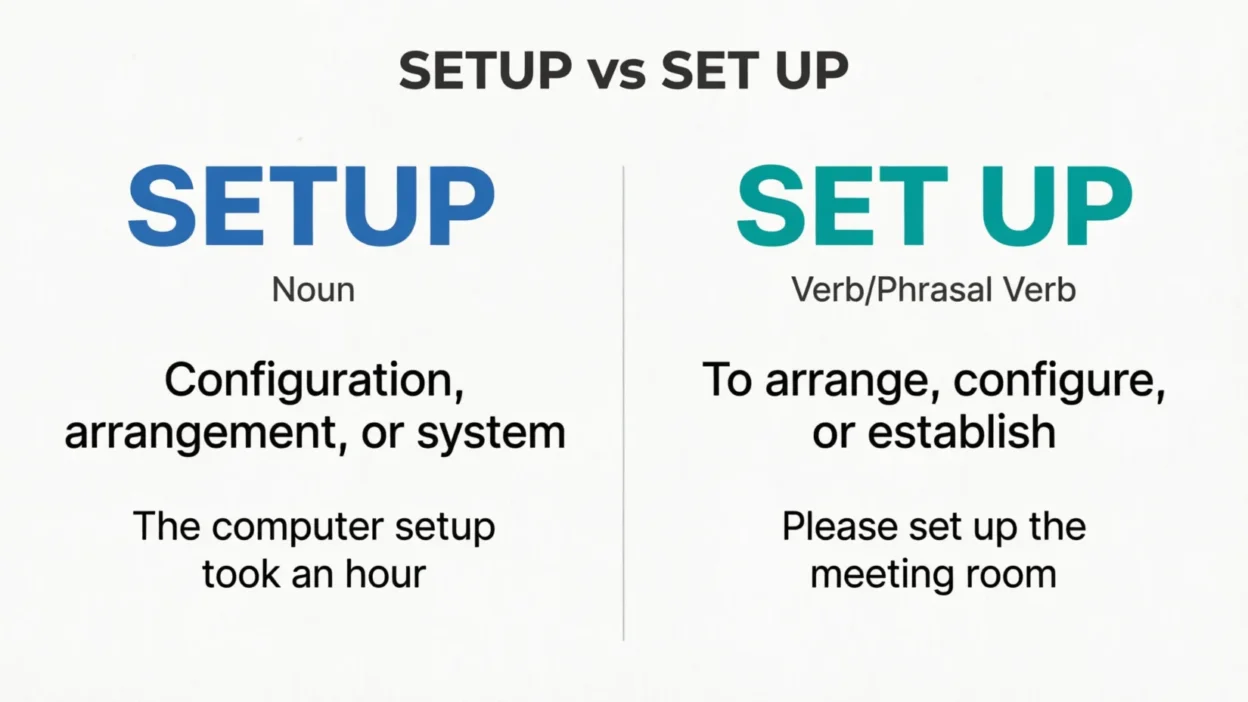
“Setup” is a noun or adjective (a thing), while “set up” is a verb phrase (an action). Use setup for objects or arrangements, and set up when describing an action.
What Does “Set Up” Mean?
“Set up” is a verb phrase. It describes an action—specifically, the act of arranging, organizing, or preparing something.
1. Meaning and Definition
Meaning: To arrange, prepare, or establish something
Usage Rule: Use when showing an action being performed
Example: I will set up the meeting tomorrow
Tip: If you can replace it with “arrange,” it’s likely correct
2. Common Usage in Daily Life
Meaning: Used for organizing tasks or systems
Usage Rule: Always written as two separate words
Example: She set up her new phone quickly
Tip: Think action = two words
3. Professional and Business Context
Meaning: Refers to establishing systems or plans
Usage Rule: Used in formal and informal writing
Example: The company will set up a new office
Tip: Frequently used in workplace communication
4. Technology and Digital Context
Meaning: Installing or configuring devices or software
Usage Rule: Common in tech instructions
Example: Follow the guide to set up your account
Tip: Seen in manuals and tutorials
What Does “Setup” Mean?
“Setup” is a noun or adjective. It refers to a thing, arrangement, or configuration—not an action.
1. Meaning and Definition
Meaning: The arrangement or structure of something
Usage Rule: Use when referring to a result or object
Example: The setup of the room looks great
Tip: If it’s a thing, use one word
2. As a Noun
Meaning: A system, arrangement, or plan
Usage Rule: Functions as a subject or object
Example: This setup works perfectly for me
Tip: Often follows articles like “a” or “the”
3. As an Adjective
Meaning: Describes a noun
Usage Rule: Comes before another noun
Example: He has a setup process ready
Tip: Used to modify something else
4. Informal Use
Meaning: Can describe a trick or scheme
Usage Rule: Context-dependent
Example: It felt like a setup from the start
Tip: Common in casual conversation
Setup vs Set Up: Key Differences Table
| Feature | Setup | Set Up |
|---|---|---|
| Part of Speech | Noun / Adjective | Verb phrase |
| Meaning | Arrangement or system | Action of arranging |
| Usage | Refers to a thing | Refers to an action |
| Example | The setup is complete | Please set up the equipment |
| Word Form | One word | Two words |
When to Use Setup vs Set Up
Understanding context is everything here.
Use “Set Up” When:
- You’re describing an action
- Something is being arranged or prepared
- It answers “what is happening?”
Examples:
- I need to set up the event
- They will set up the system today
Use “Setup” When:
- You’re referring to a thing or result
- It answers “what is it?”
- It acts as a noun or adjective
Examples:
- The setup is ready
- This is a simple setup process
Common Mistakes and How to Avoid Them
This pair trips up even experienced writers, but a few simple checks can help.
Mistake 1: Using “Setup” as a Verb
❌ I will setup the meeting
✔ I will set up the meeting
Mistake 2: Using “Set Up” as a Noun
❌ The set up is confusing
✔ The setup is confusing
Mistake 3: Ignoring Sentence Structure
Many writers don’t identify whether they need a verb or noun.
Tip: Check the role of the word in your sentence before choosing.
Easy Memory Trick
Here’s a simple way to remember:
- Set up = action (two words)
- Setup = thing (one word)
If you can insert a word between “set” and “up” (like “set it up”), then it should be two words.
Practical Example Paragraph
Let’s see both forms in action:
Before the event, we need to set up the equipment and organize the seating. Once everything is ready, the setup should look clean and professional. A good setup not only improves efficiency but also creates a better experience for everyone involved.
American vs British English Differences
There’s no difference between American and British English for these terms.
- Both use “set up” as a verb
- Both use “setup” as a noun or adjective
Spelling and usage remain consistent across regions.
Related Words and Synonyms
Using variations can improve your writing and SEO value:
- Arrange
- Organize
- Install
- Configuration
- Structure
- Preparation
- System
These LSI keywords help provide context and improve readability.
FAQs
1. Is it “setup” or “set up” in emails?
Use “set up” if it’s an action (I will set up a call) and “setup” if it’s a noun (the setup is complete).
2. Can “setup” be used as a verb?
No, “setup” is not used as a verb in standard English.
3. Why is this mistake so common?
Because both forms sound identical and look similar, making them easy to confuse.
4. Is “set-up” with a hyphen correct?
Sometimes used informally, but standard usage prefers “setup” or “set up.”
5. How can I quickly check which one to use?
Ask: Is this an action or a thing? That will guide your choice.
6. Is “setup” formal or informal?
It’s acceptable in both formal and informal writing when used correctly.
7. Do grammar tools catch this mistake?
Not always—context matters, so manual checking helps.
Final Thoughts
The difference between setup vs set up comes down to one simple idea: action vs object. “Set up” is something you do, while “setup” is something you have. Once you start thinking in these terms, the confusion disappears.
Clear writing builds trust and professionalism. By mastering this small but important distinction, you’ll avoid common mistakes and communicate more effectively in both personal and professional settings.
Actionable Takeaway
- Use set up for actions (verbs)
- Use setup for things (nouns/adjectives)
- Double-check your sentence structure before choosing
- Practice with real examples to build confidence
Master this rule, and your writing will instantly become sharper and more precise.