It’s a tiny spelling difference—but capital vs capitol can completely change the meaning of your sentence. Many writers mix them up because they sound identical, yet they refer to very different things. If you’ve ever paused mid-sentence wondering which one to use, you’re definitely not alone.
Understanding the difference isn’t just about grammar—it’s about clarity, professionalism, and confidence in your writing. Whether you’re writing essays, emails, or formal documents, mastering these commonly confused words will instantly improve your communication.
Quick Answer
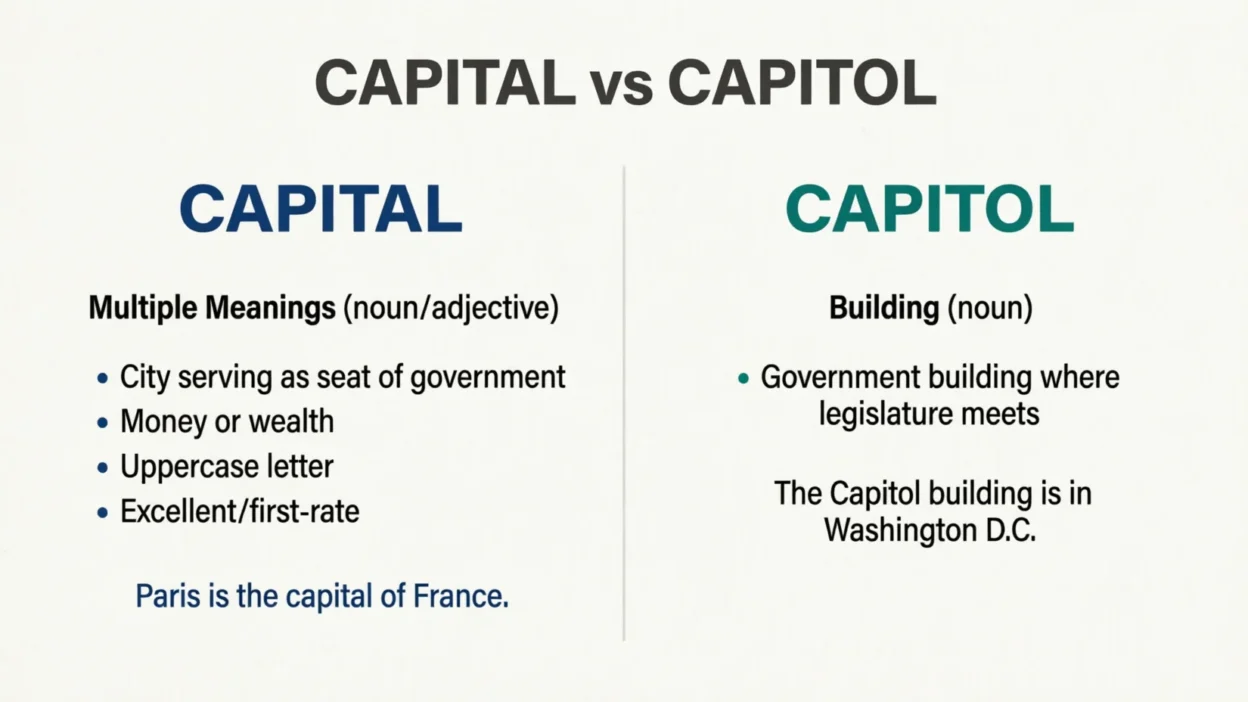
“Capital” has multiple meanings (city, money, uppercase letter), while “capitol” refers specifically to a government building where lawmakers meet.
What Does “Capital” Mean?
“Capital” is a versatile word with several meanings depending on context. It’s one of those English words that plays multiple roles.
1. Capital as a City
Meaning: The main city where a government is based
Usage: Refers to political or administrative centers
Example: Islamabad is the capital of Pakistan
Tip: Think “capital = country center”
2. Capital as Money or Wealth
Meaning: Financial assets or resources
Usage: Common in business and economics
Example: The company raised capital for expansion
Tip: Often used in finance and investment contexts
3. Capital as Uppercase Letter
Meaning: A large letter (A, B, C)
Usage: Grammar and writing rules
Example: Always start a sentence with a capital letter
Tip: Easy to remember—capital letters stand “tall”
4. Capital as Important or Major
Meaning: Something extremely important
Usage: Formal or descriptive tone
Example: This is a capital idea
Tip: Less common but still correct
What Does “Capitol” Mean?
“Capitol” is much more specific and easier to define.
1. Capitol as a Government Building
Meaning: A building where a legislative body meets
Usage: Used in political or official contexts
Example: The meeting was held at the Capitol
Tip: Only refers to buildings, not cities
2. Historical and Cultural Use
Meaning: Often associated with famous government buildings
Usage: Common in news and political discussions
Example: Tourists visited the Capitol building
Tip: Usually capitalized when referring to a specific building
3. Proper Noun Usage
Meaning: Often used as part of a name
Usage: Refers to a specific structure
Example: The U.S. Capitol is in Washington, D.C.
Tip: “Capitol” is almost always a proper noun
Capital vs Capitol: Key Differences Table
| Feature | Capital | Capitol |
|---|---|---|
| Meaning | City, money, letters, importance | Government building |
| Usage Scope | Broad and flexible | Very specific |
| Context | Geography, finance, grammar | Politics, government |
| Example | Paris is the capital of France | The law was passed in the Capitol |
| Frequency | Very common | Less common |
When to Use Capital vs Capitol
Choosing the correct word depends entirely on context.
Use “Capital” When:
- Referring to a city
- Talking about money or finance
- Writing about uppercase letters
- Describing importance
Use “Capitol” When:
- Referring to a legislative building
- Writing about government meetings
- Mentioning official political locations
Easy Memory Trick
A simple trick can help you remember:
- CapitOl = building with a dOme
- Both “capitol” and “dome” contain the letter “O”
This visual connection makes it much easier to recall the correct spelling.
Common Mistakes and How to Avoid Them
Even experienced writers make these errors, but they’re easy to fix once you know what to look for.
Mistake 1: Using “Capitol” for a City
❌ Lahore is the capitol of Punjab
✔ Lahore is the capital of Punjab
Mistake 2: Using “Capital” for a Building
❌ The meeting was held in the capital
✔ The meeting was held in the capitol
Mistake 3: Ignoring Context
Many people guess instead of checking meaning.
Tip: Always ask—Is this about a place or a building?
Practical Example Paragraph
Correct usage in real writing:
The capital city hosts the country’s main government offices, but laws are passed inside the capitol building. Investors often bring capital into the city to support economic growth, making it a hub of both political and financial activity.
American vs British English Differences
Good news—there’s no difference between American and British English here.
- Both use “capital” for cities, money, and letters
- Both use “capitol” for legislative buildings
The spelling and usage remain consistent across regions.
FAQs
1. Is “capitol” ever used for a city?
No, “capitol” only refers to a building, not a city.
2. Why do people confuse capital and capitol?
They sound the same (homophones), which leads to frequent spelling mistakes.
3. Can “capital” mean something important?
Yes, it can describe something significant or essential.
4. Is “capitol” always capitalized?
Usually yes, especially when referring to a specific building.
5. Which word is more common?
“Capital” is far more common because it has multiple meanings.
6. Is “capital letter” related to government?
No, it simply means an uppercase letter.
7. How can I quickly remember the difference?
Think of “capitol” as a building with a dome (both contain “O”).
Final Thoughts
The difference between capital vs capitol may seem small, but it carries big importance in writing. “Capital” is flexible and widely used across multiple contexts, while “capitol” is specific and tied to government buildings. Once you understand this distinction, choosing the right word becomes second nature.
To improve your writing, focus on context every time you use these words. Ask yourself what you’re referring to—a city, money, or a building—and the correct choice will follow naturally.
Actionable Takeaway
- Use capital for cities, money, and letters
- Use capitol only for government buildings
- Remember the “O = dome” trick for quick recall
Master this difference once, and you’ll never second-guess it again.

Fenwick Quentin is a creative blogging author known for his analytical yet engaging writing style.
He explores topics such as innovation, digital culture, and personal development with depth and clarity.
Through his articles, Fenwick encourages readers to think critically and embrace continuous growth.