At first glance, edition vs addition might seem like a simple spelling issue—but these two words carry completely different meanings. Because they sound similar, it’s easy to mix them up, especially in writing where precision matters most.
Whether you’re talking about books, updates, or including something new, choosing the right word can make your message clearer and more professional. In this guide, you’ll learn the exact difference, practical usage rules, and easy tricks to remember them forever.
Quick Answer
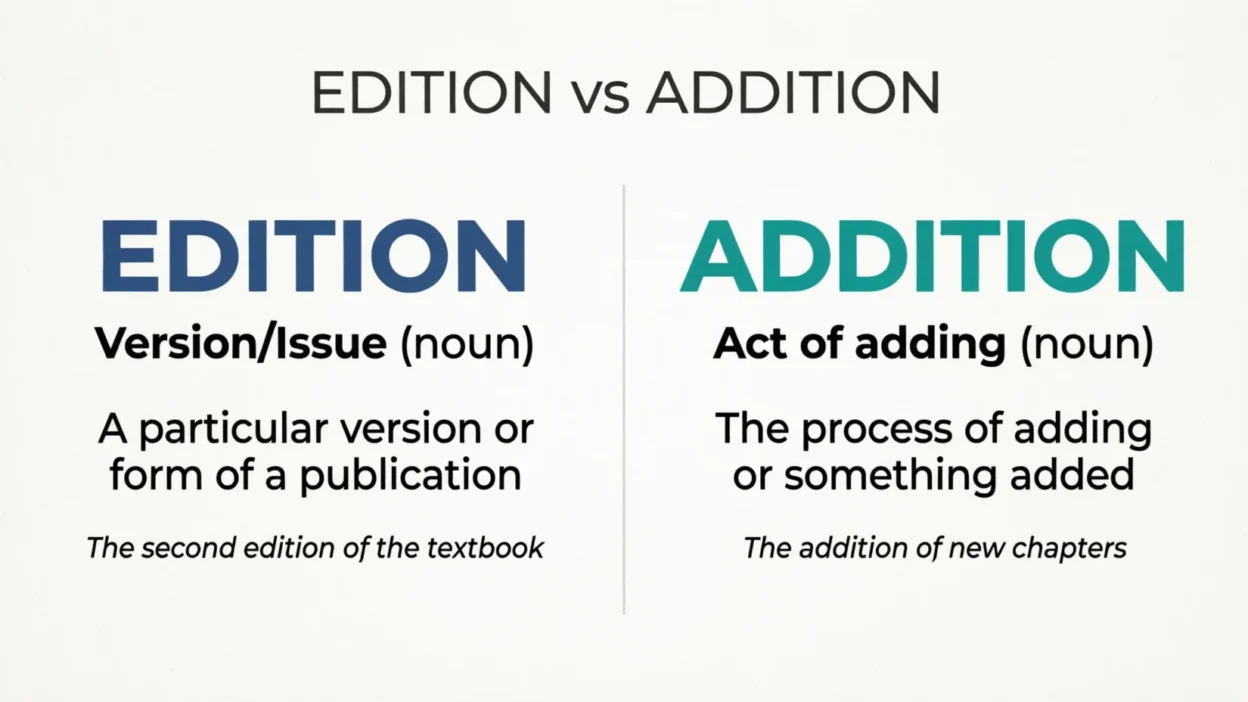
“Edition” refers to a version of something (like a book or publication), while “addition” means something that is added or included.
What Does “Edition” Mean?
“Edition” is a noun used to describe a specific version or release of something, often updated or revised.
1. Meaning and Definition
Meaning: A particular form or version of a published work
Usage Rule: Use when referring to versions or releases
Example: This is the latest edition of the textbook
Tip: Think “edition = version”
2. Used in Publishing
Meaning: Refers to books, magazines, and newspapers
Usage Rule: Indicates updates or reprints
Example: The first edition is rare and valuable
Tip: Common in academic and literary contexts
3. Digital and Software Context
Meaning: Versions of software or products
Usage Rule: Shows differences between releases
Example: The premium edition includes extra features
Tip: Often paired with terms like “standard” or “pro”
4. Event or Series Context
Meaning: Refers to repeated events
Usage Rule: Used for yearly or recurring events
Example: This year’s edition of the festival was amazing
Tip: Indicates a specific occurrence in a series
What Does “Addition” Mean?
“Addition” is also a noun, but it refers to something that is added or included.
1. Meaning and Definition
Meaning: The act of adding something or the thing added
Usage Rule: Use when something is included or increased
Example: The addition of new features improved the app
Tip: Think “addition = adding”
2. Mathematical Use
Meaning: A basic arithmetic operation
Usage Rule: Used in calculations
Example: Addition is one of the four basic operations
Tip: Common in education and math
3. Everyday Usage
Meaning: Adding items, people, or features
Usage Rule: Used in casual and formal contexts
Example: The new room is a great addition to the house
Tip: Indicates improvement or expansion
4. Business and Growth Context
Meaning: Expansion or inclusion
Usage Rule: Often used in planning and development
Example: The addition of staff boosted productivity
Tip: Suggests positive growth
Edition vs Addition: Key Differences Table
| Feature | Edition | Addition |
|---|---|---|
| Meaning | Version or release | Something added |
| Usage | Books, software, events | Growth, inclusion, math |
| Context | Publishing, updates | Expansion, increase |
| Example | Second edition of the book | Addition of a new feature |
| Keyword Clue | Version | Add |
When to Use Edition vs Addition
Choosing correctly depends on what you’re describing.
Use “Edition” When:
- Talking about versions or releases
- Referring to books, magazines, or software
- Describing a specific iteration
Examples:
- The revised edition is more accurate
- This limited edition is expensive
Use “Addition” When:
- Something is being added or included
- Talking about growth or increase
- Referring to math or expansion
Examples:
- The addition of a new member helped the team
- We made an addition to the building
Common Mistakes and How to Avoid Them
These words are often confused because of their similar pronunciation.
Mistake 1: Using “Edition” Instead of “Addition”
❌ The edition of a new feature improved the app
✔ The addition of a new feature improved the app
Mistake 2: Using “Addition” Instead of “Edition”
❌ This is the latest addition of the magazine
✔ This is the latest edition of the magazine
Mistake 3: Ignoring Context
Writers sometimes rely on sound instead of meaning.
Tip: Always ask—Is this a version or something added?
Easy Memory Trick
Here’s a quick way to remember:
- Edition = version (both relate to publishing)
- Addition = add (both start with “add”)
This simple association helps you choose the correct word instantly.
Practical Example Paragraph
Let’s see both words used correctly:
The latest edition of the software includes several improvements. One important addition is a new user interface that makes navigation easier. This addition enhances the overall experience, making this edition more user-friendly than previous versions.
American vs British English Differences
There is no difference between American and British English for these words.
- Both use “edition” for versions
- Both use “addition” for including something new
Spelling and usage remain consistent globally.
Related Words and Synonyms
Using related terms can improve clarity and SEO performance:
For edition:
- Version
- Release
- Issue
- Copy
For addition:
- Inclusion
- Increase
- Expansion
- Supplement
These variations help enrich your writing naturally.
FAQs
1. Is “edition” the same as version?
Yes, “edition” often means a specific version, especially in publishing.
2. Can “addition” be used in non-math contexts?
Yes, it commonly refers to adding anything, not just numbers.
3. Why do people confuse edition and addition?
They sound similar, which leads to spelling and usage mistakes.
4. Is “limited edition” correct?
Yes, it refers to a special version produced in small quantities.
5. Can “addition” mean improvement?
Yes, adding something often enhances or improves a situation.
6. Which word is more common?
Both are common but used in different contexts.
7. How can I quickly remember the difference?
Think: edition = version, addition = add.
Final Thoughts
The difference between edition vs addition comes down to meaning and context. “Edition” refers to a version or release, while “addition” refers to something being added. Once you understand this distinction, choosing the right word becomes simple and intuitive.
Clear communication starts with correct word choice. By mastering commonly confused words like these, you not only avoid mistakes but also improve your writing quality and credibility.
Actionable Takeaway
- Use edition for versions, releases, or publications
- Use addition when something is added or included
- Focus on context before choosing the word
- Use memory tricks to reinforce correct usage
With consistent practice, you’ll never mix up edition vs addition again.

Fenwick Quentin is a creative blogging author known for his analytical yet engaging writing style.
He explores topics such as innovation, digital culture, and personal development with depth and clarity.
Through his articles, Fenwick encourages readers to think critically and embrace continuous growth.