
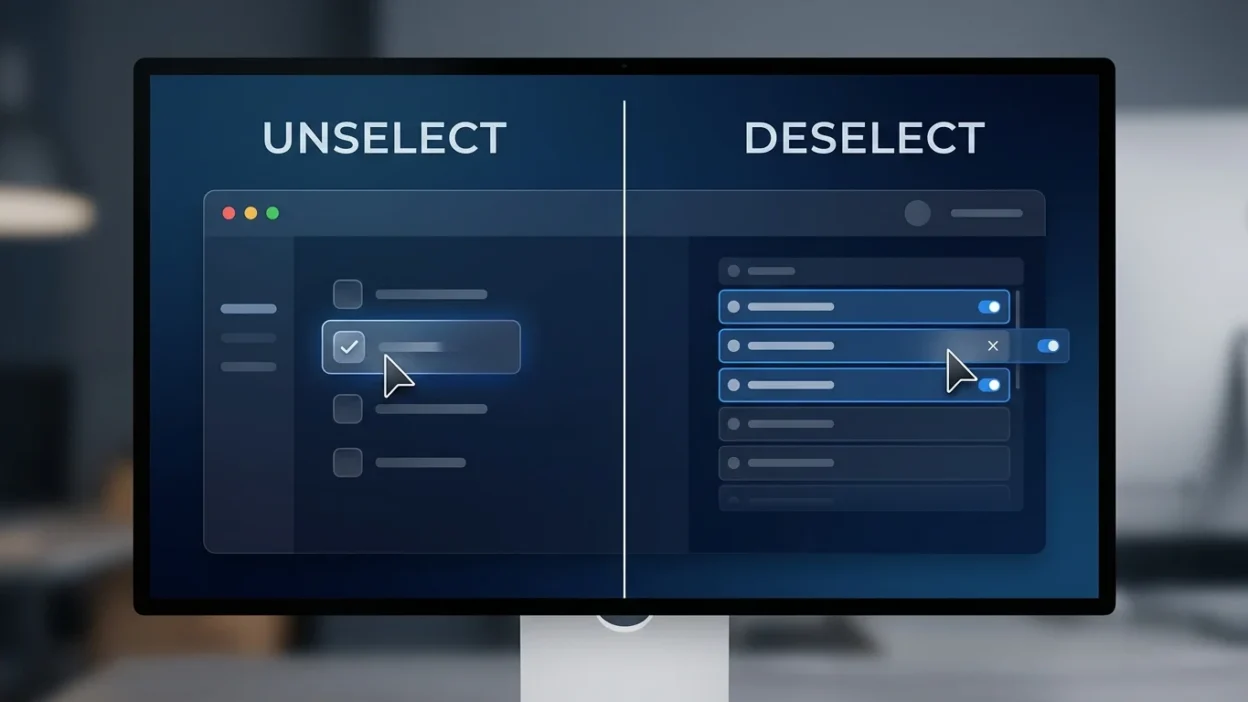
When talking about removing a selection, “deselect” is the standard and more natural word in modern English. It means to remove something from a selected group, list, menu, or set of options. For example, “Deselect the option you do not want.” “Unselect” is also used, especially in software and user-interface contexts, but it is generally less common and can sound less natural to some speakers.
The two words are closely related because both can describe the action of reversing a selection. However, they are not always equally suitable in every sentence. If you are writing instructions, explaining software, or learning standard English, deselect is usually the safer choice. Understanding the difference will help you choose the clearest word for buttons, instructions, forms, applications, and everyday writing.
Quick Answer
Deselect is the standard choice when you mean “remove from a selection.” Unselect can also mean the same thing, particularly in computing and user-interface language, but it is less widely preferred in formal or carefully edited English. In most situations, use deselect for clarity and natural usage.
Why Do People Confuse “Unselect” and “Deselect”?
People confuse these words because both contain a prefix attached to select:
- un- + select = unselect
- de- + select = deselect
Both can describe reversing an earlier selection. For example:
- “Deselect the checkbox.”
- “Unselect the checkbox.”
The intended meaning is usually clear in both sentences. The main difference is usage and naturalness. Deselect is the more established term for reversing a selection, particularly in technical instructions and interface terminology.
What Does “Unselect” Mean?
Unselect means to stop something from being selected or to remove it from a selected group.
It is most often encountered in computing, software, forms, and interface instructions.
Examples
- Please unselect the items you do not need.
- You can unselect a file by clicking it again.
- Unselect the unwanted options before continuing.
Although understandable, unselect is not always the preferred wording. In many contexts, deselect sounds more standard.
What Does “Deselect” Mean?
Deselect means to remove something from a selection or to cancel its selected status.
It is especially common in computing and technical instructions.
Examples
- Deselect the checkbox to turn the feature off.
- Click the image again to deselect it.
- Deselect all unnecessary files.
- You can deselect an option at any time.
Deselect is usually the best choice when you want a clear, conventional word for reversing a selection.
Unselect vs Deselect: Comparison Table
| Feature | Unselect | Deselect |
| Meaning | Remove from a selection | Remove from a selection |
| Common in computing | Yes | Yes |
| Standard choice | Less preferred | More preferred |
| Formal writing | Less common | More natural |
| Interface instructions | Possible | Very common |
| Example | Unselect the item | Deselect the item |
| Recommended for general use | Usually avoid if “deselect” works | Yes |
When Should You Use “Unselect” or “Deselect”?
Use “Deselect” When:
Use deselect when giving instructions about removing an item from a selection.
Examples:
- Deselect the checkbox.
- Deselect the selected files.
- Deselect this option if you do not want notifications.
- Click outside the box to deselect the item.
It is particularly useful in software documentation, tutorials, forms, and user-interface instructions.
Use “Unselect” When:
Unselect can be used when discussing software or interfaces where the term is already established by the application or system.
For example:
“Click the button to unselect all items.”
The sentence is understandable, but “deselect all items” would generally sound more conventional.
10+ Examples of Unselect and Deselect
Examples with “Deselect”
- Deselect the checkbox if you do not want email notifications.
- Click the image again to deselect it.
- Deselect all files except the one you want to upload.
- You can deselect an option before submitting the form.
- Deselect the items you do not want to delete.
- The user accidentally deselected the correct option.
- Deselect the selected text before making another choice.
- Click anywhere outside the menu to deselect the item.
Examples with “Unselect”
- Unselect the options you do not need.
- You can unselect a file by clicking it again.
- Unselect the checkbox to disable the setting.
- The application allows users to unselect multiple items.
In these examples, deselect would generally be the more conventional replacement for unselect.
Common Mistakes
Mistake 1: Assuming “unselect” is always wrong
Unselect is understandable and is used in real English, especially in computing. It is not simply meaningless.
Better distinction:
Unselect = used, but less conventional
Deselect = standard and generally preferred
Mistake 2: Using “select” when you mean the opposite
Incorrect meaning:
Select the checkbox to remove it.
If you mean removing the checkbox from the selection, say:
Deselect the checkbox.
Mistake 3: Confusing “deselect” with “delete”
Deselect does not mean delete.
- Deselect = remove something from a selection.
- Delete = remove something from the system, document, or storage.
For example:
Deselect the photo.
means the photo remains there but is no longer selected.
Delete the photo.
means remove the photo itself.
Mistake 4: Confusing “deselect” with “disable”
These words have different meanings.
- Deselect = remove from a selection.
- Disable = make a feature inactive or unavailable.
For example:
Deselect the checkbox.
is different from:
Disable the feature.
Memory Trick
Think of deselect as the opposite of select:
Select → Deselect
If you select an option and then change your mind, you deselect it.
A simple memory sentence is:
Select it, then deselect it.
This makes deselect easy to remember and use correctly.
American vs British English
There is no major American-versus-British spelling difference between unselect and deselect.
Both forms can be encountered in English-language software and technical contexts. However, deselect is the more broadly established choice for describing the reversal of a selection.
So whether you are writing for American or British English readers, deselect is generally the safer word.
Similar Words
Several words are related to deselect, but they are not always interchangeable.
Select
To choose something.
Select your preferred language.
Deselect
To remove something from a selection.
Deselect the language you no longer want.
Choose
To decide which option you want.
Choose your preferred language.
Uncheck
To remove the check mark from a checkbox.
Uncheck the box to disable notifications.
Delete
To remove something completely.
Delete the unwanted file.
Cancel
To stop an action or process.
Click Cancel to stop the operation.
Final Verdict
Deselect is the better general choice when you mean “remove something from a selection.” It is clear, established, and especially natural in software instructions, technical writing, and user-interface language.
Unselect is also understandable and appears in computing contexts, but it is generally less conventional. If you are unsure which word to use, choose deselect.
FAQs:
Is “unselect” a correct word?
Yes. Unselect is used in English, particularly in computing and interface contexts. However, deselect is generally the more conventional choice.
Is “deselect” better than “unselect”?
For most writing, deselect is the safer and more standard choice. It clearly describes reversing a selection.
Can I say “unselect the checkbox”?
Yes. The sentence is understandable and can be found in software-related contexts. “Deselect the checkbox” is generally more natural.
What is the opposite of “select”?
Deselect is commonly used as the opposite of select when you remove an item from a selection.
Is “deselect” used in computing?
Yes. Deselect is widely used for actions involving selected files, text, images, checkboxes, menu items, and other interface elements.
Does “deselect” mean “delete”?
No. Deselect means to remove an item from a selection. Delete means to remove the item itself.
Is “unselect” formal English?
Unselect is a legitimate word, but it is less common and less conventional than deselect in formal or carefully edited instructions.
Which should I use: “unselect” or “deselect”?
Use deselect in most situations, especially when writing instructions, documentation, educational material, or professional content.
Remember This
- Select = choose something.
- Deselect = remove something from a selection.
- Unselect = also used for removing a selection, but less conventional.
- Delete = remove something completely.
- When in doubt, choose deselect.
Conclusion:
Unselect and deselect can have the same basic meaning: to remove something from a selection. However, deselect is the more established and generally preferred term, especially in software instructions and technical writing. It provides a clear opposite to select and is easy for readers to understand.
You may still encounter unselect, particularly in applications, documentation, or informal technical language. It is not necessarily confusing or impossible to understand. Nevertheless, if you want the most conventional wording, deselect is the better choice. Remember: select an option, then deselect it when you change your mind.