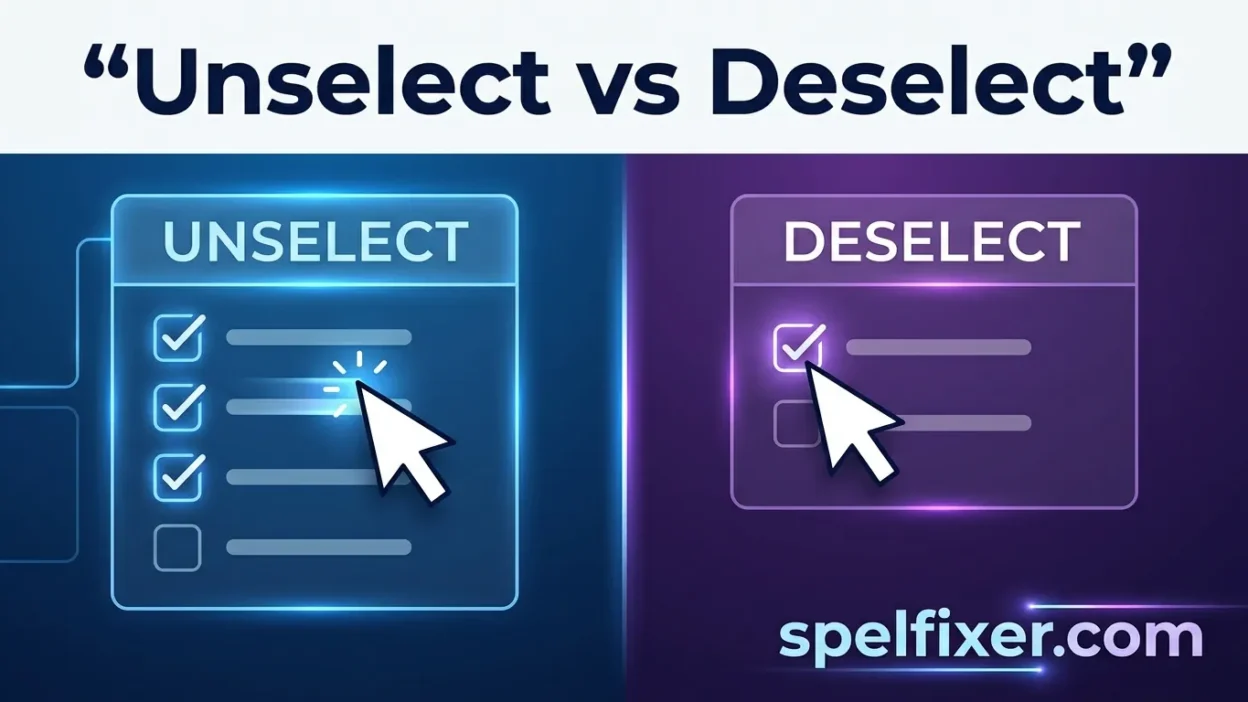
If you have ever wondered about unselect vs deselect, you are not alone. Both words are used when talking about removing a selection, especially in software, forms, menus, apps, and digital tools. At first glance, they seem to mean exactly the same thing, but there is a small difference in usage and naturalness.
In most situations, deselect is the better and more widely accepted choice. If you are writing instructions such as “deselect the option” or “deselect the checkbox,” deselect sounds more natural and professional. However, unselect is also used, particularly in technical interfaces and informal instructions.
Quick Answer:
Deselect is generally the preferred word when you mean to remove a selection.
- Deselect = remove something from a selected state.
- Unselect = also means to remove a selection, but it is less common in standard English.
- Deselect is usually better for formal writing, documentation, instructions, and professional communication.
- Unselect may appear in software interfaces, technical discussions, and everyday digital language.
- Neither word normally means “choose nothing” in every context; the exact meaning depends on the interface or sentence.
Best choice: When in doubt, use deselect.
What Does Deselect Mean?
Deselect is a verb meaning to remove something from a group of things that has already been selected.
The word is especially common in computing and technology. For example, if you click a checkbox and then click it again to remove the check mark, you deselect the checkbox.
Examples of deselect
- Please deselect the options you do not want.
- Click the checkbox again to deselect it.
- You can deselect multiple files at once.
- I accidentally selected the wrong image, so I deselected it.
- Deselect the current item before choosing another one.
The word can be understood as the opposite of select.
Select → Deselect
This makes “deselect” particularly useful in user interfaces, software documentation, online forms, spreadsheets, and other digital environments.
What Does Unselect Mean?
Unselect can also mean to remove something from a selected state.
It follows a straightforward pattern:
Select → Unselect
Although understandable, unselect is generally less common than deselect in standard English. You may still encounter it in software, websites, technical instructions, or informal communication.
Examples of unselect
- Unselect the box if you do not want notifications.
- You can unselect an item by clicking it again.
- Unselect the file before closing the program.
- I need to unselect this option.
- The user can select or unselect several items.
These sentences are understandable, but in many cases, replacing unselect with deselect would sound more polished.
For example:
Please deselect the options you don’t need.
This generally sounds more natural than:
Please unselect the options you don’t need.
Unselect vs Deselect: Key Differences
The biggest difference is not usually the basic meaning. Both words can describe removing a selection. The difference is mainly usage, frequency, and style.
| Feature | Deselect | Unselect |
| Basic meaning | Remove a selection | Remove a selection |
| Common in standard English | Yes | Less common |
| Common in technology | Very common | Common in some contexts |
| Formal writing | Preferred | Usually avoided |
| Software instructions | Natural | Understandable |
| Opposite of select | Yes | Yes |
| Recommended choice | Yes | Sometimes |
If you are writing an article, help guide, user manual, business document, or professional email, deselect is usually the safer option.
Deselect vs Unselect in Everyday Examples
Understanding the difference becomes easier when you see the words in practical situations.
Example 1: Checkbox
Preferred:
Deselect the checkbox if you do not want promotional emails.
Possible but less natural:
Unselect the checkbox if you do not want promotional emails.
Here, deselect is the stronger choice because checkbox instructions commonly use “select” and “deselect.”
Example 2: Multiple files
Select the files you want to upload, then deselect any files you added by mistake.
This is natural and clear.
Example 3: Online survey
If you change your mind, deselect your previous answer.
Again, “deselect” clearly communicates that the existing selection should be removed.
Example 4: Graphic design software
Click outside the object to deselect it.
This is particularly natural in software-related instructions.
Example 5: Informal technical language
Just unselect the option and try again.
This is understandable and may be used in casual technical communication, even though deselect is generally preferable.
Is Unselect a Correct Word?
Yes, unselect is a word that can be used to mean removing a selection. However, being understandable or attested in usage does not necessarily mean it is the best choice in every sentence.
English has many words formed with prefixes such as un- and de-, and their usage varies. In the case of selection, deselect has become the more established term, particularly in computing and formal technical writing.
Therefore, calling “unselect” simply “wrong” would be misleading.
A better explanation is:
Unselect is understandable and used in English, but deselect is generally more conventional and preferable when you want the clearest standard term.
When Should You Use Deselect?
Use deselect when you want your writing to sound clear, professional, and natural.
It works especially well in:
- Software documentation
- User guides
- Website instructions
- Online forms
- Technical manuals
- Educational content
- Business communication
- Help-center articles
- UX and UI instructions
- Computer-related writing
For example:
To remove the item from your list, deselect the checkbox.
This is concise and immediately understandable.
If you are writing for a broad audience, choosing deselect can also reduce confusion because it is the term many readers already recognize.
When Might Unselect Be Used?
Unselect may be appropriate when you are describing wording that appears in a particular application, interface, programming environment, or informal conversation.
For example:
The application allows users to select and unselect items.
You may also see unselect used when developers or users naturally form it as the opposite of “select.”
However, if you are creating your own instructions, you generally do not need to choose “unselect” simply because it looks like the direct opposite of “select.” Deselect already performs that job effectively.
Common Mistakes With Unselect and Deselect
1. Assuming unselect is always incorrect
This is one of the most common misconceptions.
Unselect is used in English, particularly in technical contexts. It is better described as less common or less preferred rather than automatically incorrect.
2. Using both words inconsistently
Avoid switching between “unselect” and “deselect” throughout the same set of instructions.
For example, writing:
Select the checkbox. Unselect it when finished. Deselect the option below.
can feel inconsistent.
Choose one term—preferably deselect—and use it consistently.
3. Confusing deselect with delete
Deselect does not mean to delete something.
- Deselect = remove its selected status.
- Delete = remove the item itself.
For example, if you select a photograph and then deselect it, the photograph still exists. You have simply removed its selected state.
4. Confusing deselect with cancel
Deselect also does not necessarily mean canceling an action.
If you select an option and then deselect it, you are changing its selection status. Cancel usually means stopping or abandoning an operation.
5. Assuming “unselected” and “deselected” always mean exactly the same thing
In many situations, they do describe a similar state, but the preferred terminology can depend on the software or context.
For general writing, deselected is often the clearer choice:
The checkbox is deselected.
American vs British English: Is There a Difference?
There is no major American-versus-British spelling difference between deselect and unselect. Both varieties of English can use these words.
You may occasionally encounter different preferences in technical terminology depending on the software, organization, or style guide, but this is not primarily a US-versus-UK spelling issue.
Also remember the related word selected has the same spelling in American and British English.
For example:
- American English: deselect the option
- British English: deselect the option
So if you are writing content for either American or British readers, deselect remains a safe and natural choice.
Deselect as a Verb and Deselecting as a Noun-Like Form
The most common forms of deselect include:
- deselect — present/base form
- deselected — past tense and past participle
- deselecting — present participle
Examples
Click the button to deselect the item.
The option was deselected automatically.
Deselecting unnecessary items can make the list easier to manage.
You may also see deselection, which refers to the act or process of removing a selection.
The software supports automatic deselection of inactive items.
These forms are particularly common in technical and computing contexts.
A Simple Trick to Remember the Difference
If you are unsure whether to use unselect or deselect, remember this simple rule:
Select something → Deselect it when you want to remove the selection.
Think of common digital instructions:
Select → Deselect
This pair is widely recognized and works naturally in most contexts.
You do not need to completely avoid unselect, but if you are writing something where clarity and professionalism matter, deselect is usually the better option.
FAQs
Is “unselect” grammatically correct?
Yes, unselect can be used as a verb meaning to remove something from a selected state. However, deselect is generally more common and conventional.
Is “deselect” the opposite of “select”?
Yes. In many contexts, deselect means to remove the selection that was previously made.
Should I say “unselect” or “deselect”?
In most professional and formal contexts, choose deselect. It is clearer, more established, and especially common in technical instructions.
Is “unselected” a proper word?
Yes. “Unselected” can describe something that has not been selected or is no longer selected. However, deselected may be more precise when you specifically mean that an existing selection was removed.
Is deselect American or British English?
Deselect is used in both American and British English. It is not a word that belongs exclusively to one variety.
Can I use “unselect” in software instructions?
Yes, particularly if the software itself uses that terminology. However, when writing your own instructions, deselect is generally the more natural choice.
Does deselect mean delete?
No. Deselect means to remove a selection. It does not mean to permanently remove the selected item.
Which is more professional: unselect or deselect?
Deselect is generally more professional and standard, especially in documentation, technical writing, UX content, and formal instructions.
Summary:
When comparing unselect vs deselect, both words can communicate the idea of removing a selection. The important distinction is that deselect is the more established and widely preferred term, particularly in standard English and technical writing.
Unselect is understandable and does appear in real-world usage, but it is usually less natural when you are creating polished instructions.
If you are writing website content, software documentation, tutorials, forms, or professional instructions, deselect is the safest choice. Use unselect when you are specifically referring to terminology used by a particular application or when the context naturally calls for it.
Actionable Takeaway
When you need to tell someone to remove a selection, use deselect by default. Remember the simple pair select → deselect, and avoid confusing it with delete or cancel. This small word choice can make technical instructions clearer, more consistent, and easier for readers to follow.