The difference between either vs neither confuses many English learners and even native speakers because the two words are closely connected in meaning and grammar. They often appear in similar sentence structures, but they express completely different ideas. Using the wrong one can change the meaning of a sentence entirely.
If you have ever wondered whether to say “either option works” or “neither option works,” you are not alone. These words appear frequently in conversations, academic writing, business communication, and everyday English. Understanding how they work will help you speak and write more naturally and confidently.
In this guide, you will learn the meaning of “either” and “neither,” discover the key grammar rules, explore practical examples, avoid common mistakes, and understand how these words are used in both American and British English.
Quick Answer
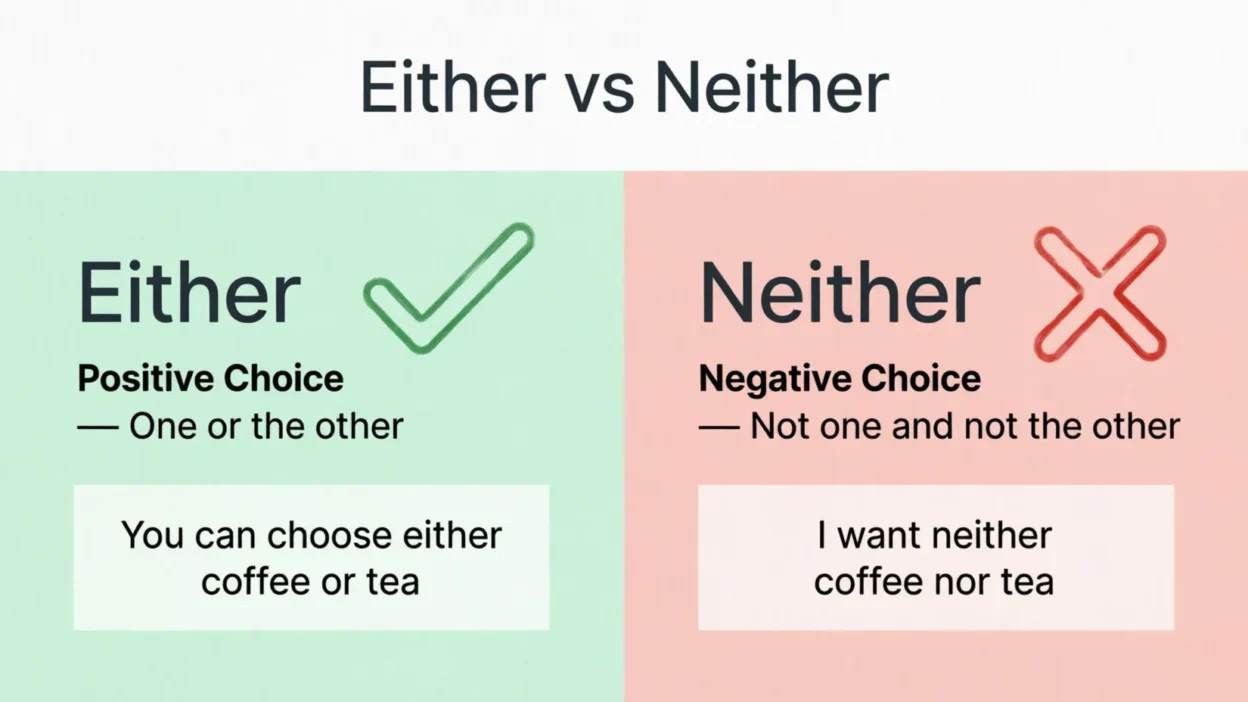
“Either” refers to one of two options, while “neither” means not one and not the other.
Examples:
- You can choose either dress. ✅
- Neither answer is correct. ✅
A simple way to remember:
- either = one or the other
- neither = not either one
What Does “Either” Mean?
“Either” usually refers to one of two people, things, or choices.
It often means:
- one or the other
- any one of the two
- both options are acceptable individually
Examples of Either
- You can sit on either side.
- Either answer could work.
- We can travel either by train or by bus.
- Either candidate would do a good job.
Common Uses of Either
“Either” can function as:
- determiner
- pronoun
- adverb
- conjunction
What Does “Neither” Mean?
“Neither” means not one and not the other.
It expresses negative meaning involving two choices.
Examples of Neither
- Neither option seems affordable.
- Neither student passed the exam.
- She likes neither coffee nor tea.
- Neither explanation was convincing.
Important Grammar Rule
Because “neither” already carries a negative meaning, you usually should not add another negative word.
Incorrect:
- I don’t like neither option. ❌
Correct:
- I like neither option. ✅
Either vs Neither Comparison Table
| Word | Meaning | Usage | Example |
|---|---|---|---|
| Either | One of two choices | Positive/neutral | Either road leads home |
| Neither | Not one and not the other | Negative | Neither road is safe |
How to Use “Either” Correctly
Understanding sentence structure makes usage easier.
1. Offering Two Choices
Examples:
- You may choose either color.
- Either restaurant sounds good.
2. Using “Either…Or”
This structure presents alternatives.
Examples:
- Either call me or send an email.
- We will travel either today or tomorrow.
3. Showing Agreement in Negative Statements
Examples:
- I don’t like spicy food either.
- She didn’t attend the meeting either.
How to Use “Neither” Correctly
“Neither” usually introduces negative meaning.
1. Referring to Two Negative Choices
Examples:
- Neither movie interested me.
- Neither explanation helped.
2. Using “Neither…Nor”
Examples:
- Neither John nor Sarah attended.
- She likes neither tea nor coffee.
3. Responding to Negative Statements
Examples:
- “I can’t swim.”
- “Neither can I.”
Common Grammar Rules for Either and Neither
These words follow specific agreement rules.
Singular Verb Agreement
Traditionally, both words take singular verbs.
Correct:
- Either option is acceptable.
- Neither answer is correct.
Informal Modern Usage
In casual English, plural verbs sometimes appear when nouns are plural.
Example:
- Neither of the students were ready.
Although common informally, formal writing usually prefers:
- Neither of the students was ready.
Common Mistakes With Either vs Neither
Many writers make similar errors repeatedly.
Mistake 1: Double Negatives With Neither
Incorrect:
- I don’t want neither option. ❌
Correct:
- I want neither option. ✅
Mistake 2: Confusing Meaning
Incorrect:
- Neither choice is fine with me. ❌
Correct:
- Either choice is fine with me. ✅
“Either” expresses acceptance.
“Neither” expresses rejection.
Mistake 3: Incorrect Either/Or Structure
Incorrect:
- Either you leave and stay quiet. ❌
Correct:
- Either you leave or stay quiet. ✅
Mistake 4: Incorrect Neither/Nor Pairing
Incorrect:
- Neither the manager or the assistant arrived. ❌
Correct:
- Neither the manager nor the assistant arrived. ✅
Practical Example Paragraphs
Real examples help these grammar patterns feel natural.
Example Using Either
For the project presentation, employees could use either PowerPoint or Google Slides. Both platforms were accepted as long as the final presentation remained professional and organized.
Example Using Neither
Neither candidate seemed fully prepared for the interview. Their answers lacked detail, and neither demonstrated strong communication skills during the discussion.
Placement and Grammar Rules Table
| Phrase | Sentence Placement | Tone | Example Sentence |
|---|---|---|---|
| Either | Before singular noun | Neutral | Either option works |
| Either…or | Connecting alternatives | Neutral/Formal | Either stay or leave |
| Neither | Negative determiner | Formal/Neutral | Neither answer is correct |
| Neither…nor | Connecting negative choices | Formal | Neither rain nor snow stopped us |
American vs British English Differences
Both American and British English use “either” and “neither” similarly.
However, pronunciation differs slightly.
American Pronunciation
- either = EE-ther or EYE-ther
- neither = NEE-ther or NYE-ther
British Pronunciation
British English often favors:
- EYE-ther
- NYE-ther
Grammar Differences
The grammar rules remain largely identical in both forms of English.
Either vs Neither in Everyday Communication
These words appear constantly in:
- workplace communication
- academic writing
- customer service
- casual conversation
- presentations
- emails
Workplace Example
- Either proposal could succeed.
- Neither proposal meets the budget requirements.
Personal Conversation Example
- We can watch either movie tonight.
- Neither movie looks interesting to me.
Synonyms and Related Phrases
Using related words improves vocabulary naturally.
Synonyms for Either
- one or the other
- any of the two
- whichever
Synonyms for Neither
- not one
- not either
- none of the two
Related Grammar Searches
People searching for “either vs neither” also often search for:
- either or grammar
- neither nor examples
- affect vs effect
- farther vs further
- fewer vs less
Helpful Memory Trick
A simple trick makes the difference easy to remember.
Either = One Option Exists
Think:
- either one works
Positive or neutral meaning.
Neither = Negative
“Neither” starts with “n,” which can remind you of:
- no
- not
So:
- neither = not one and not the other
Why Correct Usage Matters
Using “either” and “neither” correctly improves:
- grammar accuracy
- sentence clarity
- professionalism
- reader understanding
Small grammar details matter in:
- essays
- presentations
- resumes
- reports
- business emails
- published content
Accurate writing strengthens trust and readability.
FAQs About Either vs Neither
What is the difference between either and neither?
“Either” refers to one of two choices, while “neither” means not one and not the other.
Can either mean both?
No. “Either” refers to one option from two choices.
Is neither always negative?
Yes. “Neither” already carries negative meaning.
Can I say “I don’t like neither”?
No. That creates a double negative in standard English.
Which is correct: neither is or neither are?
Traditionally, “neither is” is preferred in formal writing.
How do you use either in a sentence?
Example:
- You can choose either option.
How do you use neither in a sentence?
Example:
- Neither answer was correct.
Final Thoughts
The difference between either vs neither becomes much easier once you understand the core meanings. “Either” refers to one of two possibilities, while “neither” rejects both options entirely. Although the words appear similar, they communicate opposite ideas.
Mastering these grammar patterns can improve both spoken and written English. Whether you are writing essays, emails, business reports, or casual messages, using “either” and “neither” correctly helps your communication sound clearer, smarter, and more professional.
Actionable Takeaway
Remember this simple rule:
- either = one of two
- neither = not one of two
Also keep these pairs together:
- either…or
- neither…nor
Using these structures consistently will help you avoid common grammar mistakes and write with confidence.

Fenwick Quentin is a creative blogging author known for his analytical yet engaging writing style.
He explores topics such as innovation, digital culture, and personal development with depth and clarity.
Through his articles, Fenwick encourages readers to think critically and embrace continuous growth.