
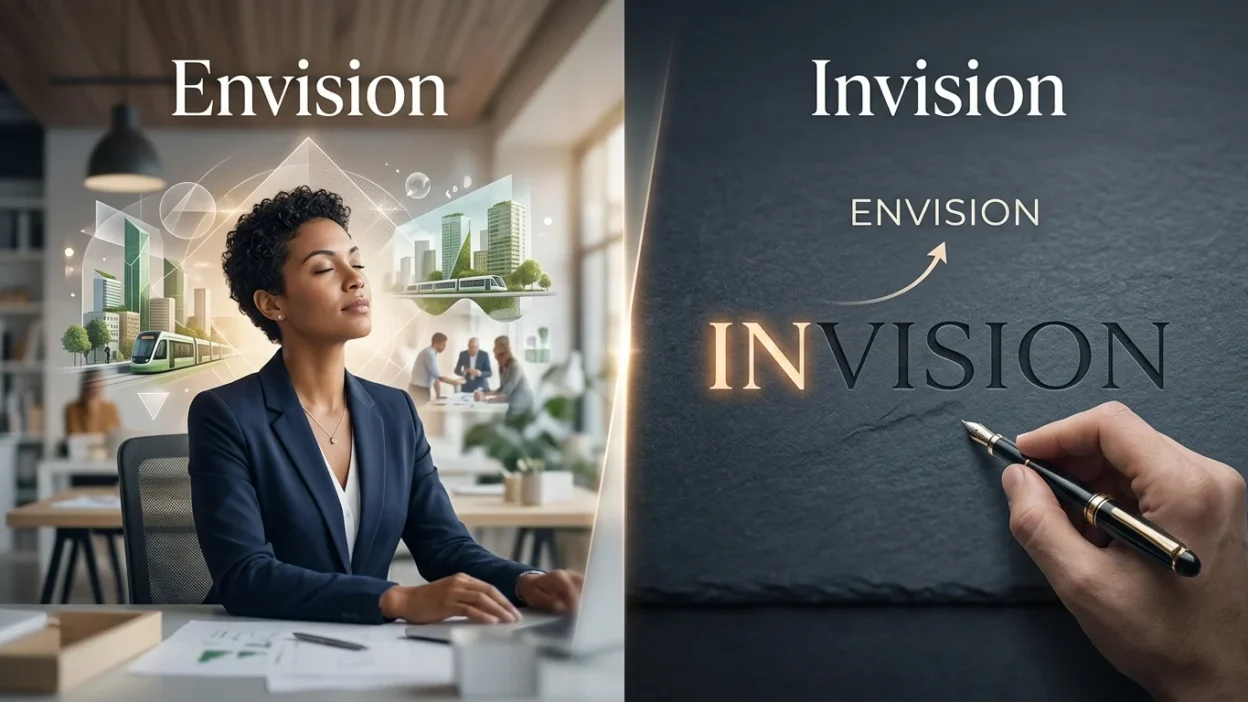
Choosing between envision and invision can be confusing because the two words look and sound very similar. However, they are not equal in standard English. Envision is the correct English word when you mean to imagine, picture, or see something in your mind. Invision is generally considered a misspelling when used with this meaning.
Understanding the difference is important because envision is common in everyday English, academic writing, business communication, and formal contexts. For example, you can say, “I envision a better future for my family.” If you write “I invision a better future,” the spelling is incorrect in standard modern English. This guide explains the meanings, correct usage, examples, common mistakes, and the difference between envision and invision.
Quick Answer
Envision is the correct standard English spelling when you mean “to imagine,” “to picture,” or “to see something mentally.” Invision is usually a misspelling of envision. Use envision in sentences such as “She envisions a successful career” or “We envision a brighter future.”
Why Do People Confuse Envision and Invision?
People often confuse these words because envision is pronounced in a way that can make the first syllable sound like “in.”
The pronunciation can lead English learners to spell the word as invision, even though the standard spelling is envision.
Another reason for the confusion is that English contains many words beginning with in-, such as:
- involve
- include
- inspire
- inform
- invent
Because of this pattern, invision may look reasonable at first glance. However, when the intended meaning is “to imagine or picture something,” the correct spelling is envision.
Envision
Envision is a verb meaning to imagine or picture something in your mind, especially something that may happen in the future.
It can describe a mental picture, a plan, a goal, or an imagined future situation.
Examples of Envision
- I envision a peaceful future.
- She envisions becoming a successful doctor.
- We envisioned a larger house for our family.
- They envision a world with cleaner energy.
- He envisioned how the project would look when finished.
Envision as a Verb
The common forms are:
- envision — present/base form
- envisions — third-person singular
- envisioned — past tense
- envisioning — present participle
For example:
She envisions a successful business.
They envisioned a better solution.
We are envisioning a new approach.
Invision
Invision is generally not the standard spelling of the verb meaning “to imagine” or “to picture.”
If you want to express the idea of imagining something, use envision.
Incorrect:
I invision a better future.
Correct:
I envision a better future.
It is worth noting that InVision has also been used as a proper name or brand name, so you may encounter the capitalized form InVision in specific contexts. That does not make invision the standard spelling of the English verb envision.
Envision vs Invision: Comparison Table
| Word | Standard English word? | Meaning | Example |
| Envision | Yes | To imagine or picture something | I envision a better future. |
| Invision | No, when used as a spelling of “envision” | Usually a misspelling of envision | I invision a better future. ❌ |
| InVision | Proper name/brand name in some contexts | A specific name | The company used the InVision name. |
When Should You Use Envision?
Use envision when you want to talk about imagining something, especially a future situation, goal, possibility, or result.
Use Envision for:
- future plans
- personal goals
- business ideas
- imagined situations
- possible outcomes
- future developments
- mental pictures
- hopes and ambitions
For example:
She envisions herself working abroad.
This means she imagines herself working abroad in the future.
When Should You Use Invision?
If you are trying to use the ordinary English verb meaning “imagine” or “picture,” you should not use invision.
Use:
envision
instead of:
invision
The exception is when InVision is being used as a specific proper name, such as a company, product, or other named entity.
10+ Examples of Envision
- I envision a bright future for my children.
- She envisions becoming a successful writer.
- They envisioned a modern school for the community.
- We envision a world without unnecessary pollution.
- He envisioned the final design before starting the project.
- Can you envision yourself living in another country?
- The company envisions significant growth over the next few years.
- She could easily envision the finished house.
- They are envisioning new opportunities for young people.
- I envision this project becoming successful.
- The architect envisioned a spacious and modern building.
- He envisions a career in technology.
Common Mistakes
Mistake 1: Writing Invision Instead of Envision
Incorrect:
I invision a successful future.
Correct:
I envision a successful future.
Mistake 2: Assuming Pronunciation Determines Spelling
The beginning of envision may sound like “in,” but that does not mean the word should be spelled invision.
Mistake 3: Using Invision in Formal Writing
In essays, applications, reports, and professional communication, use envision when you mean “imagine.”
Mistake 4: Confusing a Proper Name With the English Verb
A capitalized name such as InVision may refer to a specific brand or organization. That is different from the ordinary verb envision.
Memory Trick
A simple way to remember the correct spelling is:
ENvision = imagine what you can see in your mind.
Think:
Envision = Imagine
Whenever you mean “imagine” or “picture something mentally,” remember envision.
American vs British English
There is no major American-versus-British spelling difference between envision and envision.
Both American English and British English commonly use envision for the meaning “to imagine” or “to picture.”
For example:
American English: We envision a better future.
British English: We envision a better future.
The spelling remains the same.
Similar Words
Several words have meanings related to envision.
Imagine
Imagine means to form a picture or idea in your mind.
Imagine living beside the ocean.
Picture
Picture can mean to imagine something mentally.
I can picture myself working there.
Visualize
Visualize means to create a mental image of something.
Try to visualize your goal.
Foresee
Foresee means to expect or recognize something before it happens.
Nobody could foresee the changes.
Anticipate
Anticipate means to expect something or prepare for it.
We anticipate further changes next year.
Final Verdict
When you mean “to imagine,” “to picture,” or “to see something mentally,” use envision.
Envision is the standard English verb.
Invision is generally an incorrect spelling when used with this meaning. However, InVision may appear as a proper name in specific contexts.
FAQs:
Is envision the correct spelling?
Yes. Envision is the correct standard English spelling when you mean “to imagine” or “to picture something in your mind.”
Is invision a real word?
Invision is generally not the standard spelling of the English verb meaning “to imagine.” It is usually a misspelling of envision. Capitalized InVision can occur as a specific proper name.
What does envision mean?
Envision means to imagine, picture, or mentally see something, often something that may happen in the future.
What is the difference between envision and invision?
Envision is the standard English word. Invision is normally an incorrect spelling when used to mean “imagine.”
Can I use envision in formal writing?
Yes. Envision is appropriate in formal writing, including academic, professional, business, and general communication.
Is envision American or British English?
Envision is used in both American and British English. The spelling does not normally change between the two varieties.
What is another word for envision?
Depending on the context, alternatives include imagine, visualize, picture, foresee, and anticipate.
Remember This
Envision = correct spelling
Invision = usually a misspelling
If you mean “imagine or picture something in your mind,” choose envision.
Conclusion:
The difference between envision and invision is mainly a matter of correct spelling. Envision is the standard English verb used when someone imagines, pictures, or mentally sees something. It is widely useful when discussing future goals, plans, possibilities, and ideas.
Although invision may seem logical because of its pronunciation, it should not normally be used as a spelling of envision. Remember the simple connection: envision means imagine. If you are writing an essay, email, article, report, or professional document, envision is the form to use.