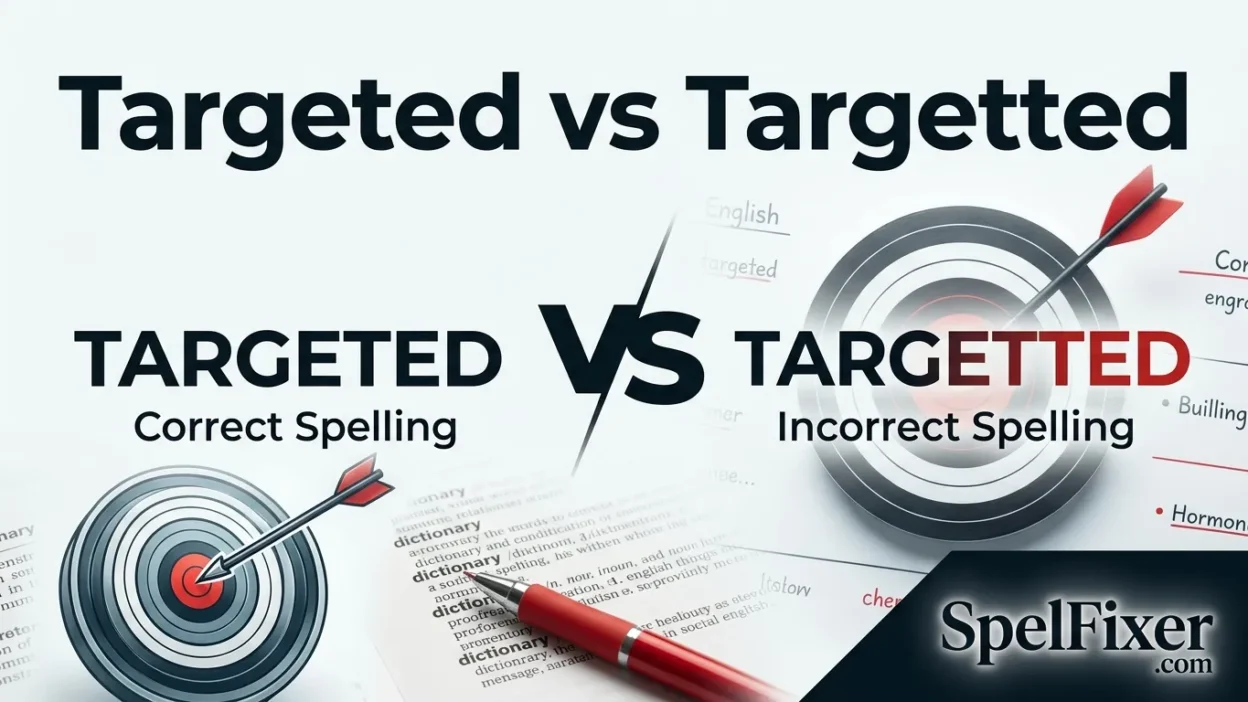
If you are unsure whether the correct spelling istargeted or targetted, you are not alone. The two forms look almost identical, but only one is the standard spelling in modern English. Targeted is the correct spelling in both American and British English. Targetted is generally considered a misspelling and should be avoided in formal writing.
The confusion happens because many English verbs double their final consonant when adding endings such as -ed or -ing. For example, planned comes from plan, and stopped comes from stop. However, target follows a different spelling pattern. Understanding why it remains targeted can help you avoid this common mistake in essays, emails, reports, and everyday writing.
Quick Answer
Targeted is the correct spelling. Targetted is incorrect in standard English. The verb target becomes targeted when adding -ed because the final consonant is not doubled. This spelling is used in both American and British English.
Why Do People Confuse It?
The confusion usually comes from the spelling rule for doubling a final consonant.
English does double the final consonant in some short words before adding -ed:
- stop → stopped
- plan → planned
- rob → robbed
- admit → admitted
Because target ends in t, some writers incorrectly assume that it should become targetted.
However, target has two syllables and does not follow the same pattern as words such as stop or plan. The standard past-tense and past-participle form is targeted.
First Word: Targeted
Targeted is the correct past-tense and past-participle form of target.
It can mean directed toward a particular person, group, place, or purpose.
Examples
- The advertisement targeted young customers.
- The campaign targeted local businesses.
- The researchers targeted a specific group.
- The company has targeted international markets.
It can also be used as an adjective:
- We need a targeted approach.
- The school introduced targeted support for students.
- The organization launched a targeted campaign.
Second Word: Targetted
Targetted is not the standard spelling in modern English.
If you are writing an essay, application, report, article, email, or other formal text, use targeted, not targetted.
❌ The campaign targetted teenagers.
✅ The campaign targeted teenagers.
❌ She targetted a specific audience.
✅ She targeted a specific audience.
Targeted vs Targetted: Comparison Table
| Feature | Targeted | Targetted |
| Standard spelling | ✅ Yes | ❌ No |
| Base word | Target | Target |
| Past tense | ✅ Targeted | ❌ Targetted |
| Past participle | ✅ Targeted | ❌ Targetted |
| Adjective | ✅ Targeted | ❌ Targetted |
| American English | ✅ Used | ❌ Not standard |
| British English | ✅ Used | ❌ Not standard |
| Recommended in formal writing | ✅ Yes | ❌ No |
When Should You Use Each?
Use “targeted” when talking about something directed at a particular target
For example:
The company targeted customers in several major cities.
Here, targeted is the past tense of target.
Use “targeted” as an adjective
For example:
The organization created a targeted program for new students.
Here, targeted describes the type of program.
Avoid “targetted”
In standard modern English, targetted should not be used. If you see it somewhere, it is most likely a spelling error or a nonstandard variant.
10+ Examples of “Targeted”
- The campaign targeted younger audiences.
- The advertisement targeted people interested in sports.
- The teacher provided targeted feedback.
- The company launched a targeted marketing campaign.
- The program targeted families in rural areas.
- The researchers targeted a specific population.
- The new policy is targeted at reducing unnecessary costs.
- The charity offers targeted assistance to vulnerable communities.
- The email was targeted toward existing customers.
- The government introduced targeted measures to address the problem.
- The campaign was specifically targeted at college students.
- The software uses targeted recommendations based on user preferences.
Common Mistakes
Mistake 1: Adding an extra “t”
❌ targetted
✅ targeted
The correct spelling has only one t between the e and the final d:
target + ed = targeted
Mistake 2: Assuming every final “t” must be doubled
English spelling rules depend on the structure and pronunciation of the word. You cannot simply double the final consonant of every verb ending in t.
Mistake 3: Thinking British English uses “targetted”
It does not. Targeted is the standard spelling in British English as well as American English.
Memory Trick
Think:
Target + ED = Targeted
There is no extra t.
A simple way to remember it is:
One target → one extra ending
So:
target → targeted
not:
target → targetted
American vs British English
There is no standard spelling difference between American and British English here.
Both varieties use:
- targeted ✅
- targetted ❌
For example:
American English:
The campaign targeted young adults.
British English:
The campaign targeted young adults.
The spelling stays the same.
Similar Words
If you are learning spelling patterns, these words can also be useful:
- target → targeted
- market → marketed
- visit → visited
- limit → limited
- benefit → benefited
- edit → edited
- inherit → inherited
- profit → profited
Notice that these words generally add -ed without doubling the final consonant.
By contrast, some words do double their final consonant:
- stop → stopped
- plan → planned
- prefer → preferred
- admit → admitted
This is why it is better to learn the spelling pattern rather than assume that every verb ending in t behaves the same way.
Final Verdict
Targeted is the correct and standard spelling.
Targetted is generally incorrect in standard English and should be avoided in formal and everyday writing.
Whether you are using American English or British English, the correct form is targeted.
FAQs
Is “targeted” or “targetted” correct?
Targeted is correct. Targetted is not the standard spelling in modern English.
Is “targetted” a British spelling?
No. Targetted is not the standard British spelling. British English uses targeted.
Why is “target” not spelled “targetted”?
The verb target takes the ending -ed without doubling its final t, giving targeted.
What is the past tense of “target”?
The past tense is targeted.
Example:
The company targeted a new market.
Is “targeted” one word?
Yes. Targeted is one word.
What is the past participle of “target”?
The past participle is also targeted.
Example:
The campaign has targeted several customer groups.
Can “targeted” be an adjective?
Yes. For example:
The company used a targeted advertising strategy.
Should I use “targetted” in formal writing?
No. Use targeted instead.
Remember This
Targeted = correct ✅
Targetted = incorrect ❌
The correct spelling is the same in American and British English:
target → targeted
Conclusion
When choosing between targeted and targetted, always choose targeted. It is the standard spelling used in both American and British English, whether you are using the word as a past-tense verb, past participle, or adjective. The extra t in targetted is a common spelling mistake.
The easiest way to remember the difference is to write target + ed = targeted. Once you recognize this pattern, you will be less likely to double the final t unnecessarily. For essays, professional writing, emails, and other formal contexts, targeted is the form you should use.