
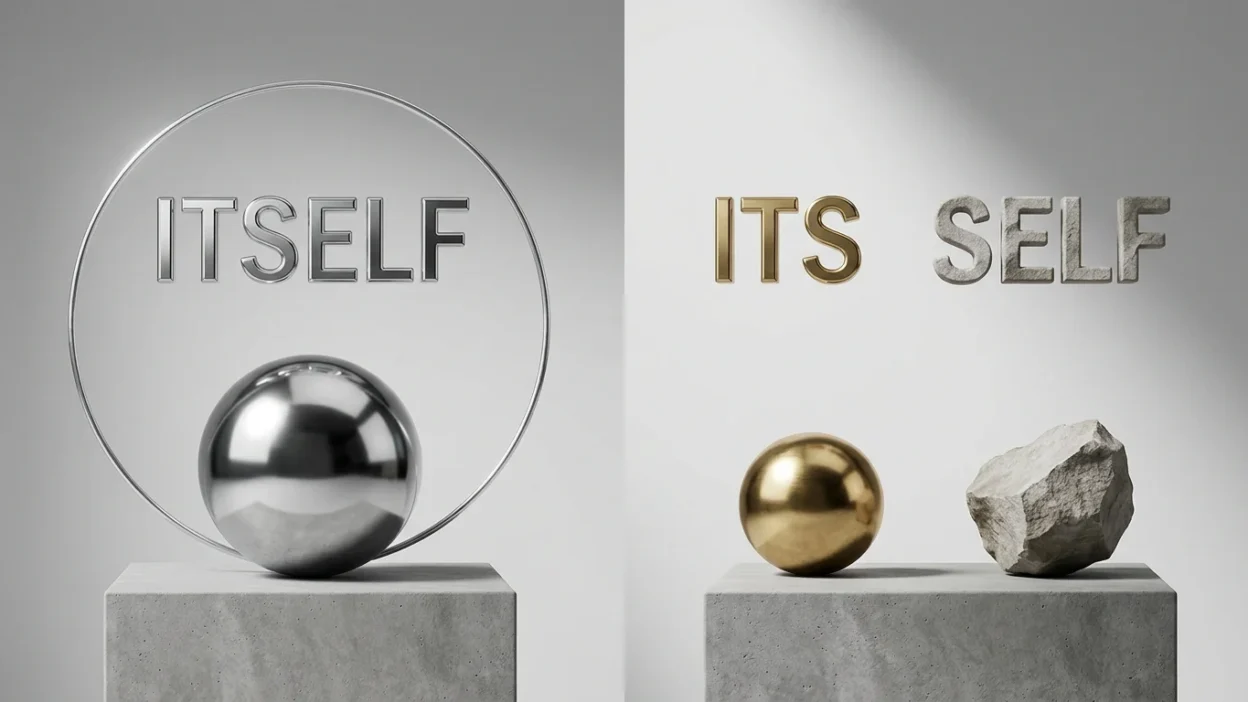
If you are confused about itself vs its self, you are not alone. These forms look almost identical, but they do not normally have the same grammatical function. In standard English, itself is the correct form when you need a reflexive pronoun referring to a thing, animal, organization, situation, or other non-human subject. For example, “The machine turned itself off.”
Its self is usually not the form you want. In most everyday sentences, writing “its self” as two separate words is incorrect or unnatural. The word itself is written as one word and can mean “that thing/person alone” or can emphasize the subject. Understanding this small spelling difference can help you avoid common grammar and writing mistakes.
Quick Answer
Itself is the standard and correct reflexive pronoun. Use it when “it” refers back to a noun: “The cat cleaned itself.” Its self is generally not used in ordinary English. If you mean the reflexive pronoun, always write itself as one word.
Why Do People Confuse It?
People often confuse itself and its self because its and self are both real English words.
- Its is a possessive determiner: “The company changed its policy.”
- Self is a noun: “He discovered his true self.”
- Itself is a reflexive pronoun: “The door opened itself.”
The spelling can be confusing because itself is made from it + self, but English normally combines these words into the single word itself when it functions as a reflexive pronoun.
First Word: Itself
Itself is a reflexive pronoun. It refers back to a singular non-human subject.
It can refer to:
- a thing
- an animal
- an organization
- a situation
- an idea
- an object or machine
Examples
- The dog hurt itself.
- The computer restarted itself.
- The door closed itself.
- The company presented itself as a leader in the industry.
- The problem itself is not difficult.
The word itself can also add emphasis.
The machine itself is not the problem.
Here, itself emphasizes “the machine.”
Second Word: Its Self
Its self consists of two separate words: its + self.
In normal modern English, this combination is not the standard way to write the reflexive pronoun. If you mean that something acts on itself, use itself.
Incorrect in ordinary usage
- The cat cleaned its self.
- The machine repaired its self.
- The company blamed its self.
Correct
- The cat cleaned itself.
- The machine repaired itself.
- The company blamed itself.
There can be unusual contexts where self is deliberately treated as a separate noun, but these are uncommon and have a different grammatical purpose. For ordinary writing, use itself.
Itself vs Its Self: Comparison Table
| Feature | Itself | Its self |
| Spelling | One word | Two words |
| Common use | Standard | Rare/unusual |
| Grammar | Reflexive pronoun | Possessive determiner + noun |
| Meaning | Refers back to “it” | Literally refers to “its” + “self” |
| Example | The bird injured itself. | Usually avoid this form |
| Recommended in normal writing | Yes | No |
When Should You Use Each?
Use “Itself” for Reflexive Meaning
Use itself when the subject and object refer to the same thing.
Examples:
- The bird injured itself.
- The phone turned itself off.
- The door locked itself.
- The organization defended itself.
A simple test is to ask:
“Is the action coming back to the same thing?”
If yes, itself is usually the correct choice.
Use “Itself” for Emphasis
You can also use itself to emphasize a noun.
- The building itself is beautiful.
- The idea itself is interesting.
- The software itself is free.
- The problem itself is easy to solve.
In these sentences, itself does not mean that the noun performs an action on itself. Instead, it gives emphasis.
10+ Examples of Itself
Here are practical examples to make the difference easier to understand:
- The cat washed itself.
- The dog scratched itself.
- The computer restarted itself.
- The door opened itself.
- The machine switched itself off.
- The company introduced itself to the customers.
- The child’s toy moved by itself.
- The phone turned itself off.
- The system can update itself automatically.
- The plant can protect itself from some environmental threats.
- The problem itself is quite simple.
- The book itself is not expensive.
- The design itself looks professional.
- The website itself is easy to use.
Common Mistakes
Mistake 1: Writing “its self” Instead of “itself”
Wrong:
The dog cleaned its self.
Correct:
The dog cleaned itself.
Mistake 2: Confusing “Its” With “Itself”
Its shows possession.
The company changed its website.
Itself is reflexive or emphatic.
The company redesigned itself.
Mistake 3: Thinking “It + Self” Must Always Be Two Words
Although itself comes historically from the combination of “it” and “self,” modern English writes the reflexive pronoun as one word.
Other reflexive pronouns follow the same pattern:
- myself
- yourself
- himself
- herself
- itself
- ourselves
- yourselves
- themselves
Memory Trick
Remember:
“It + self = itself”
When you need the reflexive pronoun, keep it together.
Think of these pairs:
- my + self → myself
- him + self → himself
- her + self → herself
- it + self → itself
- them + selves → themselves
So, when the meaning is reflexive, choose itself, not its self.
American vs British English
There is no important American-versus-British spelling difference between itself and its self in standard English.
Both American English and British English use itself as the normal reflexive pronoun.
For example:
- American English: The machine repaired itself.
- British English: The machine repaired itself.
The same spelling is standard in both varieties.
Similar Words
Understanding itself becomes easier when you compare it with other reflexive pronouns.
| Pronoun | Refers to | Example |
| Myself | I | I taught myself. |
| Yourself | You | You hurt yourself. |
| Himself | He | He introduced himself. |
| Herself | She | She prepared herself. |
| Itself | It | The cat cleaned itself. |
| Ourselves | We | We organized ourselves. |
| Yourselves | You | You should prepare yourselves. |
| Themselves | They | They introduced themselves. |
Another important pair is:
- its = shows possession
- itself = reflexive or emphatic pronoun
Example:
The company changed its name.
The company blamed itself for the mistake.
Final Verdict
Itself is the correct and standard choice when you need the reflexive pronoun referring to “it.” Write it as one word.
Its self is generally not appropriate in ordinary English. If you are writing a sentence such as “The animal hurt ___,” the correct answer is itself.
FAQs:
Is “itself” one word?
Yes. Itself is normally written as one word when it functions as a reflexive pronoun or an emphatic pronoun.
Is “its self” grammatically correct?
In ordinary modern English, its self is generally not the form used for the reflexive pronoun. Use itself instead.
What is the difference between “its” and “itself”?
Its is a possessive determiner, while itself is a reflexive or emphatic pronoun.
- The dog wagged its tail.
- The dog hurt itself.
Can I say “the machine repaired its self”?
No, not in normal standard usage. Say:
The machine repaired itself.
Is “itself” a pronoun?
Yes. Itself is a reflexive pronoun and can also be used emphatically.
What is an example of “itself” in a sentence?
The computer shut itself down.
Here, itself refers back to “the computer.”
Is “itself” the same in British and American English?
Yes. Itself is the standard form in both British and American English.
Why is “itself” written as one word?
Because itself is an established reflexive pronoun in English, just like myself, yourself, himself, and herself.
Remember This
Itself = one word = standard reflexive pronoun.
Use itself when something refers back to itself:
The cat hurt itself.
Use its when you are showing possession:
The cat moved its tail.
For normal writing, do not replace itself with its self.
Conclusion:
The difference between itself and its self is mainly a matter of grammar and word formation. Itself is the standard reflexive pronoun used when “it” refers back to the same thing. It can also emphasize a noun, as in “The problem itself is easy.”
Its self is generally not used in everyday standard English as a replacement for itself. When you mean that a thing acts on itself, choose the single word itself. Keeping this simple distinction in mind will make your English clearer and more natural.