
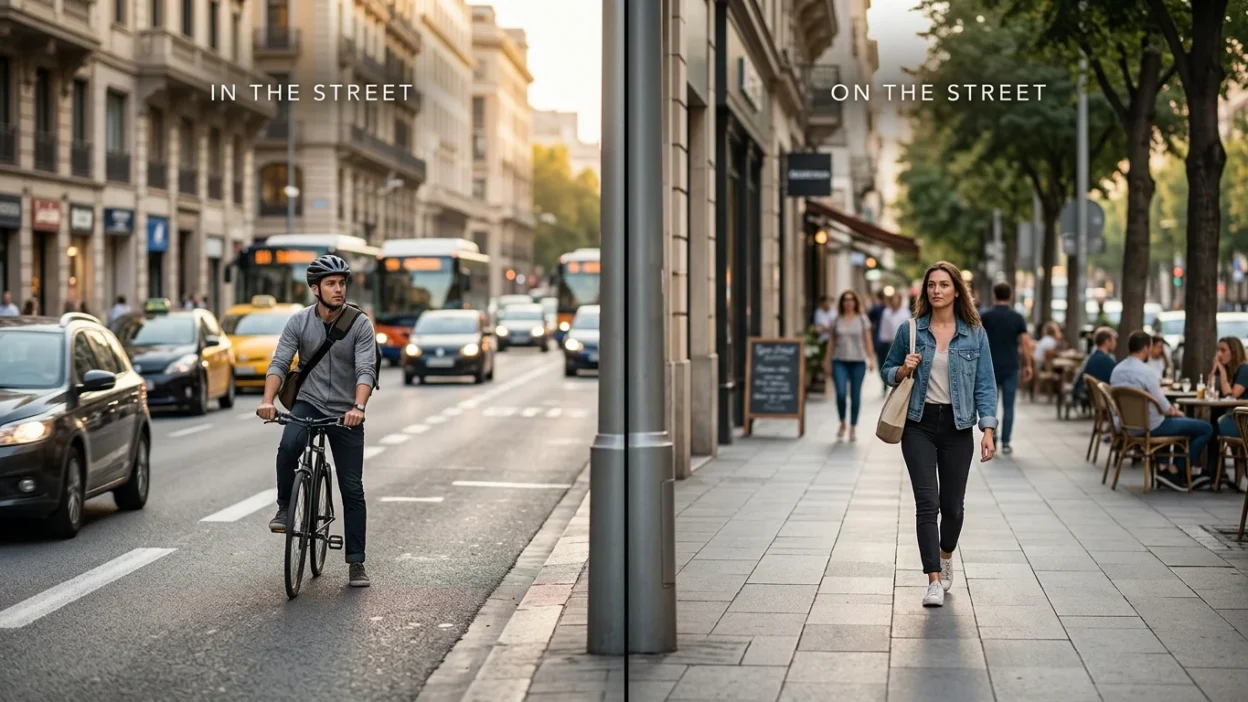
When should you say “in the street” and when should you say “on the street”? Both phrases are grammatically correct, but they describe slightly different situations. The difference mainly depends on whether you are talking about being within the street area or being on the street as a location, surface, or general place.
For example, you might say, “The children were playing in the street” when they were actually in the roadway. On the other hand, “I met Sarah on the street” usually means you encountered Sarah somewhere along a street, often while walking or traveling there. Understanding this small difference can make your English sound more natural and precise.
Quick Answer
“In the street” usually means physically within the street, especially the roadway or area used by traffic. “On the street” commonly means located along a street, walking there, or referring to street life or a specific street location. In everyday American English, “on the street” is generally more common.
Why Do People Confuse “In the Street” and “On the Street”?
People often confuse these expressions because both can describe a person’s location.
The prepositions “in” and “on” have different basic meanings:
- In often means inside or within an area.
- On often means on a surface or located along something.
A street can be viewed in two ways. It can mean the physical roadway itself, or it can mean a location or area identified by a street.
Compare these examples:
- The children are playing in the street.
They are physically in the roadway. - I saw him on the street.
I saw him while I was on or along a street.
The exact meaning can also depend on context.
What Does “In” Mean in “In the Street”?
“In” emphasizes being inside or within the physical area of the street.
When someone or something is actually in the roadway or street area, “in the street” is often appropriate.
Examples
- The children were playing in the street.
- A dog was sitting in the street.
- There was a large hole in the street.
- The protesters were standing in the street.
- He left his bicycle in the street.
Here, the focus is on physical position within the street area.
What Does “On” Mean in “On the Street”?
“On” is commonly used when talking about being at or along a street, walking or living there, or referring to a particular street location.
Examples
- I met an old friend on the street.
- There is a pharmacy on the street.
- She lives on this street.
- We saw a beautiful house on the street.
- He was walking on the street.
In these examples, “on” identifies the street as a location or route rather than emphasizing being physically inside the roadway.
In the Street vs On the Street: Comparison Table
| Expression | Main idea | Common use | Example |
| In the street | Within the physical street area | Something is physically in the roadway | The children are playing in the street. |
| On the street | At or along a street | Location, movement, or general street setting | I saw him on the street. |
| In the middle of the street | Directly within the roadway | Strong emphasis on position | The car stopped in the middle of the street. |
| On the street corner | At a street intersection | Specific location | Meet me on the street corner. |
| On the street | Living or staying without a home | Idiomatic expression | He has been on the street for several weeks. |
When Should You Use “In the Street”?
Use “in the street” when you want to emphasize that someone or something is physically within the street or roadway.
Common situations
1. Children playing in the roadway
The children were playing in the street.
2. An object blocking traffic
There is a tree in the street.
3. Someone standing in the roadway
A man was standing in the street.
4. Something located within the street
Workers found a damaged pipe in the street.
“In the street” can sometimes suggest that the person or object is in a place where traffic normally moves.
When Should You Use “On the Street”?
Use “on the street” when the street is being treated as a location, route, or general setting.
Common situations
1. Walking along a street
I saw her on the street yesterday.
2. Living at a street location
They live on Green Street.
3. Finding a business
There is a café on the street.
4. Talking about street life
There were many people on the street.
“On the street” is especially common when the exact physical position within the roadway is not important.
10+ Examples of “In the Street” and “On the Street”
Here are practical examples to make the difference clearer.
Examples with “In the Street”
- The children were playing in the street.
- A car was parked in the street.
- The dog ran in the street.
- There was broken glass in the street.
- The workers were repairing a hole in the street.
- A ball rolled into the street.
- He was standing in the middle of the street.
Examples with “On the Street”
- I met my teacher on the street.
- She lives on this street.
- There is a new restaurant on the street.
- We saw several people on the street.
- He was walking on the street.
- I found the address on the street.
- They opened a new store on Main Street.
Notice that “in the street” often focuses on physical position within the roadway, while “on the street” more often identifies the street as a place or route.
Common Mistakes
Mistake 1: Thinking “in” always means indoors
“In” does not only refer to enclosed spaces.
You can be:
- in the street
- in the park
- in the city
- in the road
So “in” can describe being within a physical area.
Mistake 2: Thinking “on” always means touching a surface
“On” has several uses in English.
For example:
- on the street
- on the bus
- on the wall
- on Main Street
Therefore, “on the street” does not necessarily mean that your feet are literally touching the street surface.
Mistake 3: Using “in the street” for every street location
If you are simply talking about someone’s location along a street, “on the street” is often more natural.
For example:
I saw John on the street.
This normally means you encountered him while you were on or along a street.
Mistake 4: Ignoring context
Sometimes both expressions can be grammatically possible, but they create different images.
Compare:
The children are in the street.
This emphasizes that they are physically in the roadway.
The children are on the street.
This can simply describe their presence outdoors along the street and may not specifically place them in the roadway.
Memory Trick
A simple way to remember the difference is:
IN = inside the street area
ON = along the street
Think:
In the street = physically within it.
On the street = located along it.
For example:
- The ball is in the street. ⚽
- The shop is on the street. 🏪
This quick distinction will help you choose the correct preposition in most everyday situations.
American vs British English
Both American English and British English use “in the street” and “on the street.”
However, usage can vary depending on the situation and regional preference.
In American English, “on the street” is very common when referring to someone’s location or a street address:
She lives on Oak Street.
British English also commonly uses “on the street” in similar contexts:
She lives on Oak Street.
“In the street” is generally used when the speaker wants to emphasize physical presence within the street or roadway:
The children were playing in the street.
So the core distinction is not simply American versus British English. Context and intended meaning are more important.
Similar Words and Expressions
Several related expressions can help you understand street-related prepositions.
On the road
Usually refers to traveling or being on a road.
We spent six hours on the road.
In the road
Usually emphasizes being physically within the roadway.
There is a large rock in the road.
On the sidewalk
Means located on the pedestrian walkway beside a road or street.
She was waiting on the sidewalk.
Across the street
Means on the opposite side of the street.
The bank is across the street.
By the street
Means near or beside a street.
There is a small house by the street.
Along the street
Means following the length or direction of a street.
There are several shops along the street.
Final Verdict
The main difference is physical position versus general street location.
Use “in the street” when you want to emphasize that someone or something is physically within the street, particularly the roadway.
Use “on the street” when you are talking about being at or along a street, living there, walking there, or describing a street as a location.
For example:
The children are playing in the street.
means they are physically in the street.
I saw the children on the street.
simply tells us that you saw them while they were on or along a street.
Frequently Asked Questions
Is “in the street” grammatically correct?
Yes. “In the street” is grammatically correct and is commonly used when someone or something is physically within the street, especially the roadway.
Is “on the street” grammatically correct?
Yes. “On the street” is also grammatically correct and is widely used for locations, movement, street addresses, and general street settings.
Which is correct: “in the street” or “on the street”?
Both are correct. The choice depends on the intended meaning. “In the street” emphasizes being within the physical street area, while “on the street” usually refers to being at or along a street.
Do Americans say “on the street”?
Yes. “On the street” is very common in American English, especially for locations and street addresses.
Should I say “I live in the street” or “I live on the street”?
Normally, say “I live on the street.”
For example:
I live on King Street.
If you mean a specific street name, “on” is the normal choice.
What is the difference between “in the street” and “in the road”?
Both can describe physical position within a roadway. “Street” often refers to an urban road, while “road” can refer more broadly to routes connecting places.
Is “walking in the street” correct?
Yes. “Walking in the street” is correct when the person is physically walking within the roadway.
Is “walking on the street” correct?
Yes. “Walking on the street” can also be correct, particularly when simply describing someone’s presence or movement along a street. Context determines the most natural choice.
Remember This
IN the street → physically within the street or roadway.
ON the street → at, along, or associated with a street.
The dog is in the street.
The shop is on the street.
When you are unsure, ask yourself: Am I emphasizing being physically inside the street area, or am I simply talking about the street as a location?
Conclusion
“In the street” and “on the street” are both correct expressions, but they highlight different ideas. “In the street” focuses more on physical position within the street, especially the roadway. “On the street” commonly describes a location along a street, movement, a street address, or the general street environment.
The easiest way to remember the difference is “in = within the area” and “on = at or along the street.” Once you understand this basic distinction, choosing between these two prepositions becomes much easier in everyday English.