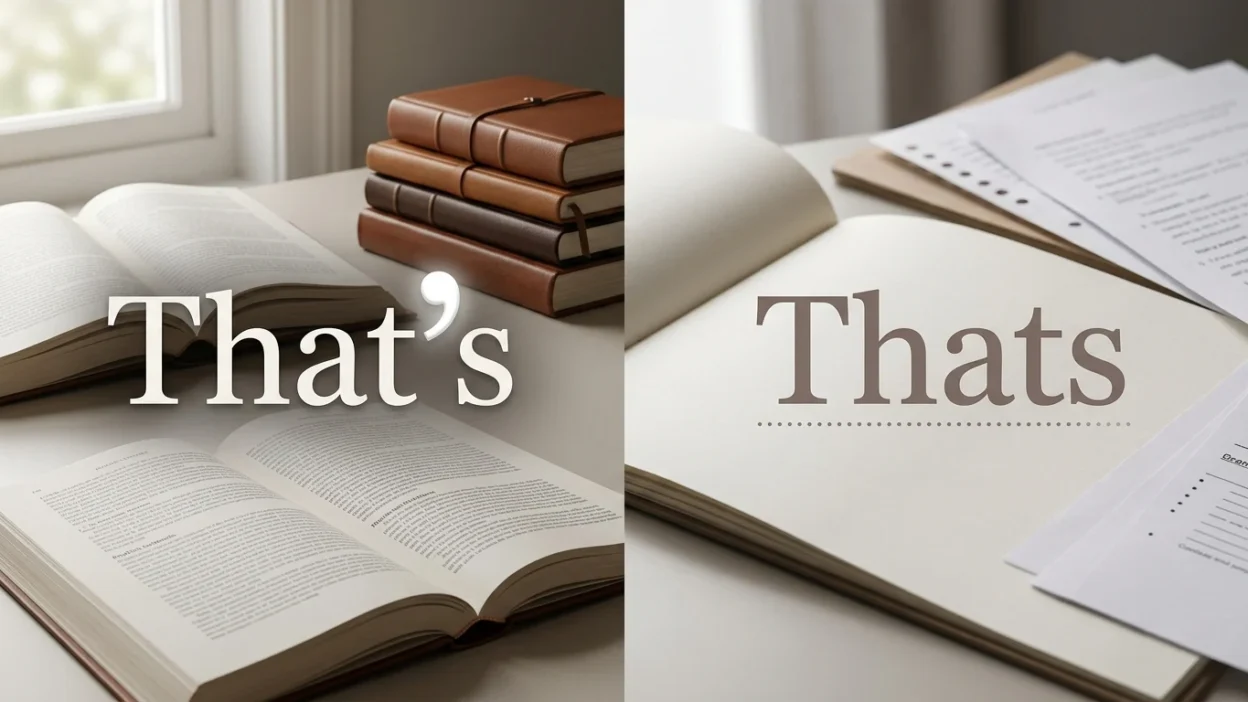
If you are confused about that’s vs thats, you are not alone. The two forms look almost identical, but only one is normally correct in standard written English. The apostrophe in that’s is important because it shows that the word is a contraction or possessive form. Thats, without an apostrophe, is generally considered incorrect in standard English.
The word that’s can mean “that is” or “that has.” For example, “That’s my book” means “That is my book,” while “That’s been difficult” means “That has been difficult.” In contrast, thats is usually just a spelling mistake caused by leaving out the apostrophe. Understanding this small punctuation difference can help you write more clearly in school assignments, emails, messages, articles, and everyday communication.
Quick Answer
That’s is the correct standard form. It is a contraction of “that is” or “that has,” and it can also show possession in some contexts. Thats, without an apostrophe, is not normally correct in standard English. Use that’s when you mean “that is” or “that has.”
Why Do People Confuse It?
People often confuse that’s and thats because the words sound exactly the same when spoken.
The main difference is punctuation:
- That’s = correct standard form
- Thats = generally incorrect spelling in standard English
When people type quickly, especially in text messages or on social media, they may leave out apostrophes. This can make thats appear frequently online even though it is not the standard written form.
Another reason for the confusion is that English has many contractions, such as:
- it’s = it is / it has
- what’s = what is / what has
- who’s = who is / who has
- that’s = that is / that has
First Word: That’s
That’s contains an apostrophe. It is usually a contraction of “that is” or “that has.”
That’s = That is
Examples:
- That’s a great idea.
- That’s my phone.
- That’s why I called you.
- That’s very interesting.
You can replace that’s with that is in these sentences:
That’s a great idea.
That is a great idea.
Both have the same basic meaning.
That’s = That has
That’s can also be a contraction of “that has,” especially when has is used as an auxiliary verb.
Examples:
- That’s been a difficult experience.
- That’s happened before.
- That’s changed everything.
For example:
That’s happened before.
That has happened before.
Second Word: Thats
Thats, without an apostrophe, is generally not the correct standard spelling of the word.
The apostrophe is needed in that’s when it represents the missing letters in that is or that has.
Incorrect:
Thats a beautiful picture.
Correct:
That’s a beautiful picture.
In casual digital communication, you may see thats used because people sometimes omit punctuation while typing. However, it is better to use that’s in formal and standard writing.
That’s vs Thats: Comparison Table
| Word | Correct in standard English? | Meaning | Example |
| That’s | Yes | That is / That has | That’s my car. |
| Thats | No, generally | Usually intended to mean “that’s” | Thats my car. |
When Should You Use Each?
When to Use “That’s”
Use that’s when you mean:
- that is
- that has
For example:
That’s my favorite book.
= That is my favorite book.
That’s been a problem for years.
= That has been a problem for years.
When to Use “Thats”
In standard English, you normally should not use “thats.”
If you want to write the contraction correctly, add the apostrophe:
thats → that’s
This applies to schoolwork, professional writing, articles, emails, and other situations where standard English is expected.
10+ Examples of That’s
Here are practical examples to help you understand the correct form.
- That’s my new laptop.
- That’s a beautiful dress.
- That’s exactly what I wanted.
- That’s not a good idea.
- That’s why I was late.
- That’s the person I told you about.
- That’s enough for today.
- That’s been a difficult question.
- That’s happened to me before.
- That’s the best solution.
- That’s what makes this place special.
- That’s everything I know about it.
Common Mistakes
Mistake 1: Leaving Out the Apostrophe
Incorrect:
Thats a good question.
Correct:
That’s a good question.
Mistake 2: Thinking “Thats” Is a Different Word
Thats is not normally a separate standard English word with a different meaning. In most cases, someone writing thats simply forgot the apostrophe.
Mistake 3: Using “That’s” When You Mean “That”
Remember that that’s contains a contraction.
For example:
I know that’s difficult.
Here, that’s means that is.
But:
I know that you are tired.
Here, that is not a contraction.
Mistake 4: Confusing “That’s” With Possessive “That”
Unlike nouns, that does not normally form possession with an apostrophe.
For example:
That’s my house.
Here, that’s means that is, not possession.
Memory Trick
A simple way to remember the difference is:
Apostrophe = missing letters.
Think:
That’s = That is / That has
If you can replace that’s with that is or that has, the apostrophe belongs there.
For example:
That’s amazing.
Replace it:
That is amazing.
It works, so that’s is correct.
American vs British English
There is no major difference between American and British English regarding the standard spelling of that’s.
Both varieties use:
That’s
rather than:
Thats
The same apostrophe rule applies in both forms of standard English.
For example:
American English: That’s my friend.
British English: That’s my friend.
The spelling remains the same.
Similar Words
Several English contractions work in a similar way to that’s.
It’s vs Its
- It’s = it is / it has
- Its = possessive form
Example:
It’s a beautiful dog.
The dog wagged its tail.
Who’s vs Whose
- Who’s = who is / who has
- Whose = belonging to whom
Example:
Who’s coming tonight?
Whose bag is this?
You’re vs Your
- You’re = you are
- Your = belonging to you
Example:
You’re very helpful.
Your answer is correct.
They’re vs Their
- They’re = they are
- Their = belonging to them
Example:
They’re ready.
Their car is outside.
These examples show why apostrophes can matter. A small punctuation mark can change the meaning or grammatical function of a word.
Final Verdict
That’s is the correct standard form when you mean “that is” or “that has.”
Thats without an apostrophe is generally considered incorrect in standard English and is usually the result of missing punctuation.
The easiest rule is:
that’s = that is / that has
If you can expand that’s into that is or that has, keep the apostrophe.
FAQs
Is “thats” a correct English word?
In standard English, thats is generally not considered the correct spelling when you mean that’s. The standard form uses an apostrophe.
Is “that’s” always correct?
That’s is correct when it means “that is” or “that has.” The surrounding sentence determines which meaning applies.
What is the difference between “that’s” and “thats”?
That’s contains an apostrophe and means “that is” or “that has.” Thats without an apostrophe is generally an incorrect spelling in standard English.
Can I use “thats” in texting?
You may see thats in informal texting because people sometimes leave out punctuation. However, that’s is the standard form and is the safer choice when writing correctly.
Is “that’s” a contraction?
Yes. That’s is commonly a contraction of “that is” or “that has.”
Can “that’s” mean “that has”?
Yes. For example:
That’s happened before.
This means:
That has happened before.
Should I use “that’s” in formal writing?
Yes. That’s is grammatically acceptable in formal writing when appropriate. However, depending on the sentence and writing style, you can also write the full form “that is” or “that has.”
Remember This
That’s = That is / That has
Thats = generally incorrect in standard English
When in doubt, try expanding that’s:
That’s → That is
That’s → That has
If the expanded sentence makes sense, that’s is the correct choice.
Conclusion
The difference between that’s vs thats is simple but important. That’s, with an apostrophe, is the standard form and is used as a contraction for “that is” or “that has.” Thats, without the apostrophe, is generally not correct in standard English.
Remembering this rule can help you avoid a common punctuation mistake. Whenever you write that’s, check whether you could replace it with that is or that has. If you can, the apostrophe is needed.

Fenwick Quentin is a creative blogging author known for his analytical yet engaging writing style.
He explores topics such as innovation, digital culture, and personal development with depth and clarity.
Through his articles, Fenwick encourages readers to think critically and embrace continuous growth.